Home Blog Page 9

KFF Health Tracking Poll: Public Weighs in on Health Care Debate and Government Shutdown 


rewrite this content and keep HTML tags

Key Takeaways

  • On October 1st the U.S. federal government shut down after Congress failed to pass a stopgap spending bill to keep it funded. Now in its sixth week, the shutdown marks the longest lapse in federal funding in U.S. history. Congress remains at a standstill over whether to extend the Affordable Care Act’s enhanced premium tax credits (ePTCs). About three quarters of the public continue to say Congress should extend the expiring tax credits, including more than nine in ten (94%) Democrats, three in four (76%) independents, and half of Republicans. As the debate continues, this poll shows that partisan loyalties among the public are deepening, with Republicans split over whether they want Congress to extend the tax credits for people who purchase their own coverage on the ACA marketplaces or allow them to expire.
  • Democrats largely support what congressional Democrats have been doing throughout this debate, while independents are split. A large majority of Democrats (81%) say Democrats in Congress should “refuse to approve a budget unless it includes extending these tax credits, even if it means the government remains shut down.” Independents are divided, while about eight in ten (84%) Republicans say Congressional Democrats should approve a budget to quickly end the shutdown.
  • If the enhanced tax credits are not extended, both political parties could face backlash from their bases. Among those who want to see Congress extend the tax credits, nearly four in ten say President Trump (28% of all adults) deserves most of the blame, and a similar share says they would blame Republicans in Congress (28% of all adults). Fewer, about one in four (17% of all adults), say Democrats in Congress deserve the most blame. Majorities of Democrats and independents say President Trump or Republicans in Congress would deserve the most blame, while a majority of MAGA Republicans say Democrats in Congress would deserve the most blame.
  • The Democratic Party maintains an edge over the Republican Party when it comes to voter trust of handling the future of the ACA, and a narrower edge when it comes to high cost of health insurance. At least one in five voters say they do not trust either party to address these issues. While majorities of Democratic and Republican voters say they trust their own party on these issues, independents are more likely to trust the Democratic Party over the Republican Party on the ACA (38% vs. 18%), though many say they don’t trust either party. Democratic and independent voters are also much more likely than Republican voters to say rising health costs would impact their willingness to vote and their candidate choice. Nearly six in ten Democratic voters and half of independent voters say an annual health cost increase of $1,000 – the average expected increase for marketplace enrollees if the ACA enhanced premium tax credits expire – would have a “major impact” on both their decision to turnout to vote and which candidate they would support, compared to about three in ten Republican voters.  
Majorities of the Public Continue to Support Extending ACA Tax Credits; Most Democrats Want Budget Deal to Include Extension

As part of the ongoing budget negotiations, Democratic leaders are pushing to extend the enhanced premium tax credits, which help some people afford their health insurance through marketplaces created by the Affordable Care Act (ACA). These tax credits are currently set to expire at the end of the year. Republican lawmakers, on the other hand, say they will take up the ACA tax credits after the government is reopened.

Conducted as people began reviewing ACA plan options for this year’s open enrollment, this poll shows that extending these tax credits beyond 2025 continues to be popular among the public. About three quarters (74%) of U.S. adults overall say Congress should extend the enhanced tax credits for people who purchase their own insurance through ACA marketplaces, about three times the share who say Congress should let these credits expire. Three quarters (76%) of adults who purchase their own health insurance, most of whom do so through ACA marketplaces, support the extension of these tax credits, while one in four (23%) say they should expire.

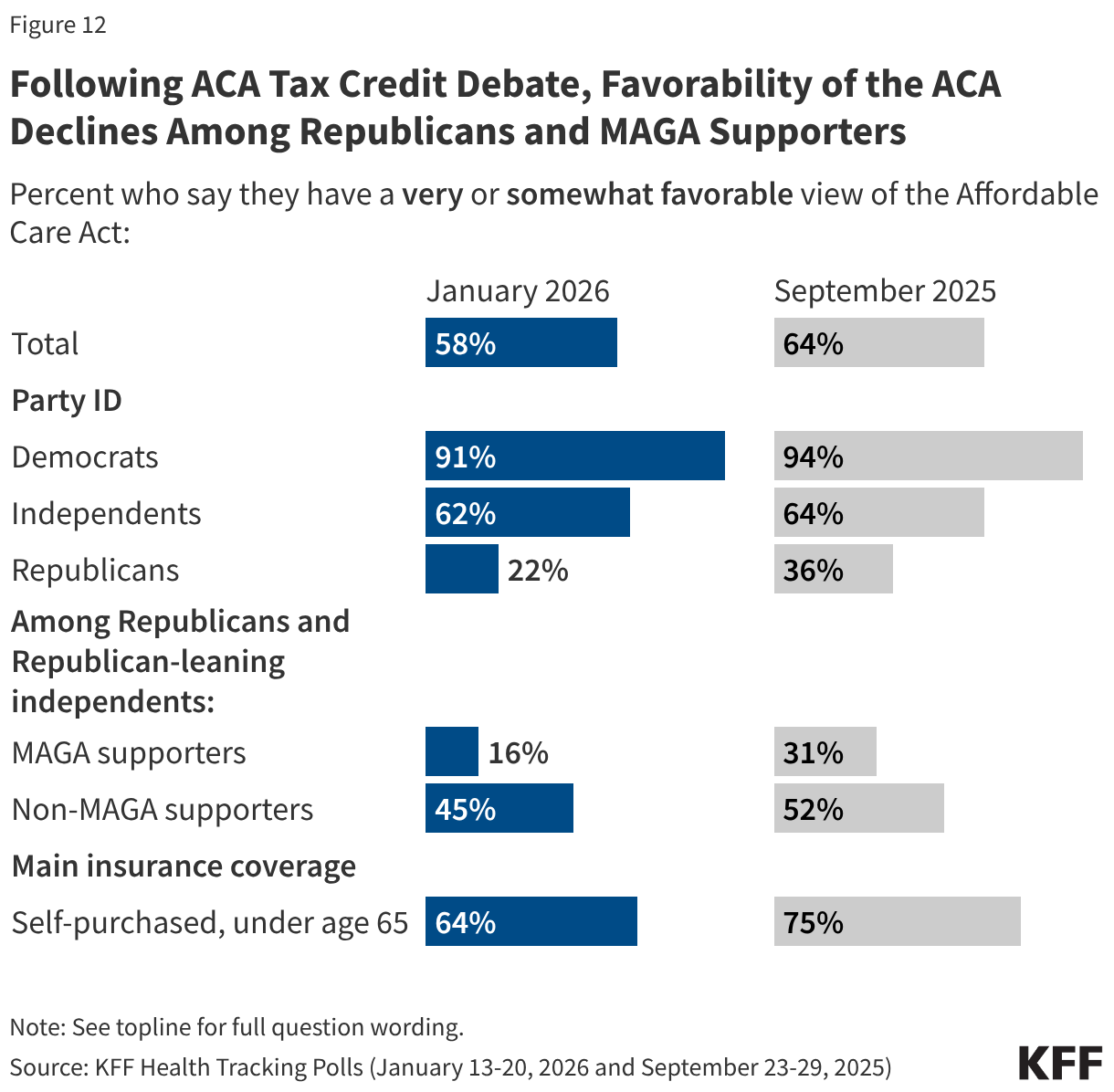
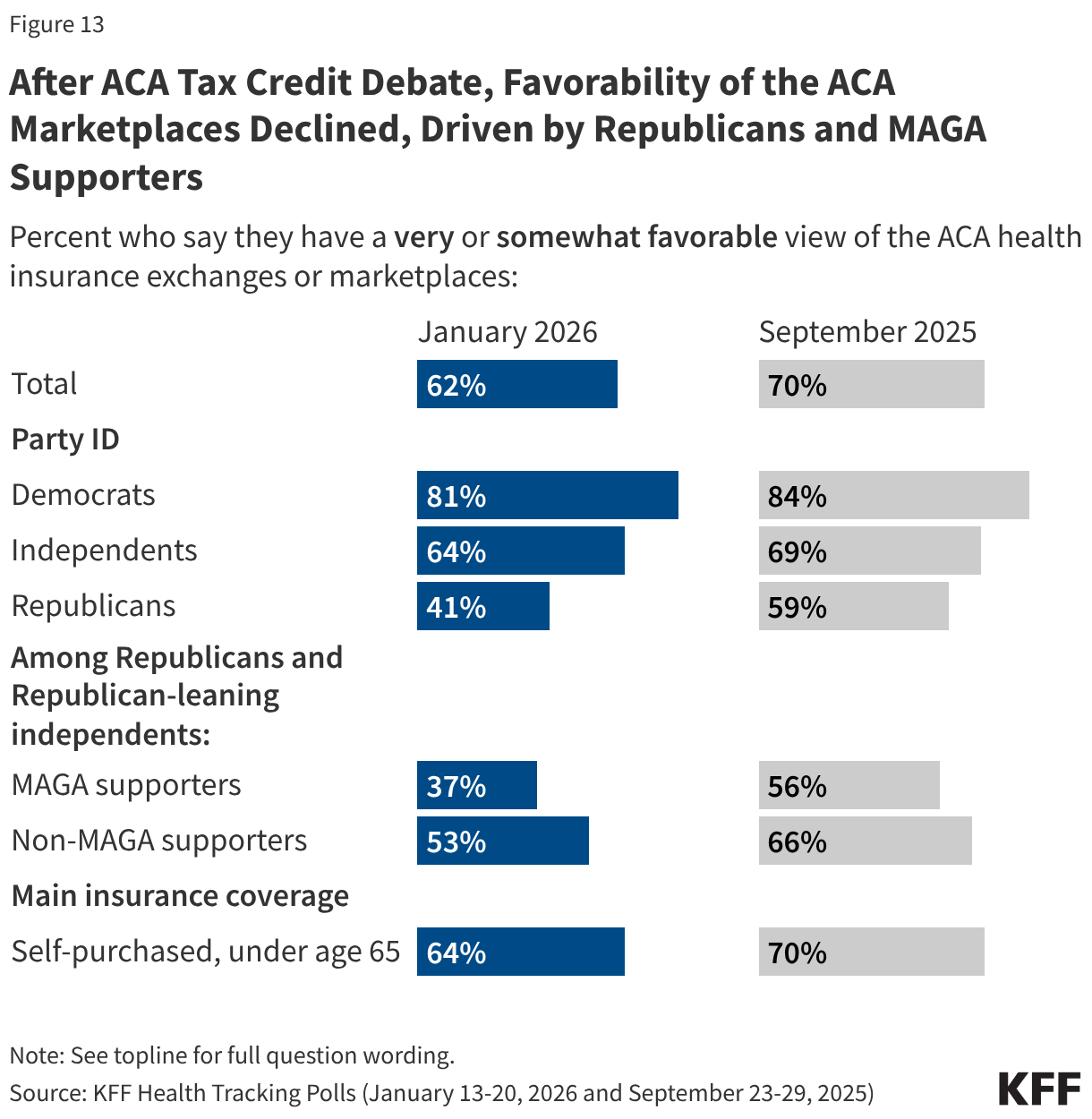
At least half of adults across partisans continue to support the extension of these tax credits. This includes more than nine in ten (94%) Democrats, three quarters (76%) of independents, and half of Republicans. However, Republican support for Congress extending the tax credits has dropped nine percentage points in the past month as the enhanced premium tax credits have become a talking point around the budget negotiations and a major sticking point for Democratic lawmakers. In addition, supporters of the “Make America Great Again” (MAGA) movement are now 13 percentage points less likely to say these tax credits should be extended, from about six in ten (57%) last month, to fewer than half (44%) now.  

A Majority of the Public Says Congress Should Extend ACA Tax Credits, Though Republican and MAGA Support Has Declined from Last Month

Now in its sixth week, the government shutdown has resulted in missed paychecks for some federal employees and delays in full SNAP benefits, adding pressure on Congress to reach an agreement. Overall, the public is split over what they think Congressional Democrats should do, with half (50%) saying they should “approve a budget that does not include extending these tax credits in order to quickly end the shutdown, even if it means the cost of health insurance will increase for some people,” while a similar share (48%) say Congressional Democrats should “refuse to approve a budget unless it includes extending these tax credits, even if it means the government remains shut down.”

A large majority of Democrats (81%) support Congressional Democrats holding out for a deal that includes extending the ACA’s enhanced premium tax credits, even if it prolongs a government shutdown. Independents are split, with about half (51%) saying Democratic leaders should refuse to approve a budget without the tax credit extensions and half (47%) saying they should approve a budget to quickly end the shutdown. More than eight in ten (84%) Republicans say Democratic lawmakers should approve a budget to end the shutdown.

More than half (55%) of those who purchase their own health insurance say Democrats should refuse to approve a budget that does not include an extension for ACA subsidies, while 45% say Democrats should approve the budget without the subsidies to quickly end the shutdown. Notably, past KFF polls have shown that nearly half of adults enrolled in ACA marketplace plans identify as Republican or lean Republican.

Most Democrats, and Half of Independents, Say Congressional Democrats Should Refuse to Approve a Budget Without ACA Tax Credit Extension

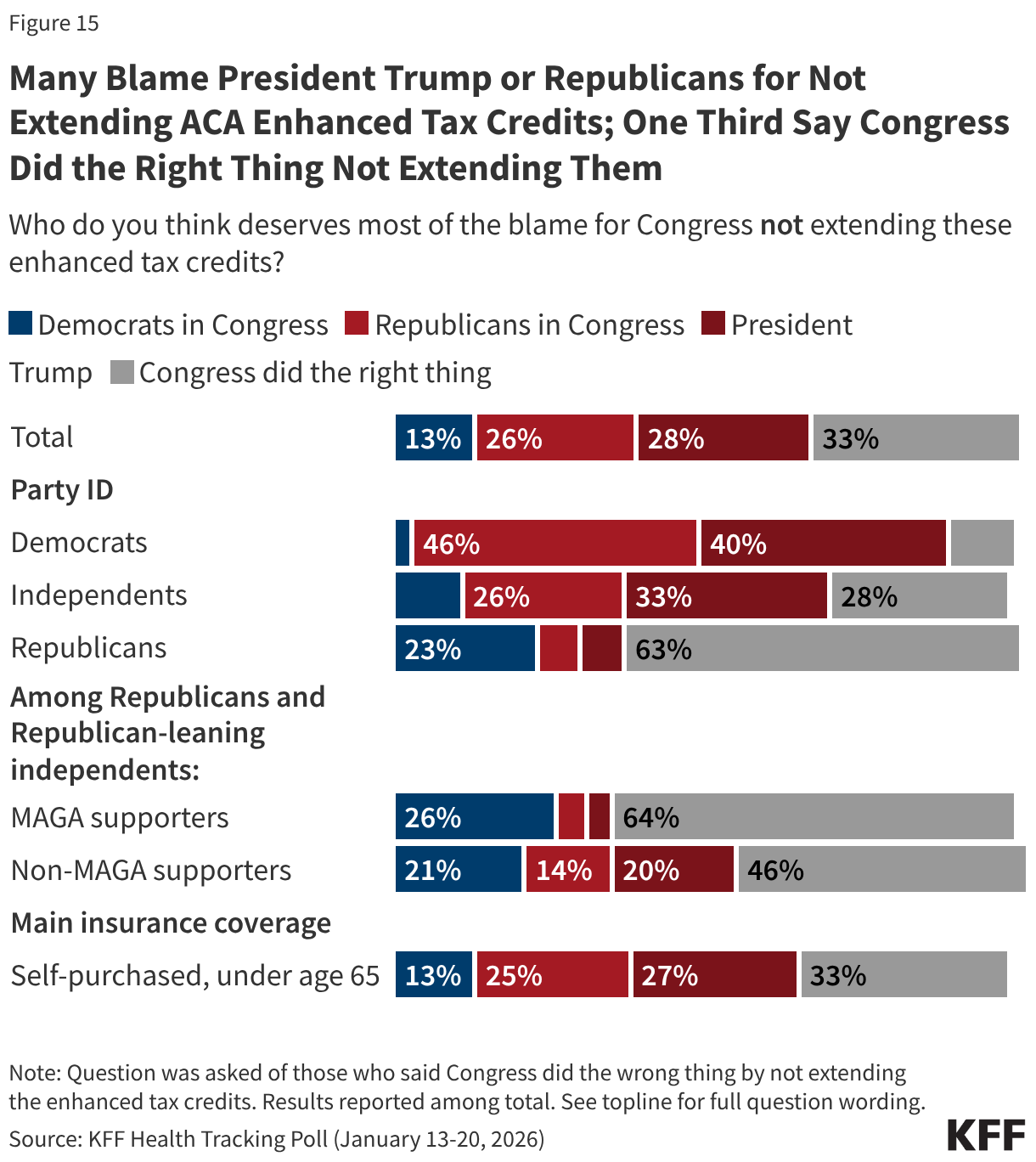
If Congress does not pass an extension for the enhanced tax credits, those who want to see the credits extended are most likely to blame Republican leaders, including President Trump. Nearly four in ten of those who support extending the tax credits say that if they are not extended Republicans in Congress deserve the most blame (38%, or 28% of all adults) and a similar share (37%, or 28% of all adults) say President Trump deserves most of the blame. About one in four (23% or 17% of total adults) say Democrats in Congress deserve the most blame. Notably, the group that supports extending the tax credits is made up of larger shares of Democrats and Democratic-leaning independents.

Among the half of Republicans who want to see the tax credits extended, seven in ten say they would blame Democrats in Congress if the tax credits are allowed to expire, rising to eight in ten MAGA-supporters.

Most Adults Who Support Extending ACA Tax Credits Blame Republican Lawmakers, Including President Trump, if Tax Credits Expire

Despite the ongoing legislative debate over the government shutdown, awareness of the lapsing enhanced premium tax credits remains limited, even among the group most directly impacted by the loss of tax credits. Overall, more than half of adults say they have heard or read “a little” (28%) or “nothing at all” (29%) about the issue, while 44% have heard or read “a lot” (13%) or “some” (30%). Among those who buy their own insurance, half say they have heard at least “some,” compared to four in ten last month.

Some Republican lawmakers have claimed that Democratic efforts to extend the ACA’s enhanced premium tax credits would allow undocumented immigrants to receive federally subsidized health insurance. This KFF poll gauged the public’s understanding of this claim over who is eligible for ACA coverage. About half (47%) of U.S. adults correctly say that undocumented immigrants are not eligible to buy health coverage on ACA marketplaces. There is some confusion, however, as about one in seven (14%) incorrectly say undocumented immigrants are eligible and nearly four in ten (39%) say they are not sure.

Although this claim has been made by some Republican lawmakers and conservative media outlets, there are no partisan differences in awareness of this aspect of ACA eligibility. At least half of Republicans (57%) and Democrats (52%) say undocumented immigrants are not eligible for this, while at least three in ten across partisans say they are not sure. A larger share of independents (44%) say they are not sure whether undocumented immigrants are eligible to buy coverage on the ACA marketplaces.

About Half of Adults Correctly Say Undocumented Immigrants Are Not Eligible for ACA Coverage, Including Similar Shares of Democrats and Republicans

Health Costs Could Influence Voters in 2026, and Democratic Party Holds Edge on Trust to Address ACA

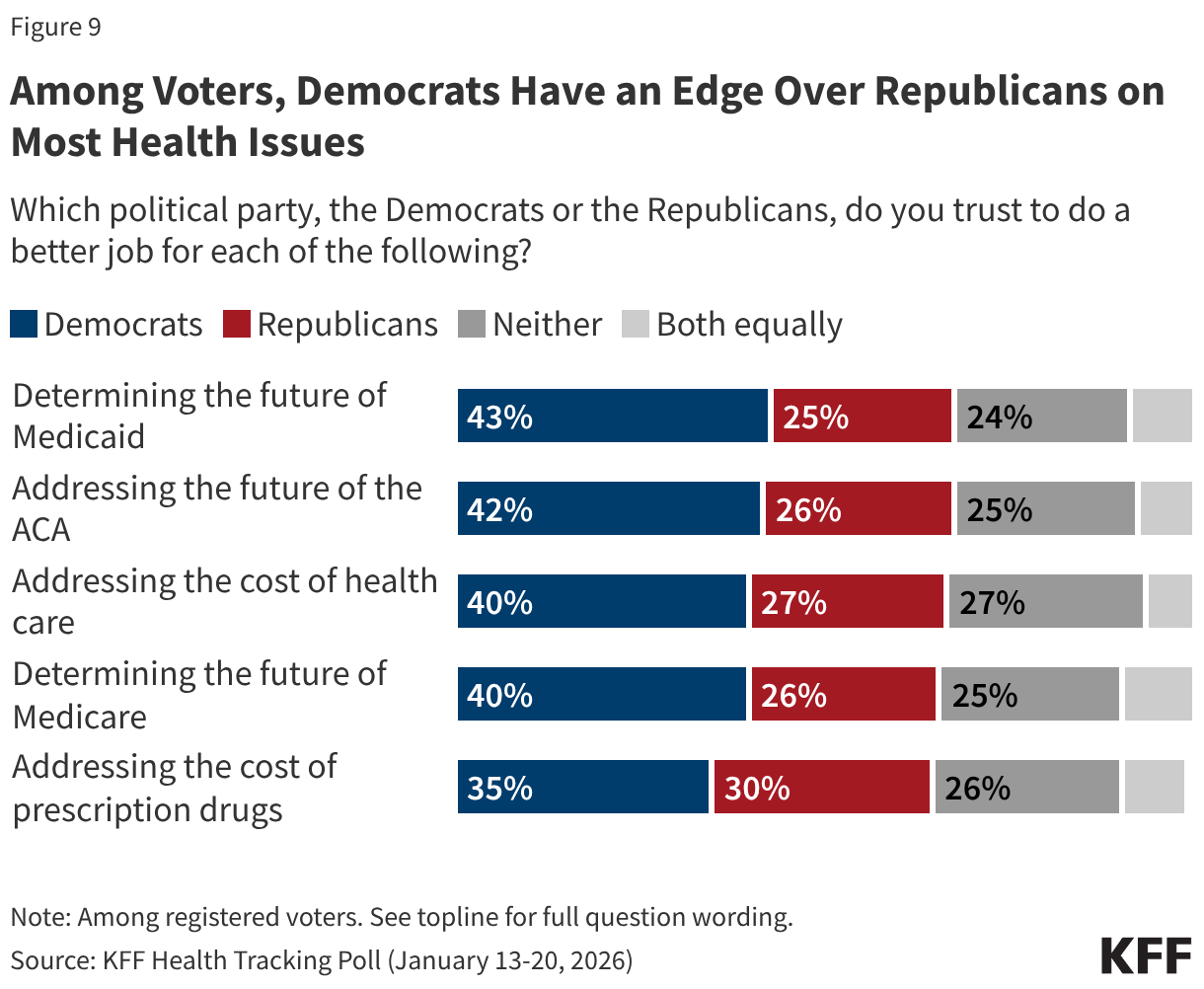
There is some indication that these budget negotiations could influence how voters think about health care and their decisions at the ballot box in coming years. Consistent with previous polling, the Democratic Party continues to hold an advantage over the Republican Party among voters on which party they trust to do a better job addressing the future of the 2010 Affordable Care Act, or ACA. About four in ten voters (43%) say they trust the Democratic Party to do a better job addressing the future of the ACA compared to one-third (32%) of voters who say they trust the Republican Party. Democrats also have a small advantage on which party voters trust to address the high cost of health insurance (39% v. 33%), though a quarter of voters say they trust neither party on this issue.

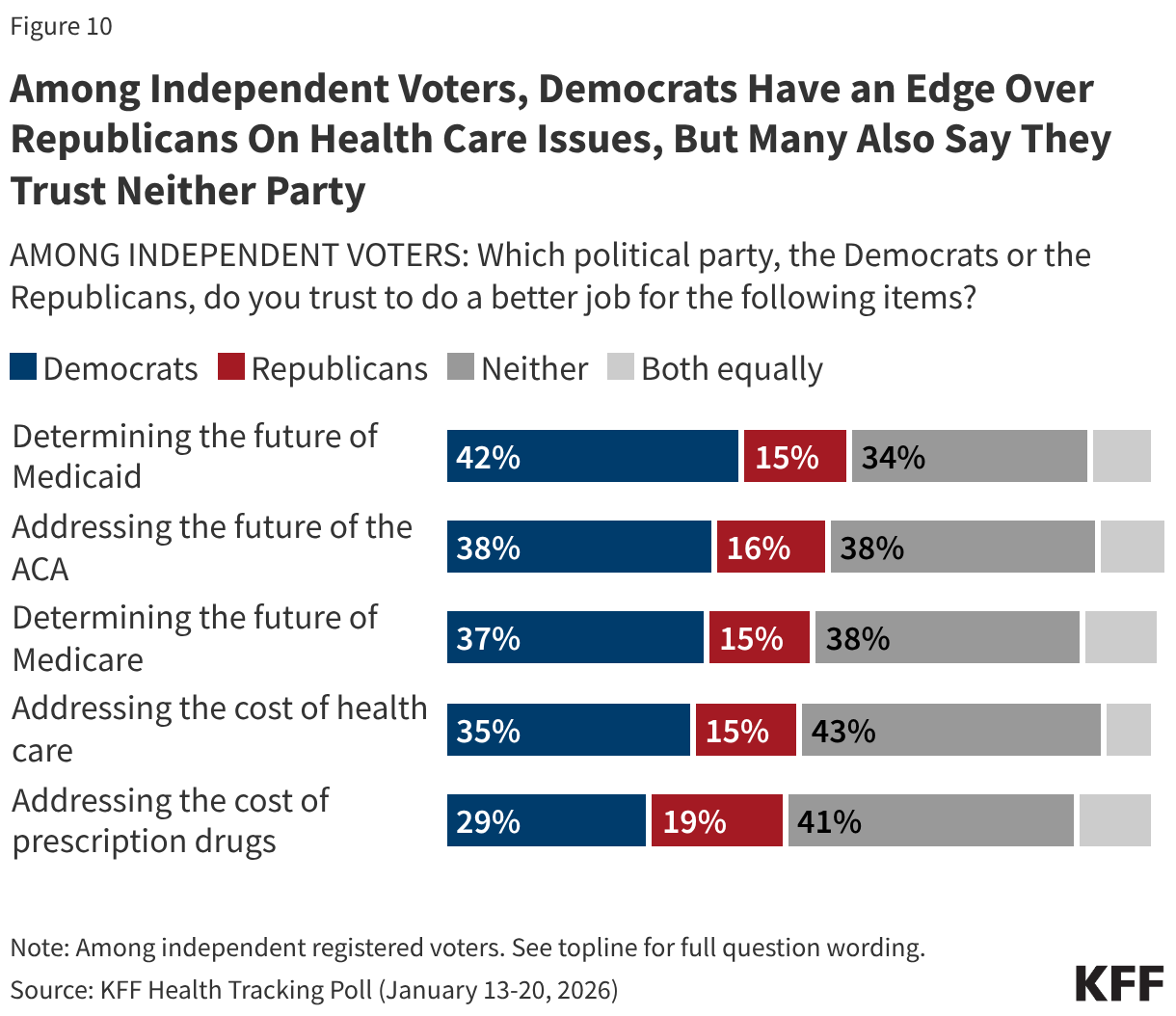
On both health care issues, Democratic and Republican voters largely trust their own party. While the Democratic Party has a strong advantage over the Republican Party among independent voters on who they trust to do a better job handling the future of the ACA (38% v. 18%, respectively), independents are more split on which party they trust to address the high cost of health insurance.  More than one-third of independent voters say they do not trust either party to do a better job handling the ACA’s future (36%) or addressing the high cost of health coverage (41%).

The Democratic Party Holds Slight Edge in Trust on ACA and Health Coverage Costs Among Voters, Though Some Don’t Trust Either Party

As leaders in both political parties blame each other for the extended government shutdown, Democratic and Republican campaign groups have started running ads in competitive congressional districts, in hopes that the situation will boost their party’s standing with voters.

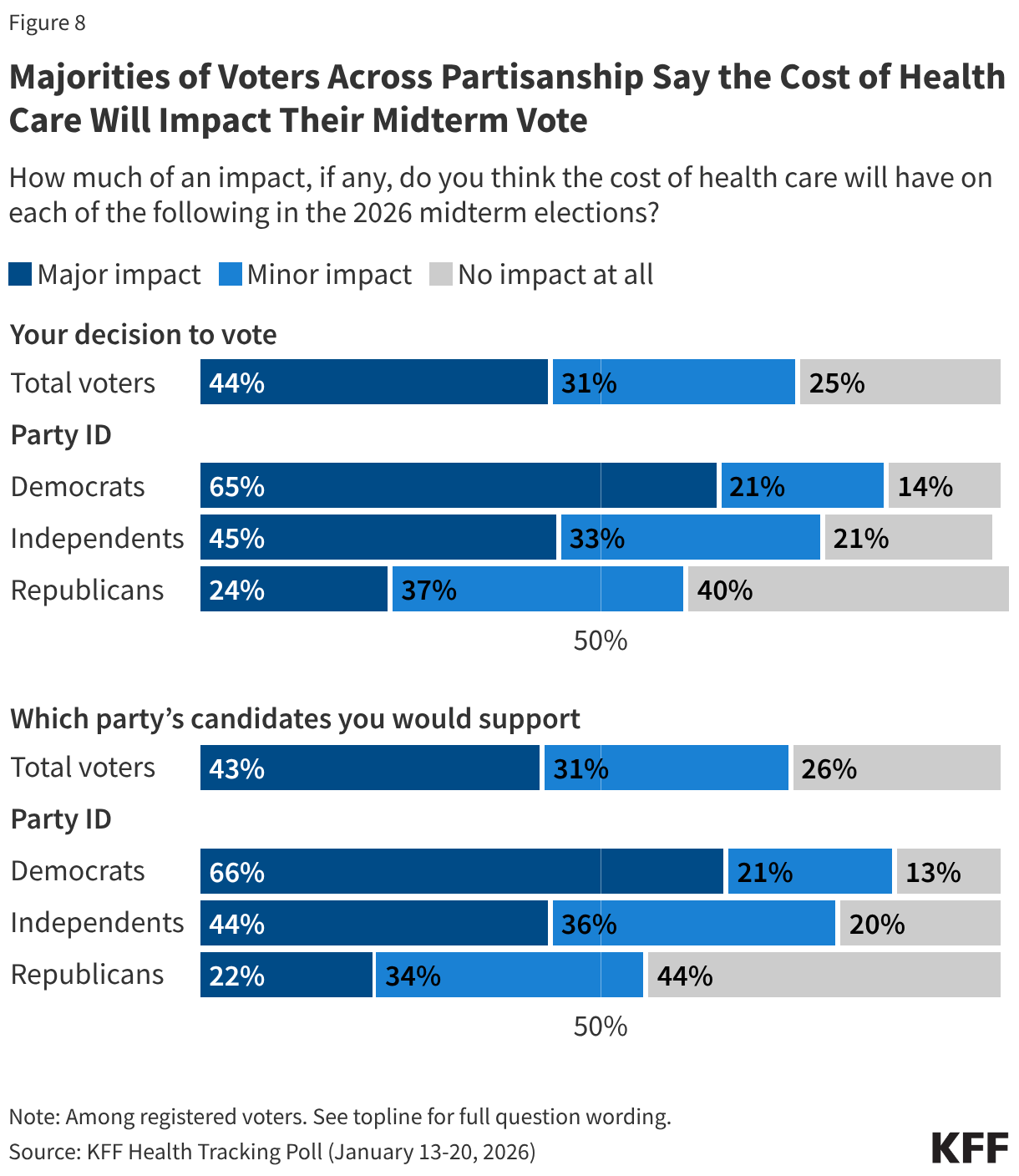
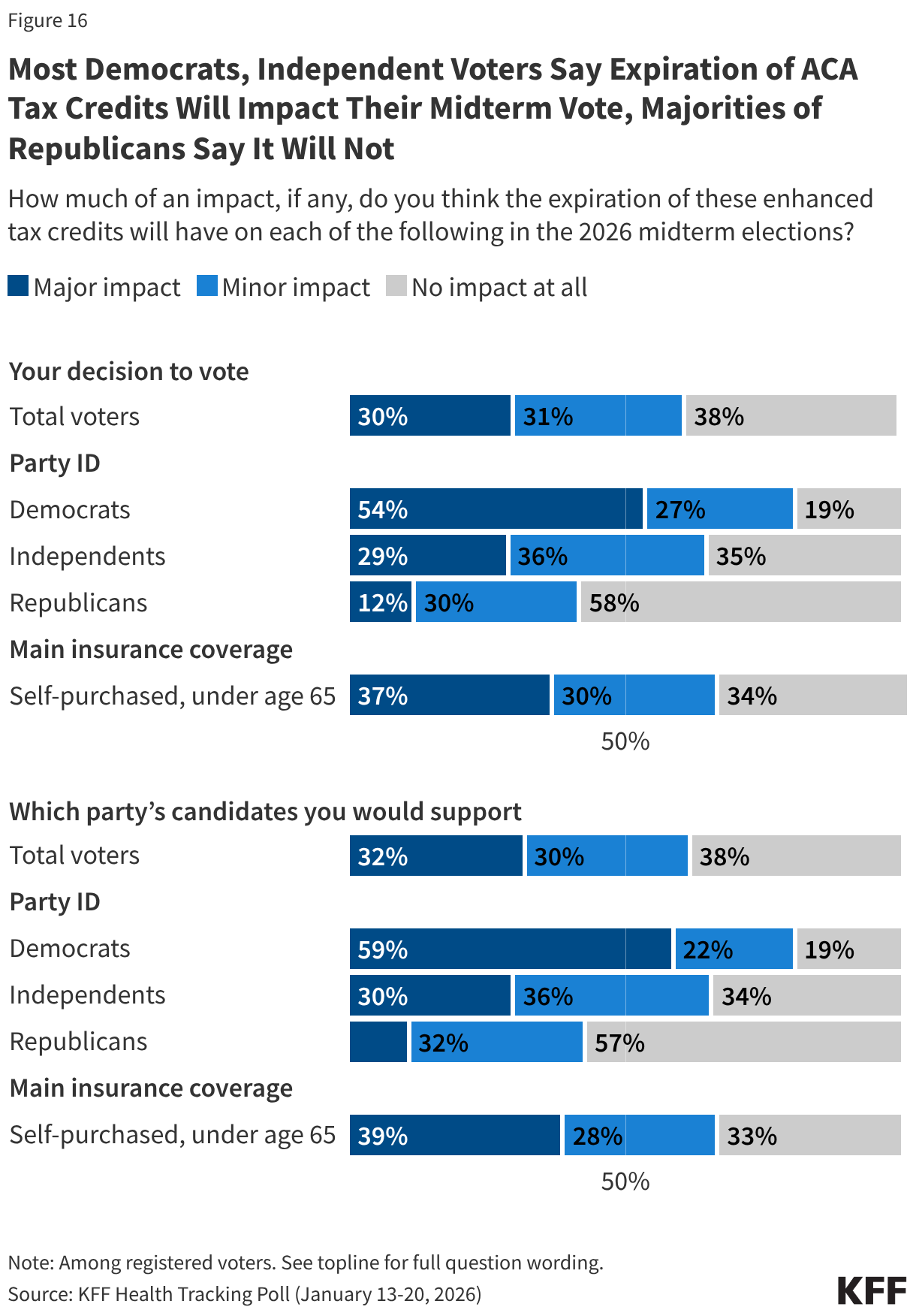
Yet, the possibility of increasing health care costs resonates as a stronger motivator for Democratic voters and independent voters, rather than Republican voters. When asked how a $1,000 increase in their health care costs – the average expected increase for marketplace enrollees if the ACA’s enhanced premium tax credits expire – would affect their 2026 vote, nearly six in ten Democratic voters and more than half of independent voters say it would have a “major impact” on both their decision to vote (59% and 54%) and which candidate they support (56% and 52%). About three in ten Republican voters say such an increase would have a “major impact” on either their decision to turn out or who they support. Although the expiring enhanced premium tax credits directly affect only those who purchase their own coverage on the ACA marketplaces, this suggests that rising health care costs resonate more as a voting issue among Democrats and independents than Republicans.

Majority of Voters Say an Increase in Their Health Care Costs Would Influence Their 2026 Vote


Source link

What the Election Results Tell Us about the Economy and Health Care Costs 


rewrite this content and keep HTML tags

We had the first glimpse of how the congressional debate in Washington over the federal shutdown and extending the enhanced premium tax credits for people who purchase coverage on the ACA marketplaces may be impacting voters’ decisions in upcoming elections last night. Looking at the 2025 Voter Poll results from Virginia and New Jersey, the economy remains the top issue for voters (48% of voters in Virginia said it was the most important issue facing the state as did 32% of New Jersey voters), health care came in behind economic issues with about one in five voters saying it was their most important issue. And this group of voters went disproportionately for the Democratic candidates. For example, in Virginia, the Democratic candidate for Governor won 81% of voters who said health care was the most important issue facing the state. The only group that the Republican candidate did as well with was the 11% of voters who said immigration was their top issue. In New Jersey, Democratic gubernatorial candidate Mikie Sherrill won 92% of health care voters. Notably, both Democratic candidates for Governor also won a majority of voters who said the economy was their most important issue – a group that President Trump won handedly back in 2024. After Tuesday’s elections, it is becoming increasingly difficult to disentangle concerns about the economy and concerns about health care as costs become the most pressing health care issue for voters, as CEO Drew Altman and I have both argued in the past.

There are many caveats and cautions before predicting how this off-year election and the current debate and government shutdown will play out a year from now including the fact that these election results are limited to two states and elections are often more about specific candidates than actually about issues. In addition, if there is a deal on the ACA tax credits, it will no longer serve as a talking point for candidates. However, the results do underscore the advantage that Democratic candidates still have on health care issues. And as economic issues and health care concerns become even more intertwined, as seen in the debate over the ACA tax credits in Washington, voters may give the upper hand to Democratic candidates in the voting booth. The 2025 election results highlight the growing importance of addressing health care costs in both policy debates and electoral choices.


Source link

How ACA Marketplace Costs Compare to Employer-Sponsored Health Insurance


rewrite this content and keep HTML tags

This analysis compares ACA Marketplace costs to employer-sponsored health insurance costs and finds that individual market premiums have become more similar to employer-sponsored premiums since 2017. In 2024, individual market insurance premiums averaged $540 per member per month, slightly below the average $587 per member per month premium for fully-insured employer coverage.

The analysis uses data from Mark Farrah Associates Health Coverage Portal to compare average premiums in the individual and group insurance markets. The data is based on insurer filings to NAIC in the Annual Exhibit of Premiums and Utilization, showing the average premiums and claims per member per month.

The full analysis and other data on health costs are available on the Peterson-KFF Health System Tracker, an online information hub dedicated to monitoring and assessing the performance of the U.S. health system.


Source link

Developments in Prescription Drug Pricing under the Second Trump Administration


rewrite this content and keep HTML tags

Amid perennial public concern about the cost of prescription drugs, the Trump administration has undertaken a raft of efforts to push or persuade drug manufacturers to lower drug prices. These include “Most Favored Nation” proposals that would tie U.S. drug prices to the lowest cost in other countries and encouraging manufacturers to make more drugs available for sale directly to consumers at discounted prices. To date, the administration has inked two voluntary deals with pharmaceutical companies to sell drugs to the Medicaid program at most-favored nation pricing and launch new drugs in the U.S. at the same price as in other countries in exchange for a three-year reprieve from new tariffs on their products. The administration also is setting up a website, Trumprx.gov, scheduled to launch in 2026, through which it plans to connect consumers to manufacturers and other vendors enabling direct-purchase of prescription drugs.

On November 20 at 12 p.m. ET, three experts join Larry Levitt, executive vice president for health policy at KFF, for a 45-minute “Health Wonk Shop” discussion about the latest developments in prescription drug pricing and what they mean for drug manufacturers, patients and public and private health insurance programs.  Among the questions to be discussed include:

  • How do the administration’s efforts to lower drug prices square with drug price negotiation in Medicare, and a provision in the One Big Beautiful Bill Act that allows drug companies to exempt more products from those negotiations?
  • Are the Trump administration’s moves translating into lower drug prices for consumers? Which consumers might benefit most from these efforts? Are those prices at least as low as those paid for the same drugs in comparable countries?
  • How will the availability of drugs be affected, if at all?
  • What might the effects be on drug prices in other countries?
  • How effective will voluntary agreements with drug companies be over time?

Moderator

Photo of Larry Levitt

Larry Levitt

Executive Vice President for Health Policy

Panelists

Juliette Cubanski, PhD

Deputy Director, Program on Medicare Policy

Stacie Dusetzina, PhD

Professor of Health Policy and Ingram Professor of Cancer Research, Vanderbilt University Medical Center

Darius Lakdawalla, PhD

Chief Scientific Officer, USC’s Schaeffer Center for Health Policy & Economics, and Quintiles Chair of Pharmaceutical Development and Regulatory Innovation at the USC Mann School


Source link

How much do dental cleanings cost without insurance?


rewrite this content and keep HTML tags

How much is a dental cleaning cost without insurance?

Without dental insurance, the average price of a dental cleaning is likely to be between $75 and $200.

Do I need insurance to get my teeth cleaned?

No. You can get your teeth cleaned without having dental insurance. You can simply pay out-of-pocket for the cleaning. But having dental insurance can be helpful in a couple of ways.

First, many dental insurance policies cover all or most of the cost of routine cleanings, as long as you use an in-network dentist. Depending on your policy, you might not have any out-of-pocket costs for a routine cleaning, and it might also cover all or most of the cost of X-rays and a dental exam, if needed.

Second, having dental insurance might make you more likely to stay on top of getting your routine cleanings, which can protect your dental health in the long run. People with dental insurance are much more likely to receive preventive dental care than those who don’t have dental coverage. This is also true of all necessary dental care, which is more likely to be skipped due to cost when the patient doesn’t have dental insurance.

What factors can impact the cost of a dental cleaning?

Several factors can impact the cost of a dental cleaning, including:

The specific dental office you use.

  • Dentists set their own prices, so they may charge more or less than average.

Whether a comprehensive exam and X-rays are needed.

  • If it’s been a while since your last dental visit, the dentist may want to do a comprehensive exam in addition to the cleaning, and that can cost between $70 and $200, depending on the dentist.
  • Dental X-rays may only be needed once every two or three years, depending on the patient. The cost of X-rays depends on the type of imaging that’s needed; a full-mouth series will likely cost between $175 and $428.

Whether you need a deep cleaning (tooth scaling and root planing) to address gum disease.

  • Deep cleanings are more involved – and are thus more expensive – than a basic dental cleaning. The cost of a deep dental cleaning can cost up to $350 if you don’t need anesthesia, although anesthesia can significantly increase the price

Whether you get a fluoride treatment.

  • Depending on the circumstances, your dentist might recommend a fluoride treatment after your cleaning is complete. A fluoride treatment will likely add about $30 to the cost of your cleaning.

How can I save money on dental cleanings?

If you don’t have dental insurance, there are several ways you can save money on dental cleanings. They include:


Louise Norris is an individual health insurance broker who has been writing about health insurance and health reform since 2006. She has written hundreds of opinions and educational pieces about the Affordable Care Act for healthinsurance.org.


Source link

How Much More Would People Pay in Premiums if the ACA’s Enhanced Premium Tax Credits Expire?| KFF


rewrite this content and keep HTML tags

The FAQs below are intended to help you understand this Calculator. More detailed questions and answers about signing up for coverage are available on our Marketplace FAQ page.

I am having difficulty viewing or understanding my results. What should I do?

It could be that you are using an older version of Microsoft Edge or Firefox. Try updating to a newer version of your web browser. Not sure which browser version you are running? Check here for Microsoft Edge or here for Firefox. If you continue to have technical problems with the Calculator after updating your browser, please contact KFF.

Please note that we are not able to provide individual advice or assistance understanding your results.

Does the calculator provide definitive results for what I will pay?

No. The comparison calculator is based on 2025 premiums for plans sold in your area, as 2026 premiums are not available yet. There are several additional reasons why your calculator results may differ from your actual tax credit amount or premium payment. For example, the calculator relies completely on information as you enter it, whereas the Marketplace may calculate your Modified Adjusted Gross Income (MAGI) to be a different amount or may verify your income against previous year’s data. Additionally, some plans may include non-essential benefits, which would not be subsidized by premium tax credits. To find out if you are eligible for financial assistance under current law and to sign up, you must contact HealthCare.gov, your state’s Health Insurance Marketplace, or Medicaid program office. Results in both columns are illustrative. Values under the enhanced premium tax credits scenario use the 2025 federal poverty guidelines as the basis for tax credit calculations whereas in plan year 2025, the Exchanges used 2024 federal poverty guidelines to calculate the required contribution toward benchmark plan coverage.

How do health insurance premium tax credits work?

Premium tax credits are financial assistance from the Federal government to help you pay for health coverage or care. The amount of assistance you get is determined by your income and family size. For more information of how health insurance premium tax credits are calculated, visit this page.

What is included in household income? How do I know what to enter for my income?

For information on how to calculate your household income, see here.

What is Medicaid? How does it relate to financial help through the Health Insurance Marketplace?

Medicaid is a comprehensive, free health insurance program  for people with limited income.  This interactive takes into account whether your state has expanded Medicaid or not and will give you an estimate of whether your household income qualifies you and your family for Medicaid or the Children’s Health Insurance Program (CHIP), if applicable. Members of your family that are eligible for either Medicaid or CHIP are not eligible for premium tax credits in the Marketplace and would instead need to sign up for Medicaid or CHIP.

If I am eligible for Medicare, can I still sign up on the Marketplace?

No, you cannot sign up for new Marketplace coverage if you are eligible for Medicare.  Most people age 65 and older are eligible for Medicare, which is the health insurance program run by the federal government.  If you are eligible for Medicare, even if you do not choose to enroll in Medicare, you are not able to purchase Marketplace coverage.

When using the Health Insurance Marketplace Calculator, if some members of your household are eligible for Medicare and others are not, you should enter your full household size (including those who are eligible for Medicare) in Question #4. For the following question, please enter only those family members who are signing up for Marketplace coverage (do not enter adults who are eligible for Medicare in Question #5).

If you are over the age of 65 but not yet eligible for Medicare due to immigration status or your work history, you may be eligible for Marketplace coverage and premium tax credits. You can use the Health Insurance Marketplace Calculator by entering your age as 64.

What are my options if I have job-based health coverage?

In general, people who qualify for health insurance through their job are not able to get financial assistance through the Marketplaces.

However, if your employer’s coverage is either unaffordable or doesn’t meet the health care law’s “minimum value” requirement, then you may be eligible for financial help to purchase through the Marketplace. Family members (spouses and children) who are eligible for employer-sponsored coverage can still qualify for Marketplace premium tax credits if the employer-sponsored coverage for the family is considered unaffordable, even if the employee has access to affordable individual coverage. Starting in 2023, the so-called “family glitch” has been fixed to allow family members in these circumstances to enroll in subsidized coverage.

When using the Health Insurance Marketplace Calculator, you can answer “No” to Question #3 if your employer’s coverage is unaffordable or does not meet the minimum value requirement.


Source link

ACA Insurers Are Raising Premiums by an Estimated 26%, but Most Enrollees Could See Sharper Increases in What They Pay


rewrite this content and keep HTML tags

The amount health insurers charge for coverage on the ACA Marketplaces is rising 26%, on average, in 2026. In states that run their own Marketplaces, the average benchmark (second-lowest cost) silver premium, on which the tax credit calculation is based, is rising 17% next year. In states that use Healthcare.gov, these premiums are rising an average of 30%.

Most enrollees would face even sharper increases in what they pay if they ACA’s enhanced premium tax credits expire. This 26% is the increase in the amount insurers are charging, which in most cases is not what enrollees pay. 22 million out of 24 million marketplace enrollees currently receive a tax credit. The amount subsidized enrollees pay is not what insurers charge, but rather a sliding-scale share of their household income, based on a formula set by Congress. If Congress extends the enhanced tax credits, the amount subsidized enrollees pay each month will remain about the same, even though the amount insurers are charging is increasing sharply.

If the enhanced premium tax credits expire at the end of this year, KFF estimates that currently subsidized enrollees will see their monthly premium payments more than double, increasing by about 114%, on average. This reflects people with incomes below four times the poverty level receiving less financial assistance and those with incomes over four times poverty no longer being eligible for financial assistance at all and therefore being hit by a double whammy of lost tax credit and higher insurer premiums.

ACA Insurers Are Raising Premiums by an Estimated 26%, but Most Enrollees Would See Sharper Increases in What They Pay if Enhanced Tax Credits Expire

Even if the enhanced tax credits expire, many lower income enrollees will continue to be eligible for a bronze plan with zero or a very low premium payment after accounting for the smaller tax credit they will continue to receive. However, this could mean switching from a silver plan with a reduced deductible as low as under $100 to a bronze plan with a deductible of over $7,000.

The amount insurers charge for ACA Marketplace premiums is rising for several reasons, including but not limited to increasing hospital costs, the rising popularity of expensive GLP-1 drugs like Ozempic, and the threat of tariffs. These factors are similarly cited by insurers selling employer coverage. However, an additional factor driving up the amount insurers charge for ACA Marketplace premiums (that is not affecting employer premiums) is the expected expiration of the enhanced premium tax credit. In their 2026 filings to state regulators describing their requested premium increases, ACA Marketplace insurers said they would charge about 4 percentage points more, on average, than they otherwise would have because they expected healthier people to drop Marketplace coverage if enhanced premiums tax credit expire.

Because the ACA’s tax credit is tied to the cost of the second-lowest cost silver plan, when these benchmark premiums rise, so does the federal cost of offering tax credits.


Source link

2026 ACA open enrollment period preview


rewrite this content and keep HTML tags

As we approach the start of the annual open enrollment for 2026 individual and family health coverage, there are numerous changes consumers should know about. (See open enrollment dates for each state.) Some changes are nationwide, and others are state-specific.

Let’s dive in:

1. Higher premiums coupled with expiration of subsidy enhancements

One of the biggest changes for people who buy Marketplace health coverage is the net premium increases due to the impending expiration of the federal subsidy enhancements that have been in place since 2021. The question of extending these subsidy enhancements has been at the heart of the government shutdown stalemate. Without Congressional action, those subsidy enhancements will expire at the end of 2025, resulting in much higher net premiums in 2026.

  • Who’s affected: The 21.8 million Marketplace enrollees with subsidized coverage, who will experience sharply higher premium payments in 2026.
  • What you can do: Comparison shop during open enrollment to see if switching to a different Marketplace plan might be a cost-effective solution. Be wary, however, of scams and non-ACA-compliant options that might be marketed to you. There are significant drawbacks that come with non-ACA-compliant coverage.

In addition to the expiration of the subsidy enhancements, insurers are raising their pre-subsidy premiums by a weighted average of more than 23% nationwide. These premiums apply to people who aren’t eligible for premium subsidies, and they’re the largest overall premium increases the individual market has seen since 2018.

  • Who’s affected:
    • The 1.6 million Marketplace enrollees who already pay full-price for their coverage.
    • The 1.6 million Marketplace enrollees with income over 400% of the federal poverty level who will be subject to the “subsidy cliff” (and thus pay full price) in 2026 if the subsidy enhancements aren’t extended.
    • Anyone who buys ACA-compliant coverage outside the exchange.
  • What you can do: Comparison shop during open enrollment, and understand the rule changes (described below) about HSA-eligibility for Marketplace Bronze and Catastrophic plans, as well as increased access to lower-cost (but still ACA-compliant) Catastrophic plans.

2. Changes to state-funded subsidy programs in some states

Several states offer state-funded Marketplace subsidy programs, in addition to the ACA’s federally funded subsidies. These can be additional premium subsidies, additional cost-sharing subsidies, or both.

Some states are making changes to their state-funded subsidy programs for 2026. In several cases, the changes are designed to try to offset some of the reduction in federal premium subsidies that will happen if Congress doesn’t extend the federal subsidy enhancements.

For example, Colorado is switching its state-funded subsidy program from a cost-sharing reduction to additional premium subsidies. And New Mexico is designing its state-funded subsidy program to completely offset the reduction in federal subsidy funding.

A state-run reinsurance program isn’t the same as a subsidy program, but it does reduce premiums for people who aren’t eligible for Marketplace subsidies. Nevada is the latest state to debut a reinsurance program, which takes effect in 2026.

3. Higher limit for maximum out-of-pocket costs

The maximum allowable out-of-pocket limit for in-network care is increasing sharply for 2026, rising to $10,600 for a single individual and $21,200 for a family. These numbers are up from $9,200 and $18,400, respectively, in 2025.

  • Who’s affected: Potentially everyone enrolled in ACA-compliant coverage, including employer-sponsored plans and individual-market plans. But many plans have out-of-pocket limits well below the maximum allowable cap.
  • What you can do: Carefully review information you receive from your plan, noting whether there are any changes to your deductible and other out-of-pocket expenses. Consider other plans that are available in your area (or from your employer, if your employer offers multiple plans) to see if there are any that would better fit your needs and budget.

4. No cap on excess APTC (subsidy) repayment

Marketplace premium subsidies are a tax credit, but most people receive them in advance (APTC), with the money sent directly to their insurer each month. Each enrollee has to reconcile their APTC when they file their tax return. If their APTC was larger than it should have been, some or all of it has to be repaid to the IRS.

From 2014 through 2025, there has been a cap on how much excess APTC has to be repaid, depending on income. But that cap has been eliminated starting with the 2026 plan year. So if too much APTC is paid on your behalf in 2026, you’ll have to repay all of the excess to the IRS when you file your 2026 tax return.

  • Who’s affected: Potentially, anyone who receives APTC in 2026, depending on how closely their projected 2026 household income matches their actual 2026 household income.
  • What you can do: Be as precise as possible when providing the Marketplace with your income projection, and update your Marketplace account if you realize mid-year that your projection was off. And you can opt to take less APTC than the Marketplace calculates for you. If your APTC ends up being smaller than it’s supposed to be, you’ll be able to claim the additional amount when you file your tax return. (The premium tax credit is a refundable tax credit.)

5. No Marketplace subsidies for low-income recent immigrants

Starting January 1, 2026, recent immigrants whose household income is under the federal poverty level will no longer be eligible for Marketplace premium subsidies.

  • Who’s affected: Immigrants who have been in the U.S. less than five years (and thus aren’t eligible for Medicaid), with a household income below the federal poverty level.
  • What you can do: If you can increase your household income – perhaps by picking up an additional part-time job or gig work – to at least the federal poverty level ($15,650 for a single person, or $21,150 for a household of two), you may still be eligible for Marketplace subsidies in 2026.

6. Bronze and Catastrophic plans: HSA eligibility and increased access

Starting with the 2026 plan year, all Bronze and Catastrophic plans purchased in the Marketplace will be HSA-eligible. This will allow enrollees to contribute pre-tax funds to a health savings account, which will reduce their household income under the ACA-specific MAGI rules.

In addition, an ACA-compliant Catastrophic plan might be available to you in 2026 even if it wasn’t in the past. But Catastrophic plans cannot be used with Marketplace subsidies, so they’re generally only a good choice if there’s no possibility that your income will make you subsidy-eligible.

  • Who’s affected: Anyone who buys Marketplace coverage.
  • What you can do: Consider talking with a financial advisor to see if HSA contributions (or pre-tax retirement contributions) might get your income into the subsidy-eligible range, and whether this might fit with your overall financial goals.

7. Marketplace insurer entries and exits

As is always the case, the list of participating Marketplace insurers will change in some states in 2026. In some states, new insurers are joining the Marketplace, existing insurers are exiting the Marketplace, or both.

  • Who’s affected: Anyone whose Marketplace plan will no longer be available, or who lives in an area where a new carrier will offer plans.
  • What you can do: Pay close attention to notifications you receive from your insurer and the Marketplace. If your plan is ending, you’ll need to pick a new plan for 2026. If new plans are available in your area, comparison shop to determine whether they’d be a good fit for your household.

States where new insurers are entering the Marketplace for 2026 in at least some region of the state:

  • Alabama: Oscar
  • Florida: Community Care Network, and Cigna HMO
  • Minnesota: Health Partners
  • Mississippi: Oscar
  • Nevada: Caresource and Community Care Health Plan (a new Anthem affiliate, offering Battle Born State Plans)
  • Texas: Harbor Health
  • Washington: Wellpoint Washington

States where at least one current Marketplace insurer will no longer offer Marketplace plans in 2026. (Aetna’s exit accounts for the majority of these.):

  • Arizona: Aetna (and BCBSAZ is terminating PPO products, but will continue to offer HMOs.)
  • California: Aetna
  • Delaware: Aetna
  • Florida: Aetna
  • Georgia: Aetna
  • Illinois: Aetna, Health Alliance, and Quartz
  • Indiana: Aetna
  • Kansas: Aetna
  • Kentucky: CareSource
  • Maryland: Aetna
  • Michigan: Molina and UM Health Plan/Michigan Care
  • Mississippi: Primewell Health Services
  • Missouri: Aetna
  • Nevada: Aetna
  • New Jersey: Aetna
  • North Carolina: Aetna, and Celtic/WellCare
  • Ohio: Aetna, and AultCare
  • Texas: Aetna
  • Utah: Aetna
  • Virginia: Aetna (including Innovation Health)
  • Wisconsin: Molina and Chorus Community Health Plan
  • Wyoming: Mountain Health CO-OP

8. Illinois residents no longer using HealthCare.gov

For enrollment in 2026 coverage, Illinois residents will use Get Covered Illinois – which is run by the state – instead of HealthCare.gov. HealthCare.gov has transferred existing accounts for Illinois residents to Get Covered Illinois, which has sent access codes to enrollees. Enrollees can use the access code to  locate and update their accounts on the new platform.

Although the Marketplace platform is different in Illinois, this doesn’t affect the available coverage or the income-based subsidies that are available. However, as noted above, some insurers are exiting the Illinois Marketplace at the end of 2025.

9. District of Columbia working to establish a Basic Health Program

For 15 years, Washington, DC has provided Medicaid to adults with household income up to 215% of the federal poverty level (FPL). But starting in January 2026, this eligibility limit will drop to 138% of FPL.

However, DC has created a Basic Health Program (BHP), called Healthy DC Plan. It will be available to adults with household income above between 139% and 200% of FPL, and will have no premiums and no out-of-pocket costs for covered services. .

DC’s BHP committee clarified in October 2025 that the federal government had approved their BHP blueprint. Enrollment in the Healthy DC Plan will begin November 1, 2025, for coverage effective January 1, 2026.

Oregon and Minnesota already have BHPs, and New York has a similar program.

10. Additional benefits in Alaska, Washington, and the District of Columbia

Alaska, Washington, and the District of Columbia Marketplaces have revised their Essential Health Benefits (EHB) Benchmark plans for 2026 in, adding new coverage requirements.

The EHB Benchmark plan sets the minimum requirements for the coverage that must be offered by all individual and small-group health plans with effective dates of 2014 or later.


Louise Norris is an individual health insurance broker who has been writing about health insurance and health reform since 2006. She has written hundreds of opinions and educational pieces about the Affordable Care Act for healthinsurance.org.


Source link

‘Subsidy cliff’ will return in 2026 if Congress doesn’t act


rewrite this content and keep HTML tags

If Congress doesn’t extend enhanced Marketplace subsidies that have been helping make coverage more affordable since 2021, hundreds of thousands of Marketplace enrollees with household incomes over 400% of the federal poverty level will  face the return of the so-called “subsidy cliff. due to subsidies ending abruptly if household income exceeds 400% of FPL.

The impact of the “subsidy cliff” would cause dramatic increases in health insurance premium expenditures. Particularly hard hit would be enrollees in their 50s and 60s, who – without subsidies – could well face premiums that consume half or more of their income. (Premiums are age-based; without subsidies, a person who is 52 will pay about twice as much as a person who is 21, and a person who is 64 will pay three times as much as a person who is 21).

Here’s what the impact might look like if the “subsidy cliff” returns:

Many older Marketplace buyers face drastic premium hikes

If the “subsidy cliff” returns to the health insurance Marketplace in 2026, a 63-year-old couple in Charleston, West Virginia, earning $85,000/year, will pay more than 15 times as much for the lowest-cost Gold plan, compared with what they paid in 2025.

In 2025, they pay about $300/month for the lowest-cost Gold plan, and they even have access to a zero-premium Bronze plan.

But if Congress doesn’t extend the subsidy enhancements that have been keeping coverage more affordable since 2021, this couple will lose their subsidy altogether.

  • The Gold plan that currently costs them $300/month will cost an estimated $4,713/month in 2026.
  • And the Bronze plan they can currently get for $0/month will cost an estimated $3,817/month.

If they keep the Gold plan, they’ll be spending two-thirds of their household income on health insurance.

And even the lowest premium Bronze plan – which they could get with no premium at all in 2025 – will cost more than half of their household income.

‘Subsidy cliff’ affects households with incomes above 400% of federal poverty level

That’s because $85,000 for a household of two is 402% of the 2025 federal poverty level (FPL). And the ACA has a so-called “cliff” where Marketplace subsidy eligibility ends abruptly if an enrollee’s household income is more than 400% of the previous year’s FPL. That’s how it worked from 2014 through 2020, when subsidies weren’t available to these enrollees, regardless of how expensive their coverage was.

The subsidy eligibility income limit was temporarily lifted from 2021 through 2025, due to the American Rescue Plan (ARP) and Inflation Reduction Act (IRA). But it will come back in 2026 unless the ARP/IRA subsidy enhancements are extended by Congress. .

American Rescue Plan and Inflation Reduction Act temporarily eliminate ‘subsidy cliff’

Section 9661 of the ARP capped Marketplace health insurance premiums (for the benchmark Silver plan) at no more than 8.5% of household income.

The 8.5% cap applies to people with household incomes of 400% of the federal poverty level or higher. For people with lower incomes, the  percentage of income that has to be paid for the benchmark premium has been reduced across the board. These subsidy enhancements were initially applicable for 2021 and 2022, but the Inflation Reduction Act extended them through 2025.

If your household income is more than 400% of FPL and the benchmark plan’s premium would already be no more than 8.5% of your income, you won’t qualify for a premium subsidy (meaning, the ARP/IRA didn’t change anything about your situation). This is more likely to be the case for younger enrollees in areas of the country where health insurance is less costly than average.

But if the full-price cost of the benchmark plan would be more than 8.5% of your income, you’ve been eligible for a premium subsidy between 2021 and 2025.  (This assumes you meet the rest of the eligibility requirements, meaning that you’re lawfully present in the U.S. and not eligible for Medicaid, premium-free Medicare Part A, or employer-sponsored coverage that’s considered affordable and provides minimum value).

So for some people, especially older enrollees in areas of the country where health insurance is particularly costly, even those with income well above 400% of FPL are receiving some sort of subsidy. But if Congress doesn’t extend the ARP subsidy enhancement provisions again, people who earn more than 400% of FPL will no longer qualify for a subsidy in 2026 – no matter how expensive their health insurance will be.

Why it’s called a ‘cliff’

If the “subsidy cliff” returns, a few hundred dollars in extra annual income could translate to the loss of thousands of dollars per month in subsidies, if it pushes you over the 400% FPL threshold. And as we illustrated above, some enrollees will find that even the most inexpensive health plan will have premiums that amount to more than half their annual income. For most households, that’s simply unaffordable.

It’s called a cliff because there’s a sharp and sudden spike in health insurance premiums when subsidies end abruptly at 400% of FPL. From 2021 through 2025, subsidies have instead phased out slowly as income increased. But that will no longer be the case in 2026 if subsidies go back to only being available to enrollees with household income up to 400% of FPL.

Let’s take another look at the 63-year-old West Virginia couple described above, but let’s assume their income in 2026 will be $84,500, instead of $85,000. That puts them just over 399% of the 2025 FPL, meaning they will still qualify for a premium subsidy in 2026.

In that case, their after-subsidy premiums for the benchmark Silver plan will be capped at a little less than 10% of their household income. That will mean the benchmark plan will cost them a little more than $700/month in 2026. They’ll be able to apply their subsidy to any metal-level plan, meaning they’ll be able to get the lowest-cost Bronze or Gold plan for even lower premiums.

But if their income goes above $84,600 (400% of the 2025 FPL), they will lose their subsidy altogether if Congress doesn’t extend the subsidy enhancements.

Areas with higher average premiums will be hit hardest by the ‘cliff’

We used West Virginia as the example here because individual/family health insurance premiums in West Virginia are much higher than the national average.

So let’s also consider Idaho, where 2025 premiums are much lower than the national average. We’ll assume we have the same 63-year-old couple, earning $85,000, but now they live in Boise instead of Charleston.

  • In 2025, the lowest-cost Bronze plan costs them less than $2/month after subsidies. In 2026, that plan will cost them $1,527/month if the “subsidy cliff” is allowed to return.
  • In 2025, the lowest-cost Gold plan costs $712/month. That will jump to $2,354/month in 2026 if the “subsidy cliff” comes back.

While these amounts aren’t as extreme as the West Virginia example (because health insurance is lower in Idaho), this couple will still have to pay more than a fifth of their household income for the lowest-cost plan, if the “subsidy cliff” is allowed to return.


Louise Norris is an individual health insurance broker who has been writing about health insurance and health reform since 2006. She has written hundreds of opinions and educational pieces about the Affordable Care Act for healthinsurance.org.


Source link

Perspectives from Employers on the Costs and Issues Associated with Covering GLP-1 Agonists for Weight Loss


rewrite this content and keep HTML tags

While more large employers are covering GLP-1 drugs for weight loss, conversations with employers highlight concerns about the cost of these medications. Many of these employers have considered scaling back coverage of GLP-1 agonists for weight loss, or in some cases, employers are adding or strengthening coverage requirements.

This analysis discusses findings from the 2025 KFF Employer Health Benefits Survey, with insights gained from interviews and group discussions with human resources directors and others who manage employer health benefits. These conversations occurred in five focus groups across the United States, covering over one hundred companies employing over a quarter of a million people, held throughout the summer and fall of 2025.

The full analysis and other data on health costs are available on the Peterson-KFF Health System Tracker, an online information hub dedicated to monitoring and assessing the performance of the U.S. health system.


Source link