Home Blog Page 8

As the 2026 Election Takes Shape, Health Care Is Becoming an Economic Issue for US Voters


rewrite this content and keep HTML tags

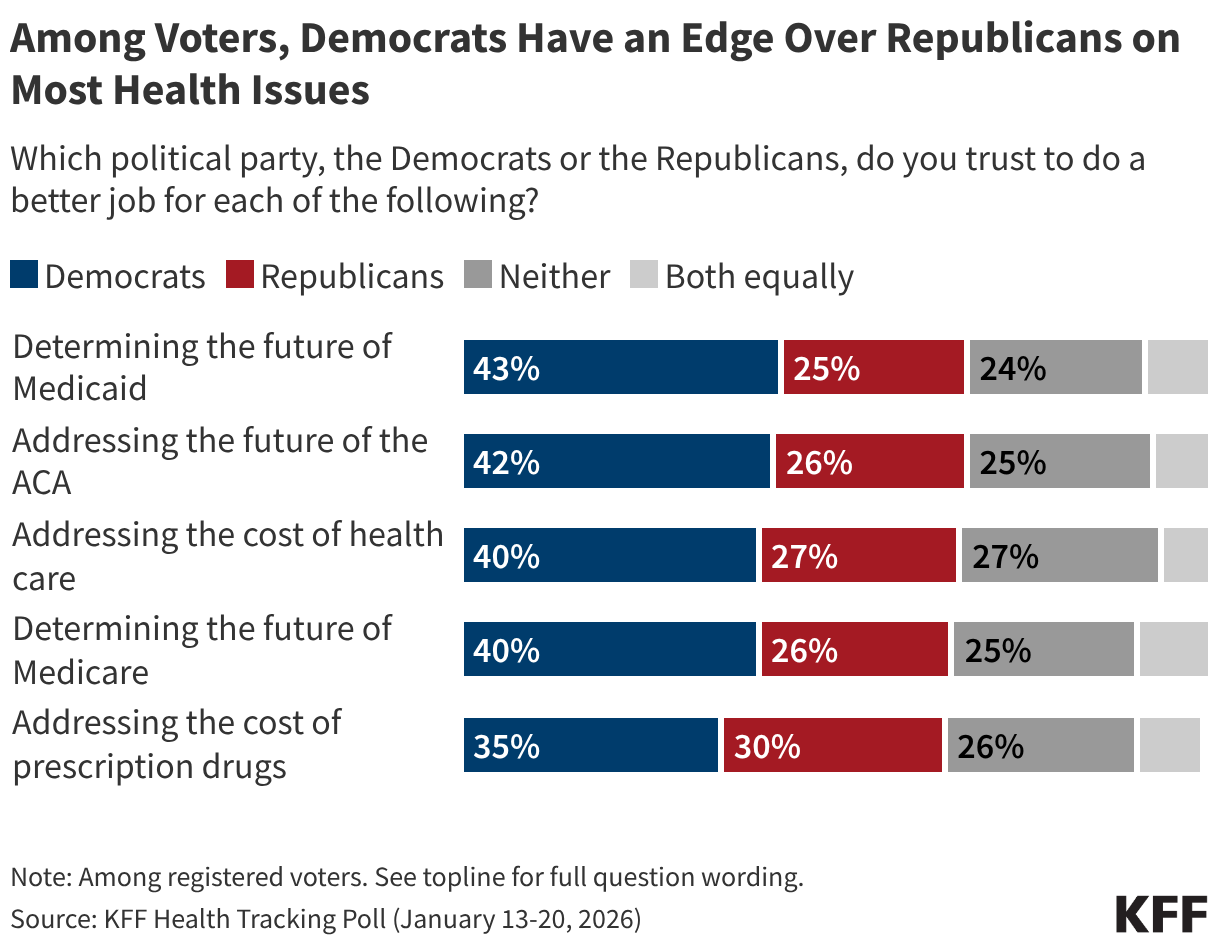
In this JAMA Viewpoints column, KFF’s Drew Altman, Ashley Kirzinger and Mollyann Brodie explore the power of health care affordability as an economic issue, how it has played out in recent election cycles, and the implications for the 2026 midterm elections. The column notes how health care increasingly has become a dimension of voters’ economic worries rather than a stand-alone issue, which explains why the debate about whether to extend the Affordable Care Act’s expiring enhanced tax credits has so much salience now that could continue into the midterms if Congress does not strike a deal to address rising costs for consumers. It also explains why Medicaid cuts will have power as an issue even though the cuts will be phased in over time.


Source link

The New ACA Repeal and Replace: Health Savings Accounts


rewrite this content and keep HTML tags

If enhanced premium tax credits under the Affordable Care Act (ACA) are allowed to expire at the end of the year, out-pocket premiums for 22 million enrollees that receive premium assistance will increase by an average of 114%, or $1,016 per person.

Democrats have pushed for the enhanced tax credits to be extended, and a vote is expected on their proposal in December. There have also been some bipartisan negotiations and proposals to extend the tax credits for up to two years, with changes like a cap on who is eligible by income and efforts to address any fraudulent signups by insurance brokers.

Meanwhile, proposals have emerged from some Republicans in Congress to effectively repeal some or all of the ACA premium tax credits and replace them with contributions to Health Savings Accounts (HSAs) or something similar. President Trump posted recently:

“THE ONLY HEALTHCARE I WILL SUPPORT OR APPROVE IS SENDING THE MONEY DIRECTLY BACK TO THE PEOPLE, WITH NOTHING GOING TO THE BIG, FAT, RICH INSURANCE COMPANIES, WHO HAVE MADE $TRILLIONS, AND RIPPED OFF AMERICA LONG ENOUGH. THE PEOPLE WILL BE ALLOWED TO NEGOTIATE AND BUY THEIR OWN, MUCH BETTER, INSURANCE.”

(The current ACA premium tax credits do not, in fact, go to insurance companies. The tax credits go to people to help them pay their premiums for ACA Marketplace plans. People can either wait until they file their taxes the following year to receive a lump sum or qualify for advance tax credits based on estimated income so they do not need to wait until they file their taxes. Those advance tax credits are forwarded directly to the insurance company they choose to purchase, directly lowering the enrollee’s monthly premium payments.)

Senator Scott Proposal

The most expansive health account proposal was recently introduced by Senator Rick Scott of Florida. It would allow the enhanced premium tax credits to expire but keep the value of the ACA premium tax credits from the original law. States could submit a waiver to the federal government to replace the original ACA premium tax credits with contributions by the federal government to accounts similar to HSAs. These “Trump Health Freedom Accounts” could be used for out-of-pocket health care costs, or to pay health insurance premiums (unlike traditional HSAs).

Unlike ACA premium tax credits, which can only be used for ACA Marketplace plans, the accounts in the Scott proposal could be used for any type of health insurance plan, including short-term plans that can exclude people based on pre-existing conditions. States could also waive certain provisions of the ACA, including the requirement to cover certain benefits.

While ACA plans would still be required to cover people with pre-existing conditions under the Scott proposal, it is likely that the ACA Marketplace would collapse in states that seek a waiver under his approach. Healthy people would be able to buy less expensive coverage that does not cover pre-existing conditions, or forgo insurance altogether and use their health accounts to pay for health care directly (carrying over any unused balanced from year to year). People with expensive health conditions would only be able to get coverage in ACA Marketplace plans, leading to a premium “death spiral” for those plans. Insurers would likely leave the ACA Marketplaces.

Senator Cassidy Proposal

Senator Bill Cassidy of Louisiana has proposed a different, narrower approach. Under the Cassidy proposal, the original ACA premium tax credits and benefit rules would remain in place. The value of the enhanced premium tax credits would be converted to federal contributions to HSAs, which could be used for out-of-pocket health care costs (e.g., deductibles and copays), but not to pay premiums. HSA contributions would only be available for people who enroll in bronze level ACA plans.

The Cassidy proposal is not yet available in legislative language, so a number of questions remain about how it would work. For example, how big would the HSA contributions be? Enhanced ACA premium tax credits vary by income, age, and the level of premiums in the county of residence, and they range from hundreds of dollars to thousands of dollars per person.

Because the health accounts in the Cassidy proposal could not be used to pay premiums, out-of-pocket premiums for ACA enrollees would more than double on average once the enhanced tax credits expire at the end of the year. HSA contributions would cushion the effect of the premium increases by helping people pay for deductibles, if people can afford the premiums to continue purchasing coverage.

However, to qualify for the HSA, enrollees would need to select a bronze plan and most people today are in a silver or gold plan. Many low-income people could get a bronze plan with no monthly premium payment, even without the enhanced tax credits. But, the lowest-income enrollees get cost-sharing reductions that bring their deductibles down to about $80 only if they purchase a silver plan. Deductibles in bronze plans average $7,476 per person.

Additionally, some middle-income people would no longer qualify for a tax credit because their incomes exceed four times the poverty level, and may be priced out of even a bronze plan premium, meaning they would not benefit from the HSA contribution.

While healthier people could benefit from the Cassidy proposal by receiving HSA contributions that could be used for a variety of health care expenses and carry over from year to year, sicker people could be stuck with higher premiums or higher out-of-pocket health costs. Because the HSAs in the Cassidy proposal are contingent upon having ACA Marketplace coverage, it does not pose the same risks of insurance market instability as the Scott plan.

Although the proposals from Senators Scott and Cassidy are quite different, they would both present trade-offs, generally benefiting people who are currently healthy at the expense of people who have expensive health conditions.


Source link

Why We Are Stuck with Prior Authorization Review


rewrite this content and keep HTML tags

When it comes to controlling health spending, the fundamental difference between our health system and those of other wealthy nations is that they each have a way to control total health spending, and then they leave health professionals and health care institutions relatively free, compared to us, to do their jobs with the resources they have. Those other countries spend a much smaller share of GDP on health care and some of them limit care just by spending less money on health, but generally, their health professionals maintain greater professional autonomy. They make less money but maintain high social status and respect. The United States, by contrast, has no mechanism to control overall health spending in our fragmented health system and then to compensate, we micromanage to control costs, making health care overly complex for patients and, too often, making the experience of providing it a desultory one for health professionals. It’s a primary reason why almost half of our doctors say they regret choosing medicine—not a good outcome no matter what you think of our health system or of doctors. 

The posterchild of how this happens in the U.S. is prior authorization review, the system by which insurance companies decide whether they will authorize payment for a procedure or a diagnostic test or a drug, or if they’ll authorize it in one setting or another. These days, prior authorization is becoming a duel between provider AI tools helping hospitals and large group practices out maneuver insurance company prior authorization, and insurance company AIs trying to weed out necessary from unnecessary care and promote “value” as well as, of course, insurance company profits. Everybody thinks they’re the good guy in the prior authorization dance. There’s the doctor who 99% of the time is looking out for the patient. There’s the insurance company, which thinks it’s on guard against unnecessary and unnecessarily costly care and bad apple doctors. And then there’s the patient, who may be waiting anxiously for the results of a crucial test or hoping that a procedure will bring relief.

Other than out-of-pocket costs, I would wager that prior authorization review is the one thing consumers find most burdensome in our current health system. I will test that out on one of KFF’s upcoming polls.

A proposal to eliminate prior authorization altogether could be the single most tangible and popular “health reform” idea a candidate could propose, Republican or Democrat. The speech would write itself: “I propose to get insurance companies out from between you and your doctor. No more hours on the phone trying to get your MRI approved. Your doctor will no longer need a team of administrators just to fight with your insurance company.”

It is, of course, not that simple. As with everything in health policy, there are tradeoffs, and addressing them makes things complicated quickly.

The most comprehensive analysis of eliminating prior authorization was conducted by Milliman in 2023 (Potential impacts on commercial costs and premiums related to the elimination of prior authorization requirements). It was a national study commissioned by the Blue Cross and Blue Shield Association in Massachusetts in the middle of ongoing fights there about meeting state cost targets. Boiling down a complex study, here are a few essentials:

  • Milliman’s mid-range estimate for eliminating prior authorization says it would raise premiums by up to 4.8% for plans with a broad range of services. (Credit to Milliman for providing ranges where exact estimates cannot reliably be determined.)
  • They worried that eliminating prior authorization could also have a “sentinel effect”—meaning services prior authorization deters just by being there would start to be provided.
  • Patient cost sharing could also go up simply because people would be using more services.
  • And yes, they concluded that there would also be a significant offsetting reduction in administrative costs (and hassles and anxiety, but Millman doesn’t go into that much).

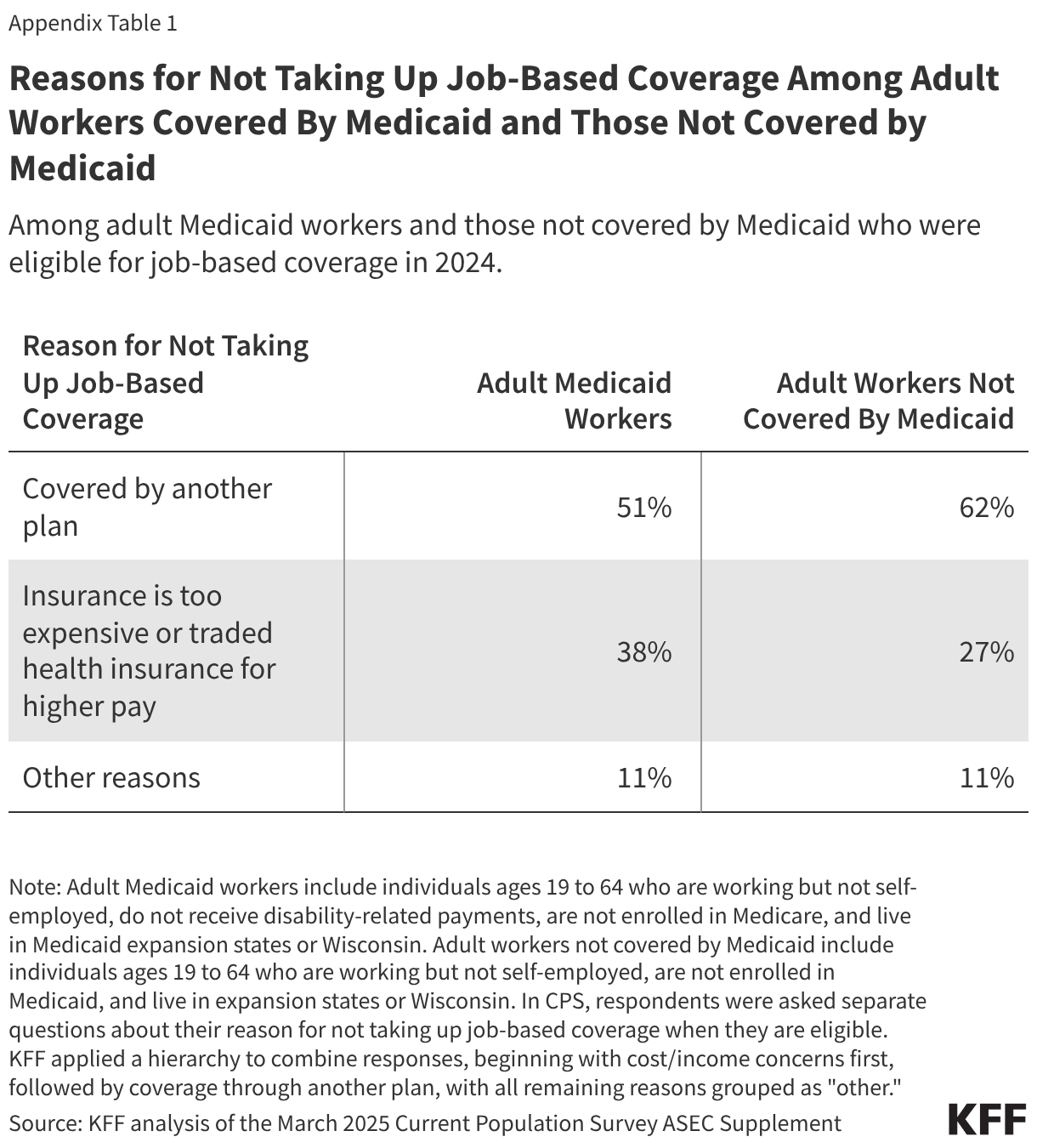
These conclusions (and more in the analysis) add up to a daunting set of reasons why in our fragmented system, with no great way to control costs or limit unnecessary care, we seem to be stuck with prior authorization review. As frustrating as prior authorization can be for patients and health professionals, it’s hard to imagine anyone swallowing an almost 5% premium increase to abandon it, or risking the bad outcome from an unnecessary procedure an insurance company might sometimes catch. Still, traditional Medicare has operated almost entirely without any form of prior authorization review for decades and survived the experience as health care’s most popular and politically sacrosanct program. (Its competitor, Medicare Advantage, features prior authorization.)

Consider a hypothetical test of how much physicians value autonomy versus money and insurers really care about value versus the bottom line. Imagine a “deal” between insurers—or an insurer—and providers in which insurers eliminate prior authorization and in return, reduce payments to physicians by, say, 2% or 3%, to offset some of the expected increase in costs. In effect, physicians would trade income for greater professional autonomy more like what their counterparts have in some other countries, and insurers would get off their high horse about the loftier purposes of prior authorization to reduce administrative costs and bank certain savings, unless physicians make up lost revenue with greater volume. I don’t expect this somewhat fantastical experiment to happen.

The tradeoffs and potential costs of eliminating prior authorization have driven most payers in a different direction: don’t eliminate it, “do prior authorization smarter.” States have mounted a long list of prior authorization reforms to make it less onerous for patients and providers (9 states pass bills to fix prior authorization | American Medical Association). These include “gold carding”: essentially exempting physicians from prior authorization with a good track record of ordering needed services. Or, eliminating or restricting prior authorization for ongoing care for patients with a chronic illness. Take a patient with lifelong chronic migraines who has taken the same prophylactic drug for 20 years and treated the migraines with Sumatriptan for the same period of time. That patient and their provider probably can go with a longer interval of time before the next set of likely identical prescriptions are reviewed.

A trend will be circumscribing the role AI plays in reviews by requiring an actual physician to approve any review determination. That’s politically popular although, of course, physicians working for insurance companies issued many a denial long before AI was around.

Even traditional Medicare has now entered the “do it smarter” game. Recently CMMI announced WISeR, the Wasteful and Inappropriate Service Reduction Model, to test out prior authorization for selected services in six states. Services targeted include skin and tissue substitutes (controversy surrounding them motivated the demo), electrical nerve stimulator implants, cervical fusion, and more. Reportedly, a “gold carding” demo is also planned. It was perhaps surprising politics that CMS would move to one of health care’s least popular practices in politically sensitive traditional Medicare at this time, but it fits with the “do prior authorization smarter” trend. Earlier the administration and a group of insurance companies also announced a voluntary initiative to streamline prior authorization and make it less burdensome. A poll we did at the time showed that few have much faith that insurance companies will follow through on the initiative.

As these initiatives show, prior authorization is down but far from out, and we are almost certainly stuck with prior authorization with some modifications around the edges. It’s an example of the “small ball” featured in cost containment in health today. However, the impact of getting rid of prior authorization cannot only be measured by actuaries in premium increases. There are also the benefits to be found in reduced complexity, hassles, anxiety and administrative costs that limiting or eliminating prior authorization would have for patients and health professionals who have to struggle through the prior authorization maze. 

View all of Drew’s Beyond the Data Columns


Source link

Employer Health Benefit Survey | KFF


rewrite this content and keep HTML tags


KFF has conducted this annual survey of private and non-federal public employers with three or more workers since 1999. The survey tracks trends in employer health insurance coverage, the cost of that coverage, and other topical health insurance issues. Findings are based on a nationally representative survey of public and private employers with ten or more employees, including those who respond to the full survey and those who indicate only whether or not they provide health coverage.

The archive includes surveys conducted in partnership with the Health Research and Education Trust through 2017 and a small business supplement of the 1998 survey conducted by KFF. Access each report below.

2025 | 2024 | 2023 | 2022 | 2021 | 2020 | 2019 2018 | 2017 | 2016 2015 2014 | 2013 | 2012 

NOTE: In 2011, our methodology for calculating employer weights was updated.  Statistics such as the percentage of firms offering health benefits or the percentage of firms offering retiree coverage are updated in the preceding reports.  Statistics based on the percentage of covered workers were not affected by this change.  Most changes were not statistically different.  For more information, see the Survey Design and Methods Section in the 2011 Report.

2011 | 2010 | 2009 | 2008 | 2007 | 2006 | 2005 | 2004 | 

NOTE: In 2003, our methodology for calculating weights was updated. New estimates for many statistics published in 1999-2002 are available in the preceding reports.  Most changes were not statistically different.  For more information, see the Survey Design and Methods Section in the 2003 Report.

2003 | 2002 | 2001 | 2000 | 1999 | 1998 |

The survey was previously conducted by KPMG from 1991–1998 and the Health Insurance Association from 1987–1991.


1 – 10 of 52 Results


Source link

Access Uncertain for New Injectable PrEP as the Affordable Care Act’s (ACA) Open Enrollment Begins


rewrite this content and keep HTML tags

Background

In June 2025, the Food and Drug Administration (FDA) approved lenacapavir (Yeztugo) as the latest pre-exposure prophylaxis (PrEP) drug to prevent HIV in adults and adolescents. Lenacapavir differs from other available PrEP products. It is the second long-acting injectable PrEP drug on the market but offers less frequent (twice annual) dosing. Its relatively infrequent dosing and its high efficacy (100% for some populations) make it a promising option at a time when PrEP uptake has continued to stall in many regions and disparities persist. 

This ACA open enrollment period is the first since lenacapavir’s approval, and some consumers may be looking for marketplace plans that cover it. However, despite lenacapavir widely being considered a major advance, early evidence suggests that insurance coverage and benefit design decisions may create barriers to access.

This brief examines challenges in assessing access to PrEP in ACA marketplace plans but it is likely that individuals would face similar challenges in other contexts, such assessing coverage in employer, Medicare Part D, or Medicare Advantage plans.

Coverage

Pharmacy Benefit Manager (PBM) Decisions

Pharmacy benefit managers (PBMs) play a central role in determining which drugs health plans cover. PBMs are independent companies that contract with plans to manage their pharmacy benefits. In addition to other possible roles, PBMs act as an intermediary between drug manufacturers and pharmacies, negotiating prices and ultimately determining enrollee prescription medication coverage. 

Notably, PBM services are concentrated with three companies —CVS Caremark, Express Scripts, and OptumRx— which together represented 73% of all commercial drug claims in 2023. Therefore, decisions by any one of these entities stand to affect millions of enrollees.

CVS Caremark, the largest of the big three (capturing 29% of the commercial market), does not cover lenacapavir. According to media reports the company initially cited needing to investigate “clinical, financial, and regulatory considerations” and in a recent email stated that price, and continued negotiations with its manufacturer, Gilead, was the main consideration. Choosing not to cover the drug has access implications to all those enrolled in plans using CVS Caremark as its PBM, including for marketplace plan enrollees. By contrast, during a Q3 2025 earnings call Gilead announced that Express Scripts (capturing 28% of the commercial market) is covering the drug.

Preventive Services Coverage Under the ACA & the U.S. Preventive Services Task Force (USPSTF) – Coverage and Cost Implications

The Affordable Care Act (ACA) requires most private health insurance plans and Medicaid expansion programs to cover preventive services recommended by the U.S. Preventive Services Task Force (USPSTF) – those receiving an “A” or “B” grade – without cost-sharing. In addition, the federal government later clarified that along with covering the drug, the coverage requirements encompass physician visits and associated lab tests ancillary to PrEP.

The USPSTF gave PrEP an “A” recommendation, first in 2019 and then in an updated recommendation in 2023, but even the later grade predated the approval of lenacapavir, and therefore the recommendation does not explicitly include it. As a result, insurers or PBMs may make different determinations about whether lenacapavir must be covered without cost-sharing. If it is not classified as an ACA-required preventive service, the drug could be subject to copayments, coinsurance, deductibles, or even exclusion. Enrollees could also face costs for related provider visits and laboratory services.

While uncertainty remains, in its Q3 2025 earnings call Gilead stated that the company had achieved 75% coverage (including among private and public payers) and that most payers are covering the drug without prior authorization or cost-sharing. Indeed, at least some issuers offering marketplace products in multiple states are offering the drug with zero cost-sharing as preventive medication, listing it in their formularies as a preventive drug (e.g. Oscar NY and IL and Molina in IL).

Whether or when the USPSTF will update its PrEP recommendation remains unclear.

Medical vs. Pharmacy Benefits

Most prescription medications are covered under the pharmacy benefit and typically picked up at a brick-and-mortar pharmacy or mailed to the enrollee. However, certain drugs, particularly those that are administered by a health care provider, are billed as a medical benefit.

Lenacapavir is provider administered and it appears at least some health plans might be covering lenacapavir as medical benefit rather than as a pharmacy benefit. When this happens, the drug may not appear in drug-search tools or on a plan’s formulary, making coverage more difficult to determine.

For example, in at least two UnitedHealthcare markets (New York and Texas), where plans use Optum as a PBM, the formulary states that lenacapavir “is not covered under your Pharmacy Benefit and may be covered under your Medical Policy. Please refer to your health plan ID card to determine next steps or contact customer service.” As such for a potential new enrollee, it would not be clear if lenacapavir is covered under the medical benefit, though on the earnings call Gilead stated the issuer is covering the drug. 

Further, even if a plan states lenacapavir is covered as a medical benefit, consumers may not easily be able to see how and if cost-sharing applies.

Marketplace Drug Search Tools

Marketplace plan search tools vary in how and if they display prescription drug coverage. Some – including the federal marketplace- allow users to check whether specific medications are covered by plans through search tools or filters, while others, like New York’s marketplace, do not. Even when available, the accuracy of these tools may be limited.

For instance, on the federal marketplace, search results for Harris County, Texas indicate Oscar plans do not cover lenacapavir, though the drug appears on the issuer formulary as a covered preventive drug.

In another scenario, in Illinois, the state-based marketplace tool does not retrieve lenacapavir by either its brand or generic name, despite some plan formularies indicating coverage.

It is possible that if lenacapavir is covered as a medical benefit and not on the traditional formulary, coverage information will not be pulled in by the marketplace plan drug search tools which are likely to rely on formulary data.  

Traditional Barriers to PrEP

Even when coverage is available, longstanding barriers to PrEP uptake persist and may be magnified with lenacapavir. Long-acting PrEP drugs, in particular, have presented unique access challenges. Providers often must purchase the drug upfront, store it, and then bill for it after it is administered—a practice known as “white bagging”—which can create financial and logistical hurdles, especially for smaller clinics. Indeed, on the Q3 2025 earnings call, Gilead reported that most lenacapavir prescribing is occurring among experienced PrEP prescribers using white bagging.

Other persistent barriers include limited awareness among providers and patients, stigma and discrimination related to people with HIV and LGBTQ+ populations, perceptions of HIV risk, variable provider comfort level prescribing PrEP, provider’s viewing PrEP as outside of their wheelhouse, and actual and perceived cost concerns. Together, these factors contribute to wide disparities in PrEP uptake.

Implications for HIV Prevention

Lack of coverage of long-acting PrEP, or even lack of clarity about coverage, could discourage its use. Out-of-pocket costs could be a barrier as well. Research has shown that increasing the out-of-pocket costs for PrEP from $0 to $10 doubled the rate at which prescriptions went unfilled.

Access to PrEP has implications for both individual and public health. Preventing HIV transmission protects individual health—HIV is a lifelong condition when treated and potentially fatal when untreated—and has an impact on public health, reducing transmission at the population level. A recent study demonstrated this, finding that states with higher levels of PrEP coverage had larger decreases in HIV diagnoses compared to states with lower levels of PrEP coverage.

The approval of twice-yearly lenacapavir represents a novel development in HIV prevention efforts, but the extent of domestic uptake remains uncertain.

Note: The description of marketplace searches took place on 11/6/2025.


Source link

2025 California Health Benefits Survey


rewrite this content and keep HTML tags

This survey asks employers about the cost of single coverage and coverage for a family of four for up to two of their largest plans.

Health Insurance Premiums

In 2025, the average premiums for covered workers in California are $10,033 for single coverage and $28,397 for family coverage. Premiums for covered workers in California are higher than for covered workers nationally for both single coverage ($10,033 vs. $9,325) and family coverage ($28,397 vs. $26,993).

Plan Type: Premiums vary by plan type. The average annual family premium for covered workers in HMOs is lower than the overall average ($26,562 vs. $28,397). Average premiums for covered workers in HDHP/SOs, including HSA-qualified plans, are similar to the overall average for both single and family coverage.

Firm Size: The average annual premium for family coverage is lower for covered workers at firms with 10 to 199 workers than for covered workers at larger firms ($24,990 vs. $29,595).

These premium amounts can be compared to the income of people with job-based coverage. In California, non-elderly individuals with employer-sponsored insurance who live alone have a median income of $86,000. Among families of four with employer-sponsored insurance, the median income is $183,560. Among all families of four, including those not enrolled in an employer plan, the median family income is $134,000.

Figure 2: Average Single Premiums for Covered Workers, by Plan Type, California vs. United States, 2025
Figure 3: Average Family Premiums for Covered Workers, by Plan Type, California vs. United States, 2025
Figure 4: Average Annual Premiums for Covered Workers, Single and Family Coverage, 2025
Figure 5: Median Family Income Of People Under 65 in California, By Family Size, 2025

Firm Characteristics: Premiums vary by the age of the firm’s workforce.

  • In California, the average premiums for covered workers at firms with large shares of younger workers (firms where at least 35% of the workers are age 26 or younger) are lower than the average premiums for covered workers at firms with smaller shares of younger workers for family coverage ($24,906 vs. $28,614).
  • In California, the average premiums for covered workers at firms with large shares of older workers (firms where at least 35% of the workers are age 50 or older) are higher than the average premiums for covered workers at firms with smaller shares of older workers for both single coverage ($10,543 vs. $9,413) and family coverage ($30,099 vs. $26,289).
Figure 6: Average Annual Premiums for Covered Workers with Single Coverage, by Firm Characteristics, 2025
Figure 7: Average Annual Premiums for Covered Workers with Family Coverage, by Firm Characteristics, 2025

Premium Growth: Since 2022, family premiums have increased 7% annually in California, similar to the national overall increase of 6%. Premiums for single coverage increased 8% annually in California and 6% nationally. For comparison, the annual inflation rate over the period was 4% on average, and workers’ wages increased 5%. In the last year, there was an increase of 4% in workers’ wages, and inflation was 2.7%.

Since 2022, the average premium for family coverage has risen from $22,891 to $28,397, an increase of 24%, compared to inflation (12.2%) and wage growth (14.4%). In the years before the 2022 CHBS was fielded, the economy had experienced high general inflation. Since 2020, inflation has risen by 24%, much faster than the 10% increase between 2015 and 2020, or the 8% increase between 2010 and 2015.

Figure 8: Cumulative Premium Increases, Inflation, and Earnings for Covered Workers with Family Coverage, 2022-2025

Distribution of Premiums: Premiums for family coverage in California vary considerably. Premiums are set based on a variety of factors, including the cost of providers in the network, the extent of covered benefits, the cost sharing structure, and the number of health services used by enrollees. Among California workers with single coverage, 15% are employed at a firm with an average annual premium of at least $12,500. Fifteen percent of covered workers are in a plan with a family premium of less than $21,000, while 27% are in a plan with a family premium of $33,000 or more.

Figure 9: Distribution of Annual Premiums for Covered Workers with Single Coverage, 2025
Figure 10: Distribution of Annual Premiums for Covered Workers with Family Coverage, 2025

Worker Contributions to the Premium

For many workers, health insurance is an important component of their total compensation. At the same time, most workers are required to contribute directly to the cost of their health insurance premiums, usually through payroll deductions. The average worker contribution for covered workers in California in 2025 is $1,303 for single coverage and $7,312 for family coverage. On average, covered workers in California contribute a similar amount to the national average to enroll in single or family coverage.

Employers contribute more to the cost of single coverage for covered workers in California than employers do nationally ($8,730 vs. $7,884).

Change Over Time: Compared to 2022, California covered workers contribute a similar amount to enroll in single coverage ($1,192 vs. $1,303) and family coverage ($6,735 vs. $7,312). Since 2022, the average contribution for family coverage in California has increased by about 9%, or roughly 3% per year, but this does not represent a statistically significant change.

Firm Size: In California, the average family coverage premium contribution for covered workers in smaller firms (10 to 199 workers) is much higher than the average for covered workers in larger firms ($9,980 vs. $6,374).

Firm Characteristics: In California, while the average premiums and worker contributions are similar between firms with a large share of lower-wage workers and those with fewer lower-wage workers, the average employer contribution differs. Firms with many lower-wage workers contribute less toward the cost of family coverage ($21,409 vs. $18,001).

Figure 11: Annual Worker and Employer Premium Contributions, California vs. United States, 2025
Figure 12: Average Annual Worker and Employer Premium Contributions for Single Coverage, 2022 and 2025
Figure 13: Average Annual Worker and Employer Premium Contributions for Family Coverage, 2022 and 2025
Figure 14: Average Annual Worker and Employer Contributions to Premiums and Total Premiums for Single and Family Coverage, By Firm Wage Level, 2025

Share of the Premium Paid for by Workers: On average, covered workers in California contribute 14% of the premium for single coverage and 27% of the premium for family coverage, similar to the national averages.

Firm Size: Covered workers in California in small firms contribute a higher percentage of the family premium than those in larger firms, 40% vs. 22%.

Share of the Premium Paid for by Workers by Firm Characteristics: The average share of the premium paid directly by covered workers differs across types of firms in California.

  • Covered workers in private, for-profit firms have relatively high average contribution rates for single coverage (18%) and for family coverage (31%) coverage. Covered workers in public firms have relatively low average premium contribution rates for family coverage (20%). Covered workers in private not-for-profit firms have relatively low average premium contribution rates for single coverage (5%).
  • Covered workers in firms with many higher-wage workers (where at least 35% earn $80,000 or more annually) have a lower average contribution rate for family coverage than those in firms with a smaller share of higher-wage workers (23% vs. 31%).
  • Covered workers in firms that have at least some union workers have a lower average contribution rate for family coverage than those in firms without any union workers (20% vs. 32%).
Figure 15: Workers' Share of Single Premium, by Firm Size, California vs. United States, 2025
Figure 16: Workers' Share of Family Premium, by Firm Size, California vs. United States, 2025
Figure 17: Average Percentage of Single Premium Paid by Covered Workers, by Firm Characteristics, 2025
Figure 18: Average Percentage of Family Premium Paid by Covered Workers, by Firm Characteristics, 2025

Distribution of Worker Contributions: In California, for single coverage, 47% of covered workers at small firms are enrolled in plans with no premium contribution, compared to only 13% of covered workers at large firms. For family coverage, 35% of covered workers at small firms are enrolled in plans with a worker contribution of more than half the premium, compared to only 5% of covered workers at large firms.

A larger share of covered workers in California are enrolled in a single coverage plan without a premium contribution than covered workers nationally (23% vs. 12%). This pattern also holds among covered workers at small firms (13% vs. 7%).

Another way to illustrate the high cost of family coverage for some workers is to examine the share of workers facing large annual premium contributions. Many workers at small firms encounter substantial costs if they choose to enroll dependents. Among firms offering family coverage, 38% of covered workers in small firms are enrolled in a plan with a premium contribution exceeding $10,000, compared to 12% of covered workers in large firms.

Figure 19: Distribution of Percentage of Premium Paid by Covered Workers for Single and Family Coverage, by Firm Size, 2025
Figure 20: Distribution of Percentage of Premium Paid by Covered Workers for Single and Family Coverage, California vs. United States, 2025


Source link

KFF Health Tracking Poll: Prescription Drug Costs, Views on Trump Administration Actions, and GLP-1 Use


rewrite this content and keep HTML tags

Key Takeaways

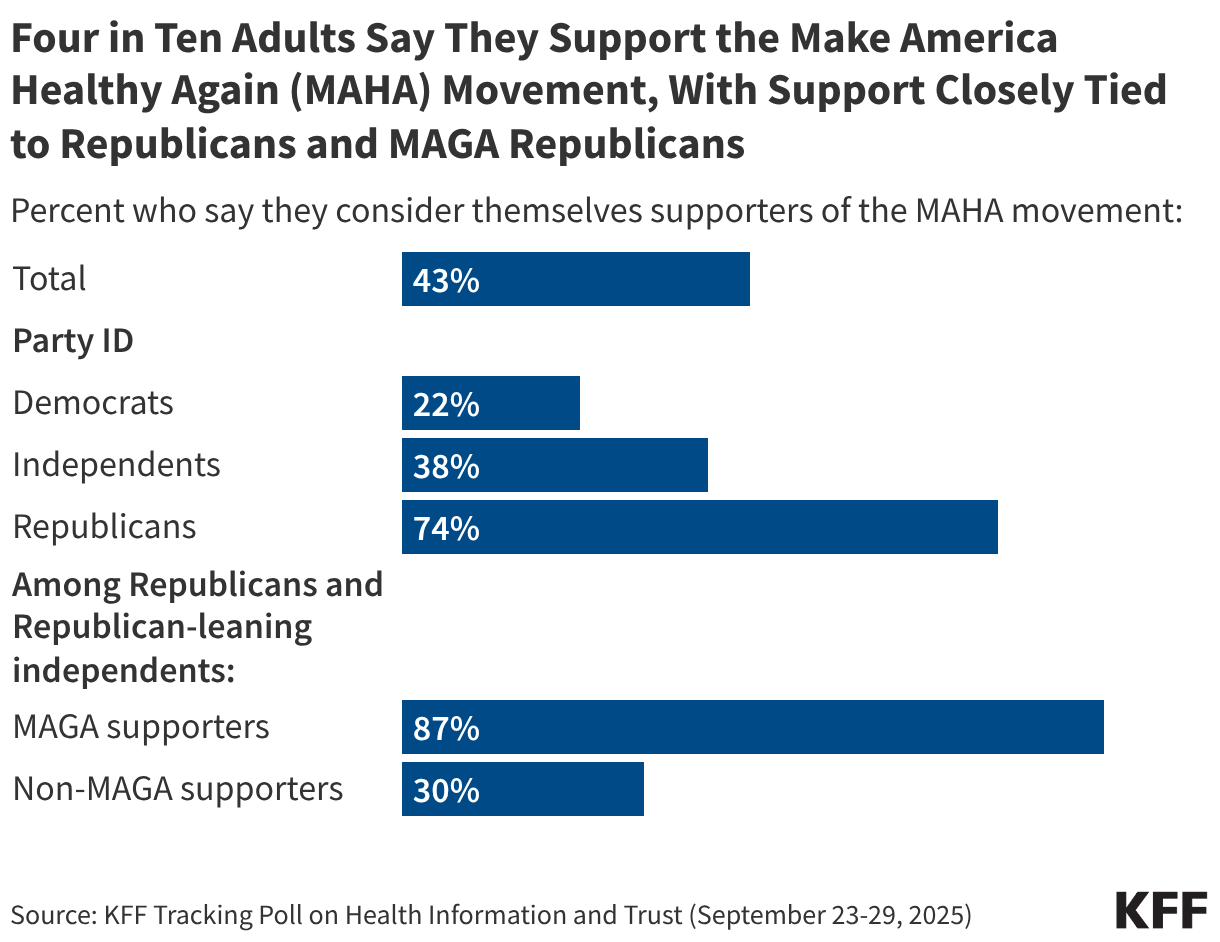
  • With the Trump administration recently announcing several high-profile prescription drug pricing deals, the latest polling from KFF suggests that few think it is likely the Trump administration’s actions will lower their prescription drug costs, but his base remains more positive. Large majorities of Republicans (73%) and MAGA-supporting Republicans (83%) say they think it is either very or somewhat likely that the administration will lower prescription drug costs for people like them, while far fewer independents (33%) or Democrats (9%) say the same.
  • One area where the Trump administration is aiming to reduce costs is for GLP-1 agonists – a class of drugs that includes brand names like Ozempic and Wegovy often used for weight loss and the treatment of diabetes and other chronic conditions. One in five (18%) adults now report having ever taken a GLP-1 agonist, including 12% who say they are currently taking this type of medication (a 6 percentage point increase from 18 months ago). Even though most GLP-1 users say their insurance covered at least some of the cost, over half (56%) of users say these drugs were difficult to afford, including one in four who say they were “very difficult” to afford. About a quarter (27%) of GLP-1 users report having insurance but paying the whole cost of the medication themselves.
  • Nearly half of people who say they have been diagnosed with diabetes (45%) report currently using a GLP-1 medication, as do three in ten (29%) adults who say they’ve been diagnosed with heart disease and about a quarter (23%) of those who report being diagnosed as overweight or obese in the past five years. Across age groups, current GLP-1 use is highest among those ages 50-64 (22%) when compared to younger and older adults. Among adults 65 and older, 9% say they’re currently using these drugs – likely a reflection of Medicare’s lack of coverage for drugs specifically used for weight loss.
  • With GLP-1 drugs widely available via direct-to-consumer websites and, increasingly, directly from drug manufacturers, most adults who have taken these medications say they got them from their primary health care provider or a specialist (76%), while about one in six (17%) report getting them from an online provider or website. Fewer say they got a GLP-1 from a medical spa or aesthetic medical center (9%).

Affordability of Prescription Drugs and Views on Trump Administration Actions

President Trump has recently announced several administrative actions aimed at tackling the issue of prescription drug costs. The latest KFF Health Tracking Poll – fielded prior to Trump’s most recent announcement related to cost and coverage of GLP-1 drugs – finds prescription drug costs remain a problem for many Americans, but few think it is likely that the Trump administration will lower their drug costs.

Overall, about one in four (26%) adults say they or someone living with them had problems paying for prescription drugs in the past 12 months, rising to four in ten (41%) among uninsured adults and about one-third among Hispanic adults (33%), Black adults (32%), and those with annual household incomes below $40,000 (33%).

A Quarter of the Public Report Experiencing Problems Paying For Prescription Drugs, Including Larger Shares of Uninsured Adults, Black and Hispanic Adults

In the past month, President Trump has announced several prescription drug pricing deals between his administration and different drugmakers, including deals with Pfizer and AstraZeneca related to what they charge state Medicaid programs for some of their drugs, and a subsequent deal with a maker of in vitro fertilization (IVF) drugs aimed at lowering the cost of these treatments. Alongside these deals, the administration announced the upcoming launch of TrumpRx, a website where the public could go to buy prescription drugs directly from manufacturers without using their health insurance. After this survey was fielded, the Trump administration announced additional deals with makers of GLP-1 weight loss drugs to lower their cost and expand coverage in some instances.

Most of the public is unaware of the Trump administration’s recent prescription drug announcements, with less than a third saying they’ve read or heard “a lot” or “some” about President Trump’s deals to lower the cost of certain drugs for state Medicaid programs (30%), efforts to reduce the cost of some IVF drugs (24%), or the planned TrumpRx website (20%). Public awareness of the launch of TrumpRx is particularly low, with most adults (59%) saying they’ve heard “nothing at all” about this.

Republicans are more likely than Democrats to say they’ve heard at least some about the administration’s recent deals with pharmaceutical companies to lower the cost of some prescription drugs for Medicaid (44% v. 22%) and efforts to reduce the cost of some drugs for IVF treatment (30% v. 19%), but similar shares across partisans say they’ve heard about TrumpRx.

Few Adults Have Heard Much About the Trump
Administration's Recent Announcements on Prescription Drug Costs, TrumpRx, or IVF Treatment

Overall, a majority (62%) of adults say it is either “not too” or “not at all likely” that the Trump administration’s policies will lower prescription drug costs for people like them, while about four in ten (38%) say they think it is “very” or “somewhat likely.”

These expectations are largely driven by partisanship, with large majorities of Republicans (73%) and MAGA-supporting Republican and Republican leaning independents (83%) saying it is likely the administration will lower drug costs for people like them. Comparably, much smaller shares of independents (33%) or Democrats (9%) say they think the administration will lower their prescription drug costs.

Most of the Public Thinks It Is Unlikely the Trump Administration Will Lower Their Prescription Drug Costs, But Views Are Largely Partisan

About half (49%) of adults ages 65 and older with Medicare say they think it is likely that the Trump administration will lower their prescription drug costs, compared to smaller shares of adults under age 65 with employer-sponsored insurance (34%) or Medicaid (32%). About four in ten (38%) adults under age 65 who purchase their own insurance say they think it is likely the administration will lower their drug costs.

Use, Access and Affordability of GLP-1 Drugs

KFF’s latest Health Tracking Poll provides an update to last year’s poll measuring public use of GLP-1 agonists, a group of prescription drugs including name brands like Ozempic, Wegovy, Zepbound and others commonly prescribed for weight loss, the treatment of diabetes, reduction of cardiovascular disease risk, and some other chronic conditions1.

Overall, nearly one in five (18%) adults now say they have ever used GLP-1 agonist drugs either to lose weight or treat a chronic condition, including 12% who say they are currently using them (an increase of 6 percentage points from May 2024).

Use of GLP-1 drugs is highest among adults who report being diagnosed with conditions these drugs are prescribed to treat, including those who have ever been told by a doctor that they have diabetes (57% ever used, including 45% currently using), heart disease (40% ever, 29% currently), and those that have been told by a doctor that they are overweight or obese in the past five years (34% ever, 23% currently).

Across age groups, current GLP-1 use is highest among those who are between the ages of 50 and 64 (22%), with smaller shares of those ages 18-29 (4%), 30-49 (11%), or over age 65 (9%) saying they are currently using these drugs. Women are more likely than men to report using GLP-1 drugs while there are not significant differences in use across race and ethnicity. Use of these drugs is much higher among adults who are currently covered by health insurance compared to those who are uninsured (12% v. 4%).

One in Eight Adults Report Currently Using GLP-1 Drugs, Including Much Larger Shares of Those with Conditions These Drugs Are Prescribed For

Who are GLP-1 Users?

Among the 18% of adults who report having ever used GLP-1 drugs, the vast majority (84%) say they have been diagnosed with at least one of the predominant conditions these drugs are prescribed to treat, including obesity or being overweight in the past five years (77%), or ever being diagnosed with diabetes (49%) or heart disease (21%). Conversely, 15% of GLP-1 users say they have not been diagnosed with any of these conditions by a medical provider.

Among adults who have ever used GLP-1 drugs, the 15% who say they have not been diagnosed with diabetes, heart disease or as overweight or obese may nonetheless have taken these drugs for treatment of other chronic conditions that these drugs are approved for, such as certain types of liver disease or sleep apnea.

The Vast Majority of Adults Who Have Used GLP-1 Drugs Say They Have Been Diagnosed With Diabetes, Heart Disease, or as Overweight or Obese

Looking at the 18% of adults who have ever used GLP-1 agonist drugs, most report using them to treat a chronic condition, while a smaller share say they used them solely to lose weight. Among adults who have used these drugs, seven in ten say they used them primarily to treat a chronic condition like diabetes or heart disease (38%) or to both treat a chronic condition and lose weight (32%), while three in ten GLP-1 users (30%) report using these drugs primarily to lose weight.

Seven in Ten Adults Who Have Used GLP-1 Medications Said They Took the Drugs, At Least in Part, to Treat a Chronic Condition Like Diabetes or Heart Disease

When looking at the public overall, 12% of all adults report ever taking these drugs at least in part to treat a chronic condition, including 7% of the public who say they took them primarily to treat a chronic condition and 6% who say they took these drugs to both treat a chronic condition and to lose weight. Overall, 5% of U.S. adults say they have taken these drugs primarily to lose weight.

Adults ages 30 to 49 and 50 to 64 are more likely than those under age 30 and older than 64 to report ever using these drugs primarily to lose weight. Lower GLP-1 use among adults ages 65 and older, including for weight loss, may reflect Medicare’s lack of coverage for prescription drugs used specifically for weight loss. In the past week, however, the Trump administration announced that some adults with Medicare will now be eligible for GLP-1 drugs as part of a pilot program, following a deal with drugmakers.

Across Age Groups, GLP-1 Use for Weight Loss is Highest Among Adults Ages 30 to 49 and 50 to 64

GLP-1 drugs have become widely available via online telehealth platforms, and in some cases, can be purchased directly from pharmaceutical companies’ websites where the public can buy these drugs without using their insurance. Compounded versions of these drugs that have not been vetted by the FDA are also available to consumers, even as the FDA recently called for an end to their sale and production.

Most adults who have taken GLP-1 drugs say they got them from their primary care doctor or specialist (76%), while about one in six (17%) say they got them from an online provider or website, and one in ten (9%) report getting them from a medical spa or aesthetic medical center.

Most Adults Who Have Taken GLP-1 Medications Say They Got Them from Their Primary Health Care Provider, About One in Six Say They Got Them Online

Most adults (70%) who have taken GLP-1 drugs say their insurance covered at least a part of the cost of these drugs, including about half (48%) who say their insurance covered part of the cost of these drugs and about one in five (22%) who say their insurance covered all of the cost.

About one in four (27%) GLP-1 users report having health insurance but say they paid the full cost themselves. The list prices for these drugs average about $1,000 per month in U.S; however, in the past week, President Trump announced deals with makers of GLP-1 drugs to offer their drugs at cheaper prices directly to consumers. In addition, the administration announced expanded coverage of these drugs for some people with Medicare and Medicaid as part of a pilot program. Health insurance coverage of GLP-1 drugs varies widely and may be more limited for those looking to take the drugs solely for weight loss2.

Most GLP-1 Users Say Their Insurance Covered At Least Part of the Cost, About One in Four Say They Paid the Full Cost Themselves

Even with health insurance covering at least part of the cost of GLP-1 medication for most users, many report difficulty affording them. Just over half (56%) of GLP-1 users – including 55% of those with health insurance – say it was difficult to afford these drugs, including one in four who say it was “very difficult.”

About Half of Adults Who Have Used GLP-1 Medications Say They Were Difficult to Afford, including a Quarter Who Say It Was Very Difficult

The cost of the medications as well as side effects are the most common reason given for discontinuing GLP-1 use. About one in seven adults who have ever used GLP-1 medications say they are no longer using these drugs because of the cost (14%), similar to the share who report no longer taking the medications because of side effects (13%). A smaller share of adults who have ever used these drugs say they stopped taking them because their condition improved (5%).

Cost and Side Effects Are the Most Commonly Cited Reasons for Stopping GLP-1 Medications

Public Interest in Using GLP-1 Drugs for Weight Loss

Beyond the share who have used these drugs, much of the public has encountered GLP-1 drugs, with about four in ten (37%) adults saying they have a close friend or family member who is using one to either lose weight or treat a chronic condition.

Overall, about one in five (22%) adults who are not currently taking GLP-1 drugs (88% of the public) say they would be interested in taking a GLP-1 drug to lose weight, including just 7% who say they would be “very interested.” This rises to four in ten (43%) among adults who are not currently taking a GLP-1 but report being diagnosed as overweight or obese in the past five years, and about one in four (27%) among those who say they have been diagnosed with diabetes or heart disease. Among adults who are not currently taking a GLP-1 medication, women are more likely than men to say they would be at least somewhat interested in taking these drugs to lose weight (27% v. 18%).

One in Five Adults Who Aren’t Using GLP-1 Drugs Say They Are Interested in Taking One for Weight Loss, Including Four in Ten Adults Diagnosed as Overweight/Obese


Source link

Understanding Various Measures to Assess Hospital Finances: A Cheat Sheet


rewrite this content and keep HTML tags

Profit margins are the most common measure of financial performance. They can be positive (if the hospital earns a profit) or negative (if the hospital loses money). Reported margins vary depending on the measure used, how the measure is calculated, the data, accounting decisions, and how data are summarized (e.g., averages vs medians). Several other measures are also useful for understanding a hospital’s financial position, such as days cash on hand. Comparing measures across hospitals can be difficult due to a lack of standardized reporting requirements. Explore more key facts about hospitals and their finances.


Source link

What can you do if you’re feeling Marketplace sticker shock?


rewrite this content and keep HTML tags

If you’ve looked at your 2026 Marketplace health insurance options and you’re feeling sticker shock because you’re seeing significantly larger premiums, don’t panic just yet. Here’s what you need to know as open enrollment for 2026 health coverage gets underway.

Who’s experiencing Marketplace sticker shock?

For the 93% of Marketplace (exchange) enrollees who are receiving premium subsidies (premium tax credits) for 2025 coverage, the after-subsidy premium for the benchmark (second-lowest-cost Silver) plan is projected to increase by 114% in 2026, unless Congress takes action to extend the subsidy enhancements that are scheduled to expire at the end of 2025.

For the 7% of Marketplace enrollees who don’t get subsidies – plus anyone who buys ACA-compliant individual market coverage outside the exchange – full-price (unsubsidized) premiums are increasing by an average of 26%, although this will vary considerably from one policy to another.

There are more than 23 million people with Marketplace coverage, and given the average rate increases, most of them could be experiencing some degree of sticker shock when they look at their 2026 premiums.

Here are five steps you can take to better understand changes in Marketplace insurance costs and take action during open enrollment.

1. Review the available plans. (Those won’t change.)

Insurers have finalized and received regulatory approval for the individual-market plans that are available in each state’s Marketplace for 2026. So although after-subsidy premiums could change if Congress takes action to extend or modify the subsidy enhancements, the coverage details of the available plans will not change.

That means you can take some time now to review details like deductibles, out-of-pocket maximums, covered drug lists, and provider networks, to get an idea of what your coverage options are for 2026. Your current plan might not be available for 2026, or there might be new plans available in your area, depending on where you live. And even in areas where plans continue to be offered by the same insurers that offered them in 2025, there could be changes in the coverage specifics.

2. Understand your income as a percentage of the federal poverty level (FPL)

Your eligibility for 2026 Marketplace premium subsidies is based on how your projected 2026 household income compares to the 2025 federal poverty level. (Note that these numbers are higher in Alaska and Hawaii.)

Here’s how household income (MAGI) is calculated under the ACA.

Unless Congress extends the subsidy enhancements, enrollees will no longer be eligible for premium subsidies in 2026 if their 2026 household income is more than 400% of the 2025 FPL. If you’re in the continental United States, here’s what 400% of FPL amounts to in annual income, for 2026 coverage:

  • Household of one: $62,600
  • Household of two: $84,600
  • Household of three: $106,600
  • Household of four: $128,600
  • Household of five: $150,600
  • Household of six: $172,600

This is why – unless Congress extends the subsidy enhancements – you’ll see no subsidy at all in the Marketplace if your projected household income is above those amounts. (If you’re in Massachusetts, New Jersey, or New Mexico, you may still see some subsidies, as those states have state-funded subsidies that extend to enrollees with incomes above 400% of FPL.)

3. Understand how HSA contributions can affect your MAGI

Consider a 60-year-old living in Atlanta, earning $63,000. (Here’s how ACA-specific modified adjusted gross income, or MAGI, is calculated.) At that income level, they’re just a little above 400% of FPL, which means they won’t qualify for any subsidy at all in 2026 if Congress doesn’t extend the subsidy enhancements. In that case, the lowest-cost plan available to this person will cost $1,079/month in premiums in 2026, which amounts to more than 20% of their household income.

But that lowest-cost option is a Bronze plan, and all Bronze Marketplace plans will allow enrollees to contribute to a health savings account (HSA) in 2026. So if this person enrolls in that Bronze plan, opens an HSA, and contributes just $1,000 to the HSA in 2026, that would bring their household income down to $62,000, which is just a little under 400% of FPL.

That would allow them to avoid the “subsidy cliff,” and would make them eligible for a significant subsidy. Their after-subsidy premium for that lowest-cost plan will drop to just $262/month – simply because they enrolled in an HSA-eligible plan, opted to contribute $1,000 to an HSA, and thus reduced their MAGI by $1,000.

That $1,000 HSA contribution (which is still their own money, and available at any time to pay for medical expenses on a pre-tax basis) results in them qualifying for a subsidy of $817/month, which covers the majority of the cost of their coverage.

This is just one example, and the specifics will vary depending on where you live, how old you are, how much you earn, and how much you’re able to contribute to an HSA. The maximum allowable HSA contribution for 2026 is $4,400 if you have self-only coverage, and $8,750 if your HSA-eligible health plan also covers at least one additional family member.

We recommend that you speak with a tax advisor if you’re considering this strategy, as there are tax ramifications when you make adjustments to your income. You should be aware of all of them before making any financial decisions.

4. Update your Marketplace account

Now is a good time to make sure your Marketplace account is up to date. If there have been any changes in your household or your income since the last time you updated your Marketplace account, be sure to report those changes to the Marketplace.

It’s particularly important to project your income as accurately as possible for 2026, and keep the Marketplace updated if you realize mid-year that your income projection wasn’t correct. This is because 2026 will be the first year when there’s no cap on how much excess advance premium tax credit (APTC) has to be repaid to the IRS.

If you underestimate your income and then end up earning more than you projected, there will be no limit on how much excess APTC you have to repay to the IRS when you file your taxes in early 2027.

5. Remember the Dec. 15 deadline (in most states) and stay tuned for updates

You have until at least December 15 (or later in some states) to pick a Marketplace plan that will take effect on January 1, 2026. So if you’re experiencing sticker shock when you see the prices that are currently displayed for 2026 coverage, you have a couple of options:

You can select a plan now, based on the prices that reflect the expiration of the subsidy enhancements.

If you do this, stay tuned for updates about the subsidy enhancements. If Congress later extends the subsidy enhancements or extends a modified version of them during open enrollment, you’ll have the option to pick a different plan if that’s your preference. The last plan you pick will take effect January 1, as long as you make the plan selection by December 15 (or the deadline in your state).

You can hold off on picking a plan for now, and stay tuned for updates regarding the federal subsidy enhancements.

If you decide to delay enrollment in the hopes that the subsidy enhancements will be extended by Congress, be sure to set a calendar reminder to enroll in a plan before December 15. If you don’t, your current Marketplace coverage will be auto-renewed. (If you’re currently uninsured, you’ll continue to be uninsured in January.) But actively selecting your own plan is generally a better option than relying on auto-renewal.

Louise Norris is an individual health insurance broker who has been writing about health insurance and health reform since 2006. She has written hundreds of opinions and educational pieces about the Affordable Care Act for healthinsurance.org.


Source link

How Do Enrollees with Private Health Insurance Use Remote Monitoring Technologies?


rewrite this content and keep HTML tags

This Healthy System Tracker analysis, authored by KFF and the Peterson Center on Healthcare, examines remote monitoring technologies, identifying the types of patients and health conditions they serve and what is spent on these services. There are an estimated 300,000 adults with employer-sponsored health coverage for whom insurers received at least one remote monitoring claim in 2023.

Among adults under 65 with private health insurance, older people and women are most likely to use remote monitoring. These services are mostly used for people with hypertension and other circulatory diseases, and musculoskeletal conditions. The median cost of remote monitoring varies, ranging from $55 a month ($12 out of pocket) for a clinician to monitor physical data, such as blood pressure, to $78 a month ($21 out of pocket) for a provider to monitor self-reported data, such as pain.

The full analysis and other data on health costs are available on the Peterson-KFF Health System Tracker, an online information hub dedicated to monitoring and assessing the performance of the U.S. health system.


Source link