Home Blog Page 6

How Does the Quality of the U.S. Health System Compare to Other Countries?


rewrite this content and keep HTML tags

This chart collection compares the United States and other similarly large and wealthy nations across various measures of care quality to show how the U.S. stacks up against its peers and how that has changed over time.

Generally, the U.S. performs worse in long-term health outcomes measures (such as life expectancy), certain treatment outcomes (such as maternal mortality and congestive heart failure hospital admissions), some patient safety measures (such as obstetric trauma with instrument), and health system capacity (such as rate of general practitioners). The U.S. performs similarly to or better than peer nations in other measures of treatment outcomes (such as mortality rates within 30 days of acute hospital treatment) and some patient safety measures (such as post-operative complications).

The chart collection is part of the Peterson-KFF Health System Tracker, an online information hub dedicated to monitoring and assessing the performance of the U.S. health system.


Source link

More Than 3 in 4 ACA Marketplace Enrollees Live in States Won by President Trump in 2024


rewrite this content and keep HTML tags

Enhanced advance premium tax credits, first signed into law as part of the American Rescue Plan in 2021, increased the amount that enrollees in the Affordable Care Act (ACA) marketplaces receive in federal subsidies to pay for monthly health insurance premiums. These enhanced tax credits benefit low- and middle-income individuals who do not receive health insurance through an employer or other government program, including many small business owners and employees, farmers and ranchers, and people who are self-employed.

States won by Trump in 2024 have received more ACA premium tax credits, and had more enrollment growth, since the subsidies were expanded. This year, 18.7 million (77%) of the total 24.3 million ACA Marketplace enrollees live in states President Trump won in the 2024 election.

Since the enhanced premium tax credits were introduced, the number of people who receive health coverage through the ACA Marketplaces has more than doubled, and more than half (55%) of the national growth comes from Texas, Florida, Georgia, and North Carolina. In six states (Texas, Louisiana, Mississippi, Tennessee, Georgia and West Virginia), enrollment has more than tripled in five years.

Nationwide, 93% of ACA Marketplace enrollees received premium tax credits in 2025, but enrollees living in states won by President Trump in 2024 were even more likely to have subsidized coverage. In Florida, West Virginia, and Alabama, 98% of people enrolled in Marketplace coverage received federal financial premium assistance, and 99% do in Mississippi.

Additionally, 80% of all premium tax credits ($115 billion) went to ACA Marketplace enrollees in Trump-won states.

Growth in ACA Individual Marketplace Enrollment, 2020-2025


Source link

KFF Health Tracking Poll: Public Weighs Political Consequences of Health Policy Legislation


rewrite this content and keep HTML tags

Key Takeaways

  • As Congress debates federal health care spending as part of spending bill negotiations, including extending the enhanced premium tax credits, the latest KFF Health Tracking Poll finds three-quarters (78%) of adults say Congress should extend the enhanced tax credits for people who buy their own insurance through the ACA Marketplace. This is more than three times the share of the public (22%) who say Congress should let the credits expire. Notably, majorities across political party want Congress to extend the tax credits including nine in ten (92%) Democrats, eight in ten (82%) independents, and six in ten (59%) Republicans. A majority of Republicans who align with the MAGA movement (57%) also say Congress should extend these subsidies.
  • Both parties could face political fallout if the enhanced tax credits are not extended, though the public says they will place most of the blame on those currently in charge. About four in ten (39%) adults who want to see the tax credits extended say that if Congress does not extend these enhanced tax credits, President Trump deserves most of the blame, while another four in ten (37%) say the same about Republicans in Congress. About two in ten (22%) say that Democrats in Congress deserve most of the blame. Democrats are most likely to place blame on President Trump (56%) followed by Republicans in Congress (42%), while six in ten Republicans (61%) say they would place the blame on Democrats in Congress. Among those who buy their own coverage (nearly half of whom identify as Republican or Republican-leaning), Republicans in Congress and President Trump receive the majority of the blame (42% and 37%, respectively). 
  • Seven in ten adults who buy their own health insurance say that if the amount they paid for health insurance each month nearly doubled, they could not pay the higher premiums without significantly disrupting their household finances. In addition, four in ten (42%) say they would go without health insurance coverage if the amount they had to pay for health insurance each month nearly doubled. About a third (37%) say they would continue to pay for their current health insurance, while two in ten (22%) would get insurance from another source, like an employer or a spouse’s employer.
  • Majorities across partisanship also report that they would be concerned if they heard about something of the outcomes for both letting the tax credits expire, as well as if Congress extended the tax cuts – granted to a lesser degree. Majorities say they would be concerned if they heard that health insurance would be unaffordable for many people who buy their own coverage (86%), that 4 million people would lose their health insurance coverage (86%), or if they heard that people who work at small businesses or are self-employed would be directly impacted (85%). On the other side, if Congress does extend these enhanced tax credits, two-thirds of the public (63%) say they would be concerned if they heard that it would require significant federal spending that would be largely paid for by taxpayers.
  • Three months after the passing of the tax and budget legislation, the bill still remains largely unfavorable among the public overall – lagging far behind both the Affordable Care Act and the ACA Marketplaces in overall popularity. Many are still unsure of how the legislation will impact them personally but four in ten (43%) think it’s most likely to hurt them and their families.

Public Still Largely Unaware That ACA Enhanced Tax Credits Are Expiring, Strong Support for Congress Extending Them

On October 1st the U.S. federal government shut down as Congress was unable to pass a stopgap spending bill. As part of the discussions around the federal budget, Democrats are seeking to include the extension of the enhanced premium tax credits (ePTCs) for people who purchase their own health insurance through the ACA Marketplace that are set to expire at the end of the year.

About six in ten adults say they have heard “a little” (30%) or “nothing at all” (31%) about the expiring ACA subsidies, showing widespread lack of information on the cost of coverage for over 24 million people in the U.S.  Four in ten say (39%) they’ve heard “a lot” or “some” – up from 27% in June of this year. Even among the group whose cost of coverage is expected to double next year – those who purchase their own insurance plans – about six in ten (58%) say they have heard just “a little” or “nothing at all” about the expiration of tax credits for people who self-purchased insurance.

Democrats seem to be more aware of the pending expiration, with about half of Democrats (50%) saying they have heard at least “some” about this, compared to about a third of independents (35%) and Republicans (34%).

Most Adults Have Heard Little or Nothing About the Enhanced Subsidies for Those Who Purchase Coverage on ACA Marketplaces

Once the public is told that the expiration date for subsidies is looming, about three-quarters (78%) of adults say Congress should extend the enhanced tax credits for people who buy their own insurance through the ACA Marketplace, more than three times the share (22%) who say Congress should let the credits expire. Over eight in ten (84%) of those who buy their own insurance say that Congress should extend the enhanced tax credits.

Although Republicans are more likely than Democrats and independents to say that Congress should let the credits expire, majorities across political party want Congress to extend the tax credits including nine in ten (92%) Democrats, eight in ten (82%) independents, and six in ten (59%) Republicans, including 57% of Republicans who align with the MAGA movement. 

Eight in Ten Adults Support Extending Enhanced Tax Credits for ACA Marketplace Coverage, Including Most of Those With Self-Purchased Insurance

Previous KFF polling has shown that attitudes towards the credits shift slightly after hearing counterarguments both for and against the extension of the credits. This month’s poll shows that large majorities of the public, including majorities of Democrats, independents, Republicans, and MAGA supporters are concerned about many of the potential consequences of letting these enhanced tax credits expire. Additionally, majorities of independents and Republicans and about half of Democrats are concerned about the consequences for extending them.

More than eight in ten adults say they would be concerned, including at least half who say they would be “very concerned,” if they heard that health insurance would be unaffordable for many people who buy their own coverage (86%), that 4 million people would lose their health insurance coverage (86%), or if they heard that people who work at small businesses or are self-employed would be directly impacted (85%).

Overwhelming Majorities Would Be Concerned About Impacts of Letting ACA Marketplace Tax Credits Expire

Concern over the possible consequences is high across party lines with large majorities of Democrats and independents saying they would be concerned about each of these potential outcomes, as well as three-quarters of Republicans and MAGA supporters.

Majorities Across Partisanship Would Be Very or Somewhat Concerned About Impacts of Letting ACA Marketplace Tax Credits Expire

On the other side, if Congress does extend these enhanced tax credits, two-thirds (63%) of the public say they would be concerned if they heard that it would require significant federal spending that would be largely paid for by taxpayers, including a quarter (27%) who would be “very concerned.” This is predictably divided along partisan lines. More than eight in ten (83%) Republicans say they would be concerned about federal spending, but notably so do more than six in ten independents (61%) and nearly half of Democrats (49%). Republicans who support the MAGA movement are among the most worried about this issue, with almost half (47%) saying they would be “very concerned.”  

Majorities Express Concern About Federal Spending if ACA Marketplace Tax Credits Are Extended

The poll finds more people say they would blame President Trump or Republicans in Congress than Democrats if tax credits are not extended. About four in ten (39%) adults who want to see the tax credits extended say that if Congress does not extend these enhanced tax credits, President Trump deserves most of the blame, while another four in ten (37%) say the same about Republicans in Congress. About two in ten (22%) say that Democrats in Congress deserve most of the blame, driven heavily by Republicans. Six in ten (61%) Republicans who want to see the tax credits extended say they would blame Democrats in Congress, including seven in ten MAGA Republicans, compared to one in six (17%) independents.

Over half of Democrats (56%) who want to see the tax credits extended say that if they are not extended, President Trump deserves most of the blame, though four in ten (42%) blame Republicans in Congress. Independents are largely split, with about four in ten saying they will blame Republicans in Congress (42%) or President Trump (39%).

Adults who purchased their own insurance, most of whom do so through the ACA Marketplace, are similarly split, with four in ten (42%) placing the blame if Congress does not extend the enhanced tax credits on Republicans in Congress and four in ten (37%) on President Trump. Two in ten (21%) of this group would blame Democrats in Congress if the subsidies expire. Notably, a previous KFF poll found that nearly half of adults enrolled in ACA Marketplace plans identify as Republican or lean Republican.

Adults Who Support Expanding Tax Credits Are Split on Who To Blame if They Expire, Though Most Blame Trump or Republicans in Congress

Marketplace Enrollees Unsure How to Afford Coverage if Enhanced Tax Credits Expire

Six in ten adults who buy their own health insurance coverage think the cost of their personal health insurance would increase at least “some” if the tax credits are not extended, while about a quarter say they think it will increase “a little” (24%), or that their costs won’t increase at all (15%). Estimates are that the amount enrollees pay for premiums for ACA Marketplace plans will more than double on average and nearly 4 million people could eventually be uninsured. Notably, more than half of adults with Medicaid (54%) also say they think that if the enhanced tax credits expire the cost of their own coverage will also increase at least “some,” as do about four in ten people with Medicare age 65 and older and about half of people with employer-sponsored insurance.  It is important to note that the expiration of enhanced tax credits only directly impact people who buy their own coverage on the ACA Marketplace.

Six in Ten Who Buy Their Own Insurance Say Costs Will Increase by at Least Some if the ACA Marketplace Tax Credits Expire

Among those who have insurance through the ACA Marketplace, seven in ten say that if the amount they paid for health insurance each month nearly doubled, they could not pay the higher premiums without significantly disrupting their household finances. Just three in ten estimate that they could pay the higher premiums.

Seven in Ten With Self-Purchased Insurance Coverage Could Not Continue To Pay if Their Premiums Doubled, Without Disrupting Household Finances

About four in ten (42%) Marketplace enrollees say they would go without health insurance coverage if the amount they had to pay for health insurance each month nearly doubled. Just over a third (37%) say they would continue to pay for their current health insurance, while about a quarter (22%) would get insurance from another source, like an employer or a spouse’s employer.

Four in Ten With Self-Purchased Insurance Would Go Without Insurance if Their Monthly Costs Doubled

Public Views of Major Health Care Legislation

On July 4, 2025, President Trump signed a sweeping legislative package known as the “Big Beautiful Bill,” that included significant changes to the country’s Medicaid program and the Affordable Care Act (ACA) Marketplaces. The package, which passed on a party-line vote, with no Democrats in favor, has been described as the biggest rollback of the country’s health care programs in modern history. Now, as part of federal budget negotiations, Democrats in Congress, are seeking to minimize some of these health insurance rollbacks. The latest KFF Health Tracking Poll shows both parties are playing to their bases, with Republicans strongly supporting the “Big Beautiful Bill” (BBB) legislation and Democrats largely opposed.

Overall, about four in ten (38%) adults hold favorable views of the tax and budget legislation passed earlier this year, including three-quarters of Republicans (75%) and eight in ten (82%) Republicans or Republican-leaning independents who support the MAGA movement. Democrats and independents, on the other hand, largely hold unfavorable views of the legislation, including nearly nine in ten (88%) Democrats and two-thirds (68%) of independents who say they view the law unfavorably.

Most Republicans and MAGA Supporters View BBB Favorably, While Large Majorities of Democrats and Independents Hold Unfavorable Views

The share of the public who say they have a favorable opinion of the tax and budget legislation has stayed relatively stable, at close to four in ten (38%), similar to 36% in July and 35% in June.

Overall favorability of the 2010 health care law known as the Affordable Care Act (ACA) continues to be at historically high levels, with about two-thirds (64%) of the public viewing the law positively. This is largely driven by Democrats and independents, with over nine in ten (94%) Democrats and two-thirds (64%) of independents viewing the law favorably, while two-thirds (64%) of Republicans have an unfavorable view. Click here to explore more than ten years of polling on the ACA.

Majorities Across Partisans View ACA Marketplaces Favorably

The ACA Marketplaces where people and small businesses can shop for health insurance are even more popular than the ACA itself, with seven in ten (70%) adults having a favorable view. The ACA Marketplaces have consistently been a more popular provision of the ACA, even before Congress passed the American Rescue Plan Act (ARPA) in 2021, which provided temporarily enhanced tax credits to adults who purchased their own health insurance through the Marketplaces. Though views of the ACA Marketplace are divided by partisanship, majorities across party lines view the ACA Marketplace positively, with eight in ten (84%) Democrats, seven in ten (69%) independents, and six in ten (59%) Republicans holding a favorable view. This also includes MAGA Republicans and Republican-leaning independents, among whom over half (56%) hold a favorable opinion of the Marketplace.

Among those who purchase their health care plan themselves, many of whom bought through the ACA Marketplace, seven in ten have a favorable opinion of the ACA health insurance exchanges or Marketplaces.

Majorities Across Demographics View the ACA Marketplaces Favorably

Many Still Unsure How the “Big Beautiful Bill” Will Impact Them

Three months after the passing of President Trump’s major legislative achievement, the “Big Beautiful Bill,” most people remain unaware of how the effects of the tax and budget legislation will impact them. Six in ten adults say they do not have enough information as to how the legislation will impact them personally, while four in ten report that they do have enough information.

Democrats (50%) are more likely than Republicans (36%) and independents (37%) to say they have enough information about how the BBB will impact them personally. About four in ten (41%) Republicans and Republican-leaning independents who identify with the MAGA movement say they have enough information about the impact of the legislation, though majorities (59%) still do not.

The BBB legislation has made changes to the ACA Marketplaces including limiting some eligibility and shortening the open enrollment period. Among those who purchase their own health insurance, two-thirds (63%) say they do not have enough information about how the legislation will impact them. 

At Least Half Across Demographics Say They Do Not Have Enough Information on Personal Impact of the “Big Beautiful Bill”

While many say they don’t have enough information about how the tax and budget legislation will affect them, partisanship once again plays a major role in public perception of the law’s impact. About four in ten (43%) say the recent legislation will generally hurt them and their families, which is twice the share who say the legislation will generally help them. More than a third of the public (36%) say the law won’t make a difference to them and their families.

Two-thirds (68%) of Democrats say the tax and budget legislation will generally hurt them and their families, as do about half (48%) of independents. Republicans are split between thinking the law will help them and thinking it won’t make a difference, with similar shares saying the law will help them and their families (43%) and saying they don’t think the law will make a difference for them (46%). Nearly half of Republicans and leaners who support the MAGA movement say the law will help them (48%) while four in ten say it won’t make a difference for them. Very few MAGA supporters (11%) say the law will hurt them.

Among those who purchase their own insurance, many through the ACA Marketplace, four in ten (42%) expect the legislation will generally hurt them and their family, while similar share (37%) expects it to not make much of a difference and just one in five (19%) say it will help.

About Four in Ten Say the Recent Tax and Budget Legislation Will Hurt Them, Driven Largely By Democrats


Source link

Employer-Sponsored Health Insurance 101 | KFF


rewrite this content and keep HTML tags

Workers contribute to health insurance in two ways. First, through a premium contribution, which is typically deducted from an employee’s paycheck. Then, secondly, through cost-sharing such as copays, coinsurance, and/or deductibles, which are paid when the employee utilizes services covered by their plan. While all workers enrolled in the plan must pay their premium (or have it paid by the employer), overall cost sharing is higher for workers who use more services.

Workers with health coverage in 2024, on average, were responsible for 16% of the premium for single coverage and 25% of the premium for family coverage. In dollar terms, the average annual contribution for covered workers was $1,368 for single coverage and $6,296 for family coverage.

Over time, the average premium contribution for covered workers has increased. For example, over the last 10 years, the single coverage average contribution has increased 27% and the family coverage average contribution increased 31%. At the same time, the share of the premium paid by workers has remained relatively consistent. In 2024, covered workers contributed, on average, 16% of the premium for single coverage and 25% of the premium for family coverage, which was similar to these averages a decade ago. This is because as premiums have increased over time, both employers and employees have faced similar increases on average.

There remains a lot of variation in how much workers are required to contribute to their health plan across firms, particularly within firm size. In 2024, 37% of covered workers at small firms were enrolled in a plan where the employer paid the entire premium for single coverage. This was only the case for 5% of covered workers at large firms. However, 26% of covered workers at small firms were in a plan where they must contribute more than half of the premium for family coverage, compared to 6% of covered workers at large firms. The family average contribution rate for covered workers in firms with fewer than 200 employees was 33%, which is higher than the average contribution rate of 23% for covered workers in larger firms. Small firms often approach the cost of health insurance differently than large firms, sometimes making the same employer contribution regardless of whether the employee enrolls any dependents. Similarly, some large employers encourage spouses and dependents to enroll in other plans, if they have access, through spousal surcharges.

Distribution of Percentage of Premium Paid by Covered Workers for Single and Family Coverage, by Firm Size, 2024

In addition to any required premium contributions, most covered workers must pay a share of the cost of the medical services they use. The most common forms of cost-sharing are deductibles (an amount that must be paid before most services are covered by the plan), copayments (fixed dollar amounts), and coinsurance (a percentage of the charge for services). Some plans combine cost sharing forms, such as requiring coinsurance for a service up to a maximum amount or requiring either coinsurance or a copayment for a service, whichever is higher. The type and level of cost sharing may vary with the kind of plan in which the worker is enrolled. Cost sharing may also vary by the type of service, with separate classifications for office visits, hospitalizations, and prescription drugs. Plans often structure their cost sharing to encourage enrollees to reflect on their use, reducing overall utilization.

Among Covered Workers Who Face a Deductible for Single Coverage, Average General Annual Deductible for Single Coverage, by Firm Size, 2006-2024

In recent years, general annual deductibles have grown in prominence in plan design. In 2024, 87% percent of covered workers were enrolled in a health plan that required an enrollee meet a deductible before the plan covered most services. The average deductible amount as of 2024 for workers with single coverage and a general annual deductible was $1,787. On average, covered workers at smaller firms face higher deductibles than those at large firms ($2,434 vs. $1,478). Generally, a substantial share of workers faced relatively high deductibles. Fifty percent of workers at small firms and 26% of workers at large firms had a general annual deductible of $2,000 or more. Over the last five years, the percentage of covered workers with a general annual deductible of $2,000 or more for single coverage has grown from 28% to 32%.

While average deductibles have not grown over the last few years, the growth over the last ten years outpaces the increases in premiums, wages and inflation. The rise in deductible costs has focused attention on consumerism in health care. Some believe that increasing deductibles will place a greater incentive on enrollees to shop for services, therefore reducing total plan spending. Alternatively, deductibles are less common in Health Maintenance Organization (HMO) plans, which use forms of gatekeeping to dissuade utilization. The growth of deductibles has had important consequences for the financial protection that health insurance provides. A multitude of plans require deductibles well in excess of the financial assets of many of their enrollees. As opposed to coinsurances and copays that accumulate throughout the year, deductible spending may require enrollees to finance relatively high expenses all at once.

Cumulative Increases in Family Coverage Premiums, General Annual Deductibles, Inflation, and Workers' Earnings, 2014-2024

In addition to looking at the average obligations enrollees face under their health plan, we can look at the actual spending incurred by enrollees in large group plans. In 2021, deductibles accounted for more than 58% of an enrollee’s cost-sharing liability, which is significantly greater than 35% of enrollee liability ten years ago.

The amount of cost sharing large group enrollees face varies, particularly around how many health services a person uses. Individuals who have a hospitalization, or a chronic condition which requires ongoing management, often incur higher cost-sharing over the year. For example, large group enrollees faced an average of $779 in cost sharing, but individuals with a diabetes diagnosis (even without complications) incurred costs of $1,585 in 2017.

Distribution of out-of-pocket spending for people with large employer coverage, 2003-2021

While some employer health plans have relatively generous benefits, there remains a concern about affordability, particularly for lower-wage workers who do not have the assets to meet the cost-sharing required under their plan, as well as for individuals enrolling in family coverage at smaller firms. Overall, individuals in families with employer coverage spend 2.4% of their income on the worker contribution required to enroll in an employer-sponsored health plan, and another 1.4% of their income on typical out-of-pocket spending on cost-sharing. Individuals covered by employer-sponsored plans in households at or below 199% of the FPL contribute nearly 10% of their income on average towards their premiums and cost-sharing.

A key component of plan design is the out-of-pocket maximum, which caps the amount of money an enrollee spends on in-network covered benefits within a year.

The ACA requires that almost all plans have an out-of-pocket (OOP) maximum below a federally determined limit. In 2024, 14% of covered workers in plans with an OOP maximum had an OOP maximum of less than $2,000 for single coverage, while 24% of these workers had an OOP maximum above $6,000.


Source link

Health Care Costs and Affordability


rewrite this content and keep HTML tags

Over the last several decades, health spending has been driven higher by a number of factors, including but not limited to an aging population, rising rates of chronic conditions, advancements in medicine and new technologies, higher prices, and expansions of health insurance coverage. While there are always differences across countries, many of these factors driving health costs upward in the U.S. are also driving health costs growth in peer nations. For example, while the U.S. population is indeed aging and that is driving health costs up, many large and wealthy nations have even more rapidly aging populations.

Other factors may explain the United States’ relatively high health spending compared to its peers. The U.S. health system is fragmented, with many private and public payers, and with regulation of these payers split between states and the federal government. However, these features are not entirely unique to the U.S., either. Indeed, some other countries with much lower health spending have multiple private payers or differences in public programs across states or provinces.  The U.S. is also not alone in having a mainly fee-for-service payment system.

The U.S. health insurance system is largely voluntary, whereas peer countries’ health systems are almost entirely compulsory. Additionally, the U.S. federal and state governments have generally done less to directly regulate or negotiate prices paid for medical services or prescription drugs than have governments of similarly large and wealthy nations. The U.S. often pays higher prices for the same brand-name prescription drugs, hospital procedures, and physician care than similarly large and wealthy countries do.

There are other factors, largely outside the control of the health system that are also likely at play, such as socioeconomic conditions (like income inequality and other social determinants of health), and differences in so-called lifestyle factors (like diet, drug use, or physical activity) that could contribute both to higher spending and worse outcomes.

Breaking total national health spending into its components can reveal the major drivers of health costs and where cost containment efforts could be most effective. The charts below show various ways of examining the key contributors to health spending. For example, the National Health Expenditure Accounts show trends in how health spending varies by type of service (e.g., hospital care vs. retail prescription drugs) or by source of funds (e.g., private health plans vs. public programs). An alternative and relatively new approach to understanding health spending is to break out total health spending into the share that goes to treat certain diseases (e.g., heart disease, cancer). Finally, health spending can also be better understood by looking at trends in prices (e.g., the dollar amount for a hospital stay) and utilization (e.g., the number of hospital stays). 

Hospital and Physician Services Represent Half of Total Health Spending

Relative Contributions to Total National Health Expenditures, by Service Type, 2023

Most health spending in the U.S. and in peer countries is on hospital and physician care, followed by prescription drugs. In the U.S., hospital spending represented close to a third (31.2%) of overall health spending in 2023, and physicians/clinics represented 20.1% of total spending. In comparison to other large and wealthy countries, the U.S.’s higher spending on inpatient and outpatient care explains the vast majority of higher spending on health care overall.

Spending Has Grown for Hospitals, Physicians, and Drugs

Average Annual Expenditures Growth Rate for Select Service Types, 1970-2023

During the 1970s, growth in hospital expenditures outpaced other services, while prescriptions and physician and clinic services saw faster spending growth during the 1980s and 1990s. From 2020 to 2023, retail prescription drugs experienced the fastest growth in spending at 8.6%, following 3.3% average annual growth from 2010 to 2020. Average spending growth for hospitals and physicians/clinics between 2020 and 2022 was 6.2% and 6.3%, respectively.

On a Per-Enrollee Basis, Private Insurance Spending Has Typically Grown Much Faster Than Medicare and Medicaid Spending

Cumulative Growth in Per-Enrollee Spending by Private Insurance, Medicare, and Medicaid, 2008-2023

Per enrollee spending by private insurance grew by 80.4% from 2008 to 2023 – much faster than both Medicare and Medicaid spending growth per enrollee (50.3% and 30.3%, respectively). Private insurance often pays higher prices for health care compared to prices paid by Medicare and Medicaid.

Per enrollee spending by Medicaid rose by 7.9% in 2023 from the previous year, and also continued to increase in private insurance and Medicare (5.9% and 7.1% respectively). Medicare and private insurance per-enrollee spending continued to grow faster between 2021 and 2023 after slower growth in 2020. Medicaid per-enrollee spending had previously declined in 2021 as total enrollment grew, particularly among children and non-elderly adults, who generally have lower per-enrollee spending.

A Substantial Share of Health Spending Goes Toward the Treatment of Circulatory and Musculoskeletal Conditions

Distribution of total medical services expenditures, by medical condition, 2021

An alternative way of examining the components of health spending is to use the Bureau of Economic Analysis (BEA)’s Health Care Satellite Account, which estimates spending and price growth by disease category (e.g., cancer, infectious disease). This approach differs from the official categorization of health spending by service type (e.g., provider services). Essentially, the new satellite account redefines the “commodity” in healthcare as the treatment for specific diseases, rather than a hospital stay or a physician visit. BEA researchers found that the largest categories of medical services spending include the treatment of circulatory diseases (10.4% of health spending in 2021), musculoskeletal conditions (9.4%) and infectious diseases (9%). Another large share of health spending (15.1%) is for “ill-defined conditions,” which can include routine check-ups and follow-up care that is not easily designated for a particular illness.

Health Spending is a Function of Prices and Use

Annual Percent Change in Price and Quantity Personal Consumption Expenditure Indexes of Health Services, 1970-2024

Health services spending is generally a function of prices (e.g., the dollar amount charged for a hospital stay) and utilization (e.g., the number of hospital stays).

People and health plans in the U.S. often pay higher prices for the same prescription drugs or hospital procedures than people in other large and wealthy nations do. In terms of utilization, there is not much evidence that people in the U.S. use more health care. In fact, Americans generally have shorter average hospital stays and fewer physician visits per capita. Therefore, a large part of the difference in health spending between the U.S. and its peers can be explained by higher prices, more so than higher utilization.

Over time, within the U.S., prices and utilization have driven health cost growth to varying degrees. In the 1980s and early 1990s, growth in health care prices far exceeded growth in use. Faster growth in health prices in the U.S. during this time drove the divergence in per capita health spending between the U.S. and other large, wealthy OECD countries. While health care prices have grown more moderately in recent decades, prices in the U.S. for health services continue to exceed what other countries pay.

More recently, the COVID-19 pandemic led to fluctuations in health care use. Early in the pandemic, many health services, such as elective surgeries, were postponed or cancelled and many elected to not get care to avoid infections at health care sites. In 2021, health services use increased by 9% from the previous year, but subsequent years showed slightly lower growth rates (2024 health services use increased 5.6% from 2023). This increase in health care use in 2021 followed a sharp decrease in health utilization in 2020. Health care prices increased moderately – between 2 and 3% – between 2020 and 2024, but changing market conditions since the pandemic and policies enacted in 2025 are likely to increase health costs at an increasing rate.


Source link

International Comparison of Health Systems


rewrite this content and keep HTML tags

Wealthy countries, including the U.S., tend to spend more per person on health care and related expenses than lower-income countries. However, even among higher-income countries, the U.S. spends far more per person on health.

Spending Growth

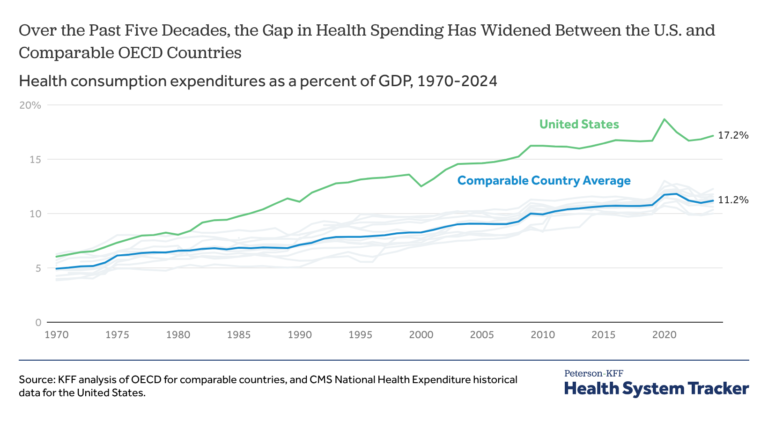
Over the past five decades, the health spending gap between the U.S. and peer nations has widened. In 1970, the U.S. spent about 7% of its GDP on health, which was similar to spending in several comparable countries (the average of comparably wealthy countries was about 5% of GDP in 1970). The U.S. was relatively on pace with other countries until the 1980s, when health spending in the U.S. grew at a significantly faster rate relative to its GDP. 

The United States spends more per capita on total health expenditures, including government spending and household payments. In 2020, the U.S. spent 19.5% of its GDP on health consumption (up from 17.5% in 2019), largely due to the increased spending during the COVID-19 pandemic, along with the economic downturn. By 2023, health spending as a share of GDP had declined to 17.6% in the U.S.—but remains substantially higher than in peer countries.

Drivers of Health Spending

The largest category of health spending in both the U.S. and comparable countries is spending on inpatient and outpatient care, which includes payments to hospitals, clinics, and physicians for services and fees such as primary care or specialist visits, surgical care, provider-administered medications, and facility fees. Americans spent $8,353 per person on inpatient and outpatient care, compared to $3,636 in peer countries, on average. The U.S.’s higher spending on providers is driven more by higher prices than higher utilization of care. Patients in the U.S. have shorter average hospital stays and fewer physician visits per capita, while many hospital procedures have been shown to have higher prices in the U.S. Higher spending on inpatient and outpatient care drives most of the difference in health spending between the U.S. and its peers. In fact, the U.S. spends more on inpatient and outpatient care than most peer nations spend on their entire health systems (including long-term care, prescription drugs, administration, prevention, and other services).

The cost of prescription drugs is another factor that partially explains the U.S.’s higher health spending. Many of the same medications cost more in the U.S. than they do in other comparable nations. In 2022, the U.S. spent $1,765 per capita on prescription drugs and other medical goods (including over-the-counter and clinically delivered pharmaceuticals as well as durable and non-durable medical equipment). However, because prescription drugs represent a relatively small share of total health spending, even if per capita prescription drug spending in the U.S. were closer to that of comparable countries, that would make only a small dent in closing the gap on health spending.

Spending on health administration is similarly much higher in the U.S. than in comparable countries: $1,078.44 per capita. Administrative costs include spending on running governmental health programs and overhead from insurers, but exclude administrative expenditures from health care providers. This includes administrative spending for private health insurance, governmental health programs (such as Medicaid and Medicare), as well as other third-party payers and programs.

The U.S. also spends more per capita on preventive care than peer nations. Activities captured in this spending category vary among countries, but in the U.S., it generally consists of public health activities, including preventive health programs and education for immunizations, disease detection, emergency preparedness, and more. In the U.S., preventive care spending more than doubled between 2019 and 2020, from $343 to $741 per capita, but subsequently declined to $649 by 2022.

Meanwhile, the only category of spending in which the U.S. spends less than most comparable countries on a per-person basis is long-term care. Long-term care spending includes health and social services provided in long-term care institutions such as nursing homes as well as home- and community-based settings. After an increase from 2019 to 2020 at the onset of the COVID-19 pandemic, U.S. spending on long-term care declined by 4.9% between 2020 and 2021 but increased again by 5.4% between 2021 and 2022. Long-term care spending was already lower in the U.S. than in peer countries before the pandemic.


Source link

ACA Marketplace Premium Payments Would More than Double on Average Next Year if Enhanced Premium Tax Credits Expire


rewrite this content and keep HTML tags

Affordable Care Act (ACA) enhanced premium tax credits are set to expire at the end of this year. Enhanced premium tax credits were introduced in 2021 and later extended through the end of 2025 by the Inflation Reduction Act. The enhanced tax credits both increased the amount of financial assistance already eligible ACA Marketplace enrollees received as well as made middle-income enrollees with income above 400% of federal poverty guidelines newly eligible for premium tax credits.

Since the introduction of the enhanced premium tax credits, enrollment in the Marketplace has more than doubled from about 11 to over 24 million people, the vast majority of whom receive an enhanced premium tax credit. If enhanced tax credits expire, many Marketplace enrollees will continue to qualify for a smaller tax credit, while others will lose eligibility altogether and be hit by a “double whammy” of losing their entire tax credit and being on the hook for rising premiums.

Since 2014, the ACA has capped how much subsidized enrollees pay for their health insurance premiums at a certain percent of their income, on a sliding scale, with the federal government covering the remainder in the form of a tax credit. Enhanced tax credits work by further lowering the share of income ACA Marketplace enrollees pay for a plan. For example, with the enhanced tax credits in place, an individual making $28,000 will pay no more than around 1% ($325) of their annual income towards a benchmark plan. If the enhanced tax credits expire, this same individual would pay nearly 6% of their income ($1,562 annually) towards a benchmark plan in 2026. In other words, if the enhanced tax credits expire, this individual would experience an increase of $1,238 in their annual premium payments net of the tax credit.

ACA Marketplace Enrollees Will Pay More for Benchmark Coverage if Enhanced Tax Credits Expire

A previous KFF analysis, based on data released by the federal government, showed the enhanced premium tax credits saved subsidized enrollees an average of $705 annually in 2024, bringing their annual premium payment down to $888. Without the enhanced premium tax credits, annual premium payments in 2024 would have averaged $1,593 (over 75% higher than the actual $888). More recent data have not been released.

Based on the earlier federal data and more recent other publicly available information, KFF now estimates that, if Congress extends enhanced premium tax credits, subsidized enrollees would save $1,016 in premium payments over the year in 2026 on average. In other words, expiration of the enhanced premium tax credits is estimated to more than double what subsidized enrollees currently pay annually for premiums—a 114% increase from an average of $888 in 2025 to $1,904 in 2026. (The average premium payment net of tax credits among subsidized enrollees held steady at $888 annually in 2024 and 2025 due to the enhanced premium tax credits).

Premium Payments in 2026 Will More than Double if ACA Enhanced Premium Tax Credits Expire

The increase in premium payments with expiration of the enhanced premium tax credits is even higher than previously estimated for two reasons:

  • Trump administration changes to tax credit calculations, and
  • Rising 2026 premiums.

The Trump administration made changes to the way tax credits are calculated, which were finalized in the ACA Marketplace Integrity and Affordability rule. The required contribution levels that will be in place for 2026 if the enhanced tax credits are not renewed will be higher relative to the required contribution levels calculated under the original methodology based on rules in effect at the time. This means that enrollees are expected to pay a higher share of their income towards a benchmark premium plan in 2026 than they otherwise would have.

Additionally, insurers in the ACA Marketplace are proposing to raise their rates by a median of 18%. Fueled by rising health care costs and the expiration of the enhanced premium tax credits, insurers are proposing the largest rate increases in 2026 since 2018, the last time uncertainty over federal policy changes contributed to sharp premium increases. As premiums increase, the enhanced tax credits provide additional savings to enrollees that receive them. This means that middle-income enrollees, whose payment for a benchmark plan is currently capped at 8.5% of their income and will lose financial assistance altogether, will have to cover the cost of premium increases in addition to the amount their tax credits would have previously covered to keep their same plan.

Enrollees across the income spectrum can expect big increases in premium payments  

Annual Premium Payments Would Increase for Subsidized Enrollees by an Average of $1,016 (114%) if Enhanced Premium Tax Credits Expire

Enrollees with incomes above 400% of poverty will be subject to large increases in premium payments if enhanced premium tax credits expire. On average, a 60-year-old couple making $85,000 (or 402% FPL) would see yearly premium payments rise by over $22,600 in 2026, after accounting for an annual premium increase of 18%. This would bring the cost of a benchmark plan to about a quarter of this couple’s annual income, up from 8.5%. Meanwhile, a 45-year-old earning $20,000 (or 128% FPL) in a non-Medicaid expansion state would see their premium payments for a benchmark plan rise from $0 to $420 per year, on average, from the loss of enhanced premium tax credits. About half (45%) of ACA Marketplace enrollees have incomes between 100-150% of poverty, about a fourth (28%) have incomes between 150-250% of poverty, and roughly 1 in 10 have incomes above 400% of poverty.

Methods

The average savings by income group for 2024 were taken from the 2024 Open Enrollment report. The average yearly premium savings from enhanced premium tax credits (ePTC) for enrollees under 400% FPL were defined as the sum of the differences between the required contribution amounts with and without ePTC, using the estimated percent of plan selections with ePTC by income category and assuming a uniform income distribution within each category. To extrapolate to 2026, income was inflated by the ratio of the 2025 federal poverty guidelines to the 2023 federal poverty guidelines for an individual in the continental US. For each income category, the savings were assumed to grow as the ratio of the savings between 2026 and 2024. Due to a provision in the reconciliation bill related to subsidized ACA Marketplace eligibility for immigrants, no enrollees under 100% FPL are assumed to receive premium tax credits in 2026 and are thus not included in the calculation of average savings. For enrollees at or above 400% FPL, savings were defined as difference between the average unsubsidized premium and 8.5% of the average individual income, the required contribution under the enhanced tax credits for enrollees in this income category. For 2026, the average unsubsidized premium was assumed to be 18% higher than the 2025 average unsubsidized premium, based on analysis of rate filings. Calculations assume that there are no changes in plan selection, family composition, income relative to FPL, and geography between 2024 and 2026. The annual premium payment for 2026 comprises the estimated savings from enhanced tax credits in 2026 and the average premium payment among subsidized enrollees in 2025 obtained from the 2025 Open Enrollment State-Level Public Use File. State-funded subsidies might offset some increases of premiums but are not accounted for in the estimation. Numbers from the Open Enrollment report for estimated consumer APTC savings due to the ARP and IRA by income category (Table 8) were reported as whole numbers; a Monte Carlo method was used to account for this rounding, keeping all observations that rounded to the grand mean listed in the report.


Source link

How an ACA Premium Spike Will Affect Family Budgets, and Voters


rewrite this content and keep HTML tags

If the enhanced ACA tax credits are not extended, premium payments will increase by more than 100% for many of the 24 million Americans who buy their own coverage (as forthcoming KFF research will show), and that’s on top of rising food and housing costs among other inflationary pressures that are already stressing many families out.

The impact will be felt especially hard in red states that did not expand Medicaid and by groups Republicans traditionally rely on to vote for them. Take small business owners, for example. Half of voters who purchase their own health insurance are small businesses or work for them. Or farmers—a quarter of all farmers get their coverage from the Marketplaces. It’s an open question whether President Trump’s loyal base will protect him, and Republicans more generally, from the usual consequences that a party in power face when voters’ costs rise, especially when they were promised they would go down.

Congress is belatedly coming to grips with the consequences of not extending the credits and a partial fix is looking increasingly possible. The tab for a full extension, $350 billion over 10 years, is likely too steep for Republicans and Democrats to agree on. A shorter extension would increase federal costs by about $30 billion per year, assuming the structure of the credits isn’t modified. President Trump may be the wild card, as he will ultimately have to agree to any deal Republicans may want to make to avoid blowback at the polls. However, his interests are different than those of a House member who has to stand for re-election, and “Obamacare” has never been his favorite program.

People will experience these health cost increases in the context of their family budgets. For literally decades, I have been giving speeches and writing about how voters view health care as a dimension of their economic concerns, and not as a separate issue. I see it that way because when we conduct surveys about voters’ top concerns, we ask likely voters who tell us that the economy is their top issue to explain what specifically about the economy worries them, and health and drug costs are usually near the top of the list, along with costs of food, housing, utilities, and gas. (Many aspects of health care, obviously, have nothing to do with costs, especially when you are sick.) The ordering of concerns jumps around depending on the year, but health care costs are always there and sometimes at the top. That’s important because that’s how Marketplace enrollees will experience premium spikes—within the context of everything else going on in their family budgets. The political impact of rising prices is then multiplied by the family members who will see or share their plight. If you see your kids suffering economically from something Congress did or did not do, or your parents, or even a close friend, that can affect your vote, too. The amount of the increase is material to its impact and people’s reactions. So is their income level. And the fact that food and housing and other costs are rising at the same time compounds the effects economically and politically.

Consider the following two illustrations of how premium increases could affect family budgets at somewhat different income levels for Marketplace enrollees, by comparing them to food and utility costs:

A Lower-Income Enrollee

Low-income Marketplace enrollees (with incomes below 150% of the federal poverty level) can currently enroll at no cost in a silver plan that has a significantly lowered deductible (often less than $100). If enhanced premium tax credits expire, they would be required to pay upwards of 4% of their income to purchase the same plan.

For example, a 40-year-old in Amarillo, Texas earning $23,000 per year could see their premium rise from $0 to $920 annually. While they would still receive financial help, the added expense could strain already tight household budgets for people living just above the poverty level. In this case, the premium increase would be the equivalent of about a quarter (22%) of their typical annual food budget, or about a third (34%) of the average utility and fuel budget for individuals with similar incomes. They could switch to a bronze plan to keep their $0 monthly premium, but that would likely leave them with a deductible that is about $7,000 higher than their current plan (for someone with a $23,000 income, that’s pretty useless coverage). 

An Individual at 150% of the Federal Poverty Level May Face Premium Increases Representing a Quarter of Their Annual Food Budget

A Moderate-Income Enrollee

The consequences are more stark for some households with incomes above 400% of the federal poverty line, who risk losing financial help all together. Consider a 60-year-old couple in Jacksonville, Florida with a combined income of $85,000. With enhanced tax credits, they pay $7,225 annually to enroll in a silver plan, which is 8.5% of their income. But if the enhanced tax credits expire, they will no longer be eligible for any financial help. They would not only lose their $16,982 tax credit, but would also face the underlying rising cost of health insurance, which is expected to be 18% next year. If enhanced premium tax credits are extended, their monthly costs would remain about the same in 2026. But if the enhanced tax credits expire and premiums rise 18% on top of that, they would have to pay as much as $28,561 (about a third of their annual income) for the same plan. That’s an increase of $21,339 in their annual premium costs. For comparison, a two-person household in this income bracket spends an average of $6,928 per year on food. The loss of financial help would mean the increase in their premium cost is about triple their food bill.

Households Above 400% of the Federal Poverty Line Could Lose Financial Help, Leading to Premium Increases Several Times Household Spending on Food and Utilities

This is how almost 24 million moderate-income working people will experience the loss of the enhanced tax credits—in the context of family budgets already straining to pay for food, utilities and housing. They don’t look at it the way we often do in health—“it’s X dollars more.” They experience it as X dollars more on top of everything else. And right now, most everything else is also going up.

View all of Drew’s Beyond the Data Columns


Source link

Why Might Republicans Consider Extending Obamacare Tax Credits?


rewrite this content and keep HTML tags

Ahead of a possible government shutdown, congressional Democrats have pushed for a stopgap government funding deal that includes an extension of the Affordable Care Act’s (ACA) enhanced premium tax credits, which are scheduled to expire at the end of this year. With open enrollment rapidly approaching (beginning November 1 in most states), the issue is likely to remain a top priority for Democrats and an area of concern for a small but growing number of congressional Republicans.

What about this policy issue could bring the two sides to the negotiating table? The answer concerns the broad group of individuals who would see their health costs rise without the enhanced tax credits. Millions of people who purchase their own health insurance coverage could see their monthly costs double or more when they log on to Healthcare.gov in November. And it’s likely these big premium increases could disproportionally hit people in southern red states, small business owners and employees, farmers and ranchers, older adults, and rural Americans.

In other words, some key Republican constituencies could be hit hard by rising health costs in the leadup to the midterm elections.

People who buy their own health insurance often do so because they work jobs that don’t offer health benefits. More than a quarter of farmers, ranchers, and agricultural managers had individual market health insurance coverage (the vast majority of which is purchased with a tax credit through the ACA Marketplaces). About half (48%) of working age adults with individual market coverage are either employed by a small business with fewer than 25 workers, self-employed entrepreneurs, or small business owners. Middle-income people who would lose tax credits altogether are disproportionately early and pre-retirees, small business owners, and rural residents.

And while the ACA Marketplaces have doubled in size nationally since these enhanced tax credits became available, more than half of that growth is concentrated in Texas, Florida, Georgia, and North Carolina. 

More than 24 million people who purchase their own health insurance could soon see their costs go up significantly, but it’s not yet clear who they will blame. KFF polling from earlier this summer found that many Marketplace shoppers were unaware of this financial help expiring. The coming weeks will be pivotal for both parties to either come to a compromise – or try to shape the narrative around rapidly rising ACA premium payments.  


Source link

How Much and Why Premiums are Going up for Small Businesses in 2026


rewrite this content and keep HTML tags

Small businesses with Affordable Care Act (ACA)-compliant plans could face a median premium increase of 11% for 2026, according to an analysis of preliminary rate filings from 318 insurers across all 50 states and DC. A deep dive into filings from 16 states and D.C. (with a 12% median proposed rate increase) shows that these small group market insurers cite rising health care costs (commonly estimated at about 9%) as the primary driver of the 2026 rate hike, including higher prices for hospital care, physician services, and prescription drugs.

Some insurers also cite broader inflation, labor shortages, uncertainty about tariff-driven cost increases, specialty drugs like GLP-1s, and decreased enrollment and worsening risk pools in small group plans as sources of the cost increases. A subset of insurers have responded to mounting prescription drug costs by excluding coverage of GLP-1s for weight-loss in 2026. Final premium changes are expected to be published in early fall.

The analysis is part of the Peterson-KFF Health System Tracker, an online information hub dedicated to monitoring and assessing the performance of the U.S. health system.


Source link