
Home Blog Page 28

Where Medicaid unwinding and disenrollments stand at the one-year mark


In this article

In early 2023, states began the process of redetermining eligibility for the approximately 94 million people who were enrolled in Medicaid/CHIP at that point. Roughly a year into the process, disenrollments appear to be on track to be higher than projected.

Here’s a look at what’s been happening with disenrollments – and also a look at the beneficiaries who have had their Medicaid coverage renewed during the process.

The Medicaid unwinding process

Medicaid disenrollments had been paused for three years due to the COVID-19 pandemic, so coverage was continuous, regardless of whether people continued to meet the eligibility guidelines. Enrollment had grown by more than 22 million people during that time.

Under the “unwinding” of the pandemic-era continuous coverage rule, states could begin to disenroll people from Medicaid as early as April 1, 2023, although most states waited until May, June, or July.

National disenrollment totals at a glance

Here’s a look at disenrollment totals and at Medicaid/CHIP total enrollment:

  • By December 2023, nine months after the end of the ban on disenrollments, total Medicaid/CHIP enrollment had dropped from approximately 94 million to approximately 85 million people. There are a few months of lag in federal data reporting, but many states are posting more recent numbers in their enrollment and unwinding dashboards.
  • KFF has been compiling this data throughout the unwinding process and reported that more than 20.1 million people had been disenrolled from Medicaid/CHIP as of April 11, 2024. But KFF noted that was an undercount, as some states have a lag in their data reporting.
  • Georgetown University’s Center for Children and Families has been tracking net Medicaid/CHIP enrollment – accounting for both disenrollments and new enrollments – and found that as of April 2024, the Medicaid population had declined by almost 11.8 million people. Like KFF, the center noted that data was not entirely up to date due to the reporting lag in some states.

Disenrollments will likely be higher than projected

In 2022, the Department of Health and Human Services (HHS) projected that about 15 million people would be disenrolled during the year-long unwinding process. Other projections had been similar but a little higher: KFF had projected 17 million disenrollments, and the Urban Institute had projected about 18 million disenrollments.

Given that there were already more than 20 million disenrollments as of April 2024 – with a reporting lag in some states and several months to go in the unwinding process in many states – it certainly looks like the total number of disenrollments will ultimately be higher than the projections once the unwinding is complete.

But net Medicaid/CHIP enrollment will likely remain higher than it was pre-pandemic. Some people disenrolled from Medicaid during the unwinding process have since re-enrolled, as shown in Idaho. And several states have expanded Medicaid in the last few years, resulting in more people becoming eligible for coverage:

  • Utah and Idaho expanded Medicaid in January 2020, just as the pandemic was beginning.
  • Oklahoma expanded Medicaid in July 2021
  • Missouri expanded Medicaid in October 2021
  • South Dakota expanded Medicaid in July 2023
  • North Carolina expanded Medicaid in December 2023

Medicaid enrollment is open year-round, so even in states where the eligibility guidelines have not changed, there have been new enrollments alongside the disenrollments. The influx of new enrollees over the last year – including some who were disenrolled and then re-enrolled or had their coverage reinstated – is why net enrollment is only down about 11.8 million people, even though 20.1 million people have been disenrolled.

How many people have had their Medicaid renewed?

By April 2024, eligibility redeterminations had been completed for nearly 64 million people. (Again, that’s an undercount due to reporting lags in many states.) The majority – 43.6 million people – were found to still be eligible and their coverage was renewed.

Of those renewals, 59% were completed on an ex parte basis, meaning the state was able to determine the person’s eligibility based on existing data, without needing the enrollee to submit any additional information. The other 41% submitted their completed renewal paperwork and were found to still be eligible.

States are required to attempt ex parte renewals before sending an enrollee a renewal packet. But there has been a great deal of variation from one state to another: Ex parte renewals account for 99% of North Carolina’s renewals, but only 8% of Pennsylvania’s. The variation is due to a variety of factors, including the data sources that states use, the process a state has in place for managing data from multiple sources, and whether a state has protocols in place to use the ex parte process when a person’s eligibility is based on both income and assets, rather than just income.

The ex parte renewal rate has increased over time during the unwinding period. In April 2023, only about 25% of redeterminations were completed with the ex parte process. By December 2023, that had grown to about 47%.

What should I do if I’ve been procedurally disenrolled?

If a person’s coverage is terminated for procedural reasons, the state must allow them at least a 90-day window during which they can submit a renewal form and have their eligibility reconsidered without having to start over with a new application.

We have only limited data on how many procedurally disenrolled people have had their coverage reinstated during the reconsideration window, as most states are not reporting this.

But regardless of where you live, the reconsideration window is available. If your coverage was terminated because you didn’t complete the renewal process, you have at least 90 days during which your eligibility can be redetermined if you submit the renewal form.

Even if you miss that deadline, you can submit a new application for Medicaid/CHIP at any time. So if your coverage has been terminated and you think you might still be eligible, your first step should be submitting your renewal paperwork, or a new application if you miss the 90-day renewal submission window.

What should I do if I’m no longer eligible for Medicaid?

If you’ve lost your Medicaid/CHIP coverage because you’re no longer eligible – and you’re certain that the state has correctly deemed you ineligible and didn’t procedurally disenroll you due to lack of information – you may find that you can enroll in new coverage right now, even if it’s been several months since you lost your Medicaid coverage.

Loss of Medicaid/CHIP is a qualifying life event that triggers a special enrollment period. This allows people to enroll in a plan in the individual/family market or a plan offered by an employer, if available. Here’s what you need to know about the timing and the financial assistance that’s available, if eligible:

  • If you’re eligible for an employer’s plan, you must submit your enrollment within 60 days of the loss of your Medicaid coverage. Otherwise, you’ll need to wait until the employer’s next annual open enrollment period.
  • If you’re not eligible for an employer’s plan, an individual/family health plan obtained through the health insurance Marketplace (exchange) might be a good option. Most people who enroll in Marketplace coverage are eligible for financial assistance. Across all Marketplace enrollees who selected plans during the open enrollment period for 2024 coverage, 92% were receiving premium tax credits and nearly 50%were receiving cost-sharing reductions.
  • The length of time you have to enroll in an individual/family plan will depend on where you live and whether you’re enrolling through the Marketplace or off-exchange (directly through an insurer).
    • In states that use HealthCare.gov as their Marketplace, enrollment in the Marketplace is open through November 30, 2024 for anyone who loses Medicaid between March 31, 2023 and November 30, 2024. So even if you lost your Medicaid several months ago, you can sign up for new coverage now.
    • In states that run their own Marketplace, the special enrollment period due to loss of Medicaid/CHIP has to continue for at least 60 days after the loss of Medicaid. But these states have the option to make this window longer, including offering the extended special enrollment period (SEP) that’s available on HealthCare.gov. Check with your state’s Marketplace for more information.
    • After November 2024, HealthCare.gov will offer a SEP that continues for 90 days after the loss of Medicaid/CHIP. State-run Marketplaces have the option to offer this extended SEP (or an even longer one) or to continue to limit the SEP to 60 days.
    • If you’re enrolling off-Marketplace, the SEP will generally only continue for 60 days after your Medicaid coverage ends. But most people choose to enroll through the Marketplace, as that’s the only way to obtain financial assistance if you are eligible.

How many people have transitioned from Medicaid to Marketplace plans?

The Centers for Medicare & Medicaid Services (CMS) are reporting data on the number of people who have transitioned from Medicaid to a Marketplace plan. (See data for states that use HealthCare.gov and for states that operate their own exchange.)

Through December 2023, more than 3.4 million people had transitioned from Medicaid/CHIP to a private qualified health plan in the Marketplace, and another 257,116 had transitioned to a Basic Health Program (currently only available in New York and Minnesota).

There is some lag in the data reporting, but millions of people who previously had Medicaid/CHIP had transitioned to a Marketplace plan during the first several months of the unwinding process.

If you’ve lost or will soon lose Medicaid or CHIP coverage and you’re not eligible to enroll in employer-sponsored coverage, a Marketplace plan could be a good option. It’s certainly worth your time to explore the available plans and understand the financial assistance that may be available to you through the Marketplace.


Louise Norris is an individual health insurance broker who has been writing about health insurance and health reform since 2006. She has written dozens of opinions and educational pieces about the Affordable Care Act for healthinsurance.org.





Source link

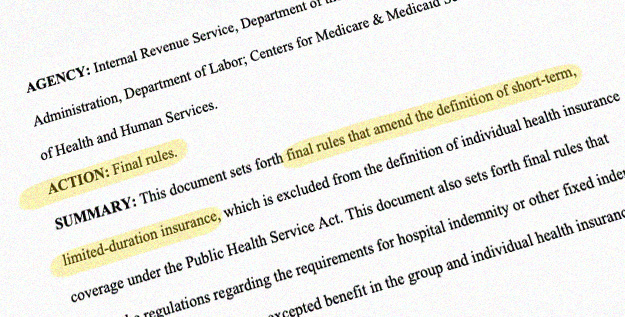
Finalized federal rule reduces total duration of short-term health plans to 4 months


A finalized federal rule announced by the Departments of Treasury, Health and Human Services, and Labor on March 28, will impose new nationwide duration limits on short-term limited duration insurance (STLDI) plans.

The rule – which applies to plans sold or issued on or after September 1, 2024 – will limit STLDI plans to three-month terms, and to total duration including renewals of no more than four months.

A “renewal” will include a new policy issued by the same insurer (or another insurer in the same controlled group, meaning they’re treated as a single employer)) within 12 months of the effective date of the first policy. So a person will not be able to purchase multiple consecutive policies – a practice known as “stacking” – from the same insurer or an affiliated insurer. The part of the rule helps to avoid scenarios in which consumers enroll in multiple STLDI policies without realizing that it isn’t comprehensive coverage.

Why did the federal government implement this rule?

As the author has previously noted, the changes are designed to ensure that short-term coverage is used to fill a temporary gap between two comprehensive policies, rather than serving as a long-term coverage solution. Since STLDI is “excluded from the definition of individual health insurance” and is thus not regulated by federal rules such as the Affordable Care Act, the No Surprises Act, the Mental Health Parity and Addiction Equity Act, etc., the federal-level consumer protections for STLDI enrollees are limited.

The rule is also intended to make it easier for consumers to distinguish between ACA-compliant individual/family health insurance and STDLI and thus reduce the number of people who inadvertently purchase short-term coverage when trying to buy comprehensive coverage.

STLDI plans sold on or after Sept. 1, 2024 will need to include an updated and comprehensive disclosure notice that highlights the major differences between STLDI and ACA-compliant individual/family health insurance sold through the Marketplace.

The disclosure, which is illustrated on page 102 of the final rule, must be displayed on the first page of the policy/contract and any associated marketing or enrollment materials.

How does the rule affect STLDI plans currently in effect?

Under the new rules, there is no change to STLDI policies that are already in effect, or policies that are sold and issued before Sept. 1, 2024. The current rules continue to apply to those policies.

This means policy durations of plans that are sold and issued prior to Sept. 1, 2024 are up to the states and the insurers as long as the policies don’t have initial terms of more than 364 days or total duration of more than 36 months.

How will state regulations be affected by the rule?

As has been the case with previous federal rules for STLDI, states can impose stricter rules but not more lenient rules regarding STLDI duration.

So for example, a state will be able to limit STLDI to a duration of under four months (or ban them altogether, as some states have already done) or prohibit the sale of a second STLDI policy within 12 months – even if it’s issued by a different insurer.[footnote “States Step Up to Protect Insurance Markets and Consumers from Short-Term Health Plans” Commonwealth Fund. May 2, 2019]

  • In most of the country, current STLDI duration limits vary from six months up to the maximum 36 months allowed under current federal rules. STLDI plans sold in those states will have to come into compliance with the new federal rules starting with plans issued on or after Sept. 1, 2024.
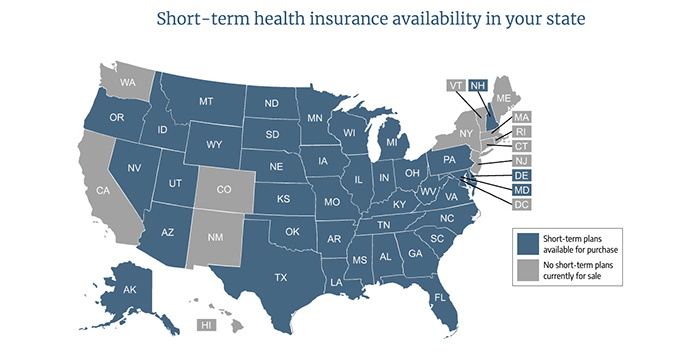
  • Short-term health plans are currently unavailable in 14 states and DC..
  • In another three statesDelaware, Maryland, and Oregon — short-term health insurance is available but already limited to three months in duration, so the new rules won’t change anything about STLDI durations in those states. (Virginia also limits initial terms to three months but allows the total duration to extend to six months. So plans in Virginia will be further limited by the new federal rules.)

How many people have short-term health insurance?

It’s difficult to pin down the exact number of enrollees, as data reporting of STLDI coverage is not consistent across states. The final rule cites a 2023 report from the National Association of Insurance Commissioners, which indicated that 235,775 people were covered by short-term health plans at the end of 2022.

But, as noted in the final rule, that doesn’t include people who had STLDI for only part of the year, nor does it include people with association-based STDLI coverage, which is a significant portion of the market.

The final rule (see page 163) also notes that the Congressional Budget Office and the Joint Committee on Taxation had previously estimated that as many as 1.5 million people might be enrolled in STLDI. But the rule also clarified that was before the ACA’s premium subsidies were enhanced by the American Rescue Plan and Inflation Reduction Act – legislation that made Marketplace coverage more affordable and perhaps reduced the number of people who opted for STDLI.

Will people with STLDI have a special enrollment period to switch to individual/family coverage?

No. The final rule (page 68) notes that while there is already a special enrollment period (SEP) for group health insurance when an STLDI policy terminates, there is no similar SEP for individual/family health coverage. That will continue to be the case under the new rule.

States that operate their own health insurance Marketplaces are allowed to establish SEPs that differ from those available through the federally run Marketplace, HealthCare.gov. But HealthCare.gov, the Marketplace platform in 32 states, will continue its current protocol of not allowing a SEP due to the termination of a short-term health insurance policy.

However, as we’ll discuss below, the timing of the new rule is designed to ensure that people can purchase a STLDI plan that can continue through the end of 2024 (assuming they’re healthy enough to enroll in STLDI and assuming that insurers in their state offer STLDI with the maximum allowable four-month duration). By then utilizing the open enrollment period for ACA-compliant coverage, the consumer would be able to transition without interruption in coverage to an individual-market policy that starts on January 1, 2025, if they choose to do so.

What can people do when their short-term policy terminates?

The current maximum duration limit for policies sold or issued before September 1, 2024 varies by state, and it’s also important to understand that insurers can further limit their short-term policies beyond what state or federal rules allow. (An insurer can, for instance, cap total policy durations at six months, even if state and federal rules allow for 36 months.)

If a person enrolls in a new STLDI plan on or after September 1, the plan will be allowed to cover them through the end of 2024, as that will be no more than four months away. But again, four months will be the maximum allowable duration, not the required duration. Insurers will be able to offer, for example, a three-month policy that isn’t renewable. For this reason, consumers need to be well-informed about their policy details.

Assuming a person purchases a policy with a four-month duration that starts on September 1, they will be able to select a non-temporary major medical plan for calendar year 2025 during open enrollment for individual/family coverage which will be effective as early as January 1, 2025. Open enrollment begins on November 1, 2024. This will allow them to avoid having a coverage gap.

If a person chooses to purchase or renew an existing longer-term STLDI policy before the end of August 2024, their plan termination dates will vary depending on the plan they choose. For example, a policy purchased while the current rules are still in effect might last for six months (i.e., into early 2025) or it might last for 36 months. This is where consumers will need to be vigilant in understanding the implications of what they’re purchasing.

If they buy a six-month, non-renewable short-term policy that takes effect August 15, 2024, it will terminate in mid-February 2025. At that point, open enrollment for ACA-compliant 2025 individual/family coverage will be over.

The person will not be able to switch to an ACA-compliant plan unless they have a qualifying life event that triggers a special enrollment period (note here that some special enrollment periods are only available if the person had prior minimum essential coverage, and STLDI is not considered minimum essential coverage.)

Under the terms of the final rule, consumers will still be able to buy another STLDI policy from a different insurer after their policy ends.

But this will depend on their health status, as the new insurer will be able to use medical underwriting.

Marketplace coverage is available

More than 21 million people enrolled in Marketplace plans during the open enrollment period for 2024 coverage. About 92% of them qualified for advance premium tax credits that reduced their average monthly premiums to just $74/month.

These Marketplace policies cover the ACA’s essential health benefits without any annual or lifetime caps on how much the plan will pay. They have caps on out-of-pocket costs, cover pre-existing conditions, and don’t base premiums on gender or medical history, unlike STLDI policies.


Louise Norris is an individual health insurance broker who has been writing about health insurance and health reform since 2006. She has written dozens of opinions and educational pieces about the Affordable Care Act for healthinsurance.org.



Source link

Six ways proposed federal rule changes might affect Marketplace enrollees


The federal government has proposed a wide range of health insurance rule changes for 2025 and – if approved – they’re likely to affect Marketplace enrollment deadlines and plan benefits as well as enrollees’ transition from Marketplace coverage to Medicare.

Two agencies – the Centers for Medicare & Medicaid Services (CMS), and Department of the Treasury – proposed the rule changes in November 2023 and have already accepted public comments on the proposals. The final rule, including potential modifications to the initial proposals, will be published in early 2024.

The proposed rule addresses a wide range of issues. Let’s take a look at six that are most likely to have a direct effect on Marketplace consumers in 2025 and future years:

1. Open enrollment start dates would be standardized in state exchanges

The proposed rule would require state-run exchanges to more closely align their open enrollment periods with the federal exchange, HealthCare.gov, beginning open enrollment on November 1, and ending it no earlier than January 15. This rule could help reduce confusion for consumers in some states.

Under current rules, the open enrollment period for the federally run Marketplace, HealthCare.gov, (used in 32 states) runs from November 1 to January 15, and most state-run exchanges follow the same schedule.

But state-run exchanges can have different start dates (Idaho’s starts in mid-October and New York’s starts in mid-November) and different end dates, as long as the end date isn’t before December 15. Idaho currently ends open enrollment on December 15, and is the only state where open enrollment ends before January 15.

If finalized, this rule change would require Idaho to change both the start and end dates of its open enrollment period, and New York would have to change its start date. And state-run exchanges created after these rules go into effect would also have to follow the standardized schedule of November 1 through at least January 15.

This proposal is supported by various entities, including the National Association of Community Health Centers, but opposed by other entities, including the National Association of Insurance Commissioners, the state of Idaho, and the state of Georgia (Georgia plans to have a fully state-run Marketplace by the fall of 2024).

2. Special enrollment period effective dates would be standardized

The proposed rule would require state-run exchanges to have first-of-the-following-month effective dates for applications submitted at any time during a calendar month during special enrollment periods.

Starting in 2022, HealthCare.gov switched to this approach. Before that, HealthCare.gov and most of the state-run exchanges required an application to be submitted by the 15th of the month for the coverage to be effective the first of the following month. (Some qualifying life events, including marriage, loss of other coverage, and birth/adoption, had more flexible enrollment deadlines.) This meant that an application submitted on June 20 would have an August 1 effective date. But under the protocol that HealthCare.gov and some state-run exchanges adopted in 2022, that application now gets a July 1 effective date.

When HealthCare.gov switched to the new rules under which coverage is effective at the start of the next month – regardless of the day of the month the application was submitted during a special enrollment period – it was optional for state-run-exchanges to also make the change. Some have since adopted the same approach, but others have not.

If the proposed rule is adopted, consumers in every state will be able to get coverage effective as of the first of the month following their application during a special enrollment period, regardless of the date they apply. The goal? Minimizing gaps in coverage by reducing the amount of time that people in some states currently have to wait for their SEP enrollments to take effect.

This proposed rule did not generate much feedback in the public comments, but there were some comments on either side of the issue. For example, it’s opposed by the state of Georgia, which plans to be running its own exchange by the fall of 2024. It’s supported, however, by the Massachusetts Health Connector (Massachusetts Marketplace), which currently requires SEP applications to be submitted by the 23rd of the month to have coverage effective the first of the following month.

3. It would be easier for states to add to their essential health benefit requirements

The proposed rule would make it easier for states to update their essential health benefits (EHB) benchmark plan requirements, and would allow states to add mandated benefits via the regulatory or legislative process without having to cover the cost of the new benefit. (Current rules require the state to pay the cost of adding the new benefits by sending money directly to the health plan or its enrollees.)

Under current rules, states can use the benchmarking process (directly updating the EHB benchmark plan, as opposed to a legislative or regulatory benefit mandate) to add benefits without defraying the cost. But states have reported that updating the benchmark plan is burdensome, and only nine states have updated their benchmark plans since this became available in 2020. If a state adds required benefits via regulatory or legislative state mandates (as opposed to the benchmarking process) after 2011, they have to defray the cost, even if they subsequently add it via the benchmarking process.

The proposed rule would ensure that if a particular benefit is covered by a state’s EHB benchmark plan, the cost doesn’t have to be borne by the state, even if the state mandated the benefit via regulation or legislation. And separately, the proposed rule calls for a more simplified process for states to update their EHB Benchmark plan, making it easier to add new benefits over time. (States have reported that the current process can be burdensome and onerous.)

To clarify, a state would not be required to make any change to its EHB Benchmark plan or add any new benefits. But for states that wish to do so, the proposed rules are designed to make the process easier and less costly.

There are a variety of services that a state could choose to add to its EHB benchmark plan, including some services that have only become available in recent years, after the original EHB benchmark plans were established (weight loss medication, for example). Other examples are gender-affirming care, vasectomies, infertility treatment, and substance use disorder treatments that have been developed since EHB Benchmark plans were first created.

Among the public comments received, the National Association of Insurance Commissioners strongly supports this proposed rule change, while Elevance Health (formerly Anthem) opposes it.

4. States would be allowed to add adult dental to essential health benefits

The proposed rule would allow – but not require – states to add adult dental coverage to their essential health benefits package. States are prohibited from adding adult dental to their EHBs under current rules.

If a state chose to add adult dental to EHB, individual and small-group health plans would have to start providing adult dental benefits without dollar limits on how much the plan would pay. Carriers could accomplish this by providing the benefits directly or by contracting with a dental plan to administer the coverage, as long as it’s “seamless to the enrollee.”

Self-insured and large-group plans are not required to cover EHBs (and most covered workers are in self-insured or large group plans). But to the extent that they do, they cannot impose annual or lifetime limits on how much the plan will pay for those services.

The proposed rule clarifies that if a state chooses to add adult dental coverage to its EHB benchmark plan and an employer purchases that plan for its workers in the large group market (51 or more employees in most states) the carrier would have to provide dental benefits without annual or lifetime benefit caps. But if a large employer uses a stand-alone dental plan in addition to a medical plan, the dental plan could continue to have benefit caps.

(For clarification, small-group health plans are sold to employers with up to 50 employees in most states, and up to 100 employees in four states. If the employer has more employees than the small-group threshold and is purchasing commercial insurance — as opposed to self-insuring — they are buying coverage in the large-group market, which is regulated under different rules than the small-group market.)

States are responsible for determining the specific services that must be covered as essential health benefits, but the Affordable Care Act prohibits states from including adult dental in their EHB package. This is because the EHB package was meant to be representative of a typical employer-sponsored health plan, and employer-sponsored health plans generally do not include dental coverage.

In the proposed rule, the government notes that they’re now looking at this from the perspective of an overall employer benefit package, which often includes separate dental coverage in addition to the medical plan. So while it continues to be the case that employer-sponsored medical plans typically do not include dental coverage, the proposed rule change would allow states to bring their EHB-Benchmark plan more in line with a typical employer benefits package, which often includes both medical and dental coverage.

Quite a few public comments were submitted in response to the proposal to allow states to add adult dental to EHB.

The proposal is supported by the American Association of Endodontists, the National Rural Health Association, the National Association of Insurance Commissioners, the National Association of Community Health Centers, and the Tribal Technical Advisory Group.

But it’s opposed by Sanford and Priority Health (both insurers), and the Academy of General Dentistry.

The agencies clarified in the proposed rule that they are not proposing a change to allow states to add adult vision or custodial long-term care coverage to EHB (both of which are also not allowed to be added to EHB at this point), but they are seeking feedback from stakeholders and the public regarding whether they should consider that in future rulemaking.

5. The low-income special enrollment period would become permanent

The proposed rule would make the low-income special enrollment period (SEP) permanent, instead of ending it if and when the American Rescue Plan’s (ARP) subsidy enhancements expire.

The rationale behind the low-income SEP is that subsidy-eligible enrollees with income up to 150% of the federal poverty level (FPL) are currently eligible for $0 premium coverage, so the adverse selection risk is low. (That means it’s unlikely that a person would let their coverage lapse when they’re healthy if they’re not having to pay for it. Adverse selection refers to situations in which healthy people do not maintain coverage, and the overall risk pool becomes less healthy and more expensive to treat.)

Under current rules, subsidy-eligible applicants with household income up to 150% of FPL will continue to be able to enroll year-round as long as the ARP subsidy enhancements remain in effect. They’re currently in place through 2025, and an extension would require Congressional action. If the proposed rule is finalized, the low-income SEP will remain in place even if the subsidy enhancements end.

The National Association of Community Health Centers supports this proposal, while Elevance Health (formerly Anthem) opposes it. Another insurer, Priority Health, expressed general opposition to the expansion of special enrollment opportunities and wants CMS to “reduce the total number of SEPs,” noting that “ongoing enrollment contributes to adverse selection and encourages healthy persons to delay enrollment until they need care.”

Conversely, CMS and the IRS note in the proposed rules that because most consumers with income up to 150% FPL would continue to be eligible for some zero-cost plans in the Marketplace even without the ARP subsidy enhancements, they “would be unlikely to use the proposed 150 FPL SEP in a way that caused adverse selection.”

6. Marketplace plans could be terminated retroactively if an enrollee is eligible for backdated Medicare

Under current rules, the option to retroactively terminate Marketplace coverage is extremely limited. The proposed rule would allow a retroactive coverage termination date if a person becomes eligible for backdated Medicare coverage. .

Once a Marketplace enrollee becomes eligible for premium-free Medicare Part A, they are no longer eligible for premium subsidies. And even if they aren’t receiving subsidies, Medicare doesn’t coordinate with individual/family coverage. The advice from CMS is that “In most cases, you’ll want to end your Marketplace coverage” when your Medicare coverage begins. And consumers are responsible for canceling their Marketplace coverage when they transition to Medicare.

In most cases, Marketplace plans can only be canceled prospectively (or at the earliest, on the day the cancellation request is made). This works well in situations where a person knows that their Medicare will take effect on a particular day in the future and can schedule the termination of their Marketplace plan for the same time. But it becomes much more complicated when a person learns that they’ve been enrolled in Medicare with a backdated effective date.

This can happen when a person is approved for Social Security Disability Insurance (SSDI) benefits with a retroactive effective date more than 25 months in the past. (Medicare becomes available in the 25th month of SSDI benefits.) It can also happen when a person enrolls in Medicare after they’re initially eligible and their Medicare Part A coverage is backdated up to six months.

In those scenarios, the person doesn’t have an opportunity to cancel their Marketplace plan prospectively, since they’re finding out after the fact that their Medicare coverage has already begun. The proposed rule would allow them to request that their Marketplace coverage be canceled back to the day before their Medicare took effect. This could result in premium savings for the individual, and also reduce the likelihood that they’ll have to repay excess premium tax credits to the IRS when they file their taxes.

The proposed rule does not allow retroactive terminations in a situation where an individual enrolled prospectively didn’t understand that they needed to cancel their Marketplace plan once they’ve got Medicare coverage and later tries to retroactively terminate enrollment in a QHP. But it could address some of the challenges Marketplace enrollees currently face when they are retroactively enrolled in Medicare.

If the proposed rule is finalized, retroactive termination would become available via HealthCare.gov, but would be optional for the state-run Marketplaces.


Louise Norris is an individual health insurance broker who has been writing about health insurance and health reform since 2006. She has written dozens of opinions and educational pieces about the Affordable Care Act for healthinsurance.org.


Source link

6 lessons Mary Lou Retton’s health scare can teach us about coverage


On January 8, Olympic gymnast Mary Lou Retton attracted national attention and an outpouring of support when she appeared on the Today Show, explaining the health scare she faced in the fall of 2023. Retton recounted how she fell gravely ill with a rare form of pneumonia and – because she couldn’t afford health insurance – faced thousands of dollars in hospital bills.

The story fortunately has a happy ending: Retton was discharged from the hospital after about a month, and is recovering at home. And her daughters had organized a fundraiser that raised more than $459,000 in contributions. The family has confirmed that any funds beyond what’s needed for medical bills will be donated to charity. And Retton reports that she now has health insurance.

But to me, Retton’s story also included some important lessons for consumers, many of whom may assume that the celebrity’s health scare is a sign of barriers to affordable health coverage. Here’s what consumers can learn from Retton’s experience:

1. Having health coverage is critical.

Retton reported that her unexpected illness resulted in a month of hospital treatment, much of which was in the intensive care unit. With the per-day cost of a hospital stay in Texas averaging $2,913 in 2021, it’s easy to see how expenses can rack up quickly — and ICU costs are higher than regular inpatient care. Retton lives in Texas and was hospitalized there, but the national average cost is similar to the Texas average, at $2,883 per day for regular inpatient care.

2. Pre-existing conditions are no longer a barrier to coverage.

On the Today Show, Retton pointed to previous health issues as a reason why she didn’t have coverage.

“When COVID hit and after my divorce and all my pre-existing (conditions), I mean, I’ve had over 30 operations of orthopedic stuff, I couldn’t afford it… But who would even know that this was going to happen to me?”

Unfortunately, that may leave some viewers with the impression that coverage might be unaffordable due to pre-existing medical conditions. In fact, medical underwriting hasn’t been used for individual/family health insurance policies since 2013.

For individual/family major medical policies with effective dates of 2014 or later, the insurer cannot take the applicant’s medical history into consideration. So pre-existing conditions will not affect the premium or the person’s eligibility for coverage. That was not true before 2014 in most states, but it has been true nationwide since 2014.

3. Enrollment windows are limited.

One possible reason that Retton didn’t have coverage is that she may have tried to enroll in comprehensive health coverage outside of open enrollment, and if she wasn’t eligible for a special enrollment period, she would have had to wait until open enrollment (with coverage effective in January).

Although coverage is guaranteed-issue regardless of medical history, enrollment in individual/family major medical plans is only available during open enrollment or a special enrollment period. This is the same as the employer-sponsored health coverage rules that have been used for decades.

4. Consumers in some states still face a coverage gap.

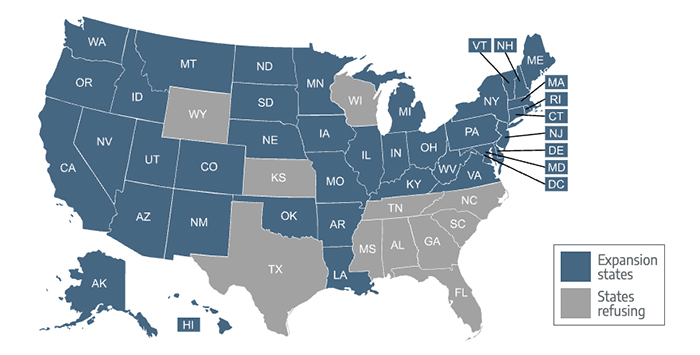
Retton, like many people in Texas, could be in the coverage gap, which exists because Texas has not yet elected to expand Medicaid under the Affordable Care Act (ACA). Texas is one of nine states where there’s a coverage gap, and an estimated 772,000 low-income Texas residents are in the coverage gap.

If a Texas resident’s household income is less than the federal poverty level, they’d be in the coverage gap, meaning they would not be eligible for Texas Medicaid or Marketplace premium subsidies.

It’s important to note that Marketplace premium subsidy eligibility is based on income, and assets are not taken into consideration. (Here’s how income is calculated under the ACA). So a person with considerable assets could still fall into the coverage gap in Texas, if their income is below the poverty level.

A person in the coverage gap can still enroll in Marketplace coverage, but will not qualify for any subsidies. Their decision to enroll in coverage will depend on whether they can afford to pay full price premiums.

5. Income affects subsidy eligibility.

On the other end of the spectrum, Retton’s income might have been too high to qualify for any Marketplace subsidies. Using HealthCare.gov’s 2023 plan comparison tool for a 55-year-old in her area, we can see that subsidies would have phased out at an income of roughly $98,000. (Subsidies phase out at the point where the price of the second-lowest-cost Silver plan becomes no more than 8.5% of the person’s household income, which is what the American Rescue Plan and Inflation Reduction Act consider affordable at that income level.)

If her income had been above that, she would have been paying full price for a plan, with 2023 premiums somewhere in the range of $501 to $1,075/month, depending on the plan. (These premiums are specific to Retton’s age and location; they will vary for other applicants).

6. But the income range for subsidy eligibility is wide.

But if an individual Retton’s age and living in her area had a 2023 household income between $13,590 (the 2022 poverty level) and about $98,000 (the level at which subsidies in that case would have phased out altogether), they would have been eligible for Marketplace premium subsidies that covered some or all of the cost of the coverage, depending on where in that income range they were, and the plan they selected.

Although the ACA prohibits insurers from considering an applicant’s medical history, a person might not know about that if they haven’t had experience with purchasing coverage in the individual market in recent years.

And if a person hasn’t applied for coverage or used a subsidy calculator, they may not be aware of how substantial the premium subsidies can be in the Marketplace.

Ultimately, even an unsubsidized premium of several hundred dollars a month is a bargain compared with having to pay for a month-long stay in the ICU. But fortunately, most Marketplace enrollees do not pay anything close to the full amount of their premiums.

In 2023, the average full-price Marketplace premium in Texas was $578/month. But thanks to premium subsidies, the average enrollee paid just $65/month. And out of the 2.4 million Texas residents who enrolled in Marketplace coverage in 2023, more than 1.4 million were paying less than $10/month for their coverage.

I’m glad that Retton recovered and has secured health insurance going forward. These circumstances remind us that ACA-compliant health insurance can be obtained – regardless of our medical history, and with substantial subsidies available to most applicants.


Louise Norris is an individual health insurance broker who has been writing about health insurance and health reform since 2006. She has written dozens of opinions and educational pieces about the Affordable Care Act for healthinsurance.org.


Source link

Over 9 million Medicaid beneficiaries disenrolled as redeterminations continue


Medicaid disenrollments resumed several months ago (in April, May, June, or July, depending on the state), and the process is proceeding mostly as expected, with millions already disenrolled. But it’s also had some unexpected problems.

Here’s a look at disenrollments thus far – and a look at who’s been losing Medicaid coverage, and how some who’ve been disenrolled are taking steps to replace their lost coverage.

How many people have been disenrolled from Medicaid?

As of October 19, more than 9 million people had been disenrolled from Medicaid as the result of states resuming eligibility redeterminations – also known as “unwinding” or “renewal.” The disenrollments were not unexpected; HHS had projected that approximately 15 million people would be disenrolled from Medicaid during the year-long redetermination period.

States had the option to prioritize eligibility redeterminations for enrollees they believed were most likely to no longer be eligible, so it’s not surprising that there was a fairly high rate of disenrollments in some states in the early months of the unwinding process. For example, by September (last month), Idaho had already completed eligibility redeterminations for everyone whose eligibility had been pending during the pandemic, and is now back to their normal annual eligibility redeterminations.

Most disenrollments due to procedural reasons

What may be surprising is that nearly three-quarters of the disenrollments have been for procedural reasons, meaning that a state was unable to determine whether someone who had Medicaid coverage was still eligible. This problem can happen because a Medicaid office doesn’t have a beneficiary’s current contact information.

In some cases, a beneficiary received a renewal packet but hasn’t submitted the information the state needs to process the renewal. This could be because the person knows they’re no longer eligible and may have already enrolled in other coverage (such as a plan offered by a new employer). But in other cases, the beneficiary might not understand what’s required in order to complete the renewal, or may have simply fallen behind on dealing with paperwork.

CMS pauses procedural enrollments in 29 states and DC

And, in late August 2023, the Centers for Medicare and Medicaid Services (CMS) addressed the fact that numerous states had problematic renewal protocols involving households where some members were eligible for ex parte (automatic) renewals and others were not. In many states, renewal paperwork was being sent to the household, and if it wasn’t completed, the entire household was being disenrolled, including household members (often children) who were eligible for ex parte renewal.

Twenty-nine states and the District of Columbia have had to pause procedural disenrollments until they can confirm that individuals who are eligible for Medicaid or CHIP (Children’s Health Insurance Program) are not being disenrolled due to eligibility redeterminations being conducted at the household (rather than individual) level. And CMS directed states to reinstate coverage for nearly 500,000 people – many of whom are children – whose coverage had been incorrectly terminated due to this issue.

CMS had previously directed some states to pause procedural disenrollments while problems with their eligibility redetermination processes were addressed. As of June 2023, some or all procedural disenrollments had been paused in DC and 16 states.

A pause on procedural disenrollments does not prevent a state from continuing to process renewals and disenroll people who no longer meet the eligibility guidelines. It just prevents states from disenrolling people when they don’t have enough information to determine whether the person is still eligible.

And states can adjust their approach to processing Medicaid redeterminations based on state-specific circumstances. For example, Hawaii opted to pause all Medicaid disenrollments through the end of 2023 due to the wildfires in Maui, and will wait until June 2024 to resume eligibility redeterminations for West Maui residents.

How many people have transitioned from Medicaid to Marketplace coverage?

People who are no longer eligible for Medicaid can switch to other coverage, typically either from an employer, Medicare, or the Marketplace. (Eligibility for each type of coverage depends on the person’s specific circumstances.)

In September 2023, CMS published data on Marketplace enrollments among people who had recently been enrolled in Medicaid. As of June 2023:

So, based on CMS’ recent reports, more than 410,000 former Medicaid enrollees had transitioned to Marketplace coverage – QHP or BHP coverage – by June 2023.

In the state-run exchanges, enrollment included nearly 7,600 people for whom a QHP had been automatically selected. Only four states (California, Maryland, Massachusetts, and Rhode Island) have implemented auto-enrollment protocols for at least some people whose Medicaid is terminated during the unwinding process. In the rest of the country, a person’s data may be transferred to the Marketplace, but they must actively select a plan in order to enroll in a QHP.

Subsidies for Medicaid beneficiaries transitioning to coverage on the Marketplace

Last year, CMS had estimated that 2.7 million people losing Medicaid during the unwinding period would be eligible for advance premium tax credits (APTC) to offset the cost of Marketplace coverage. As of June 2023, a total of about 583,000 former Medicaid enrollees had been deemed eligible for APTC (337,230 in states that use HealthCare.gov and 245,879 in states that run their own exchanges.)

APTC eligibility depends on income but also on whether the person has an offer of affordable coverage from an employer. People who lose Medicaid but are eligible to enroll in an employer’s plan are generally not eligible for financial assistance in the Marketplace.

Special enrollment in the Marketplace for those disenrolled

It’s important to note that HealthCare.gov has an ongoing special enrollment period, through July 2024, for people who lose Medicaid during the unwinding process. So a person who lost Medicaid early in the unwinding process still has a lengthy window to enroll in a Marketplace plan if that’s their preference.

States that run their own exchanges can choose to offer extended special enrollment periods for people who lose Medicaid, or they can use the normal special enrollment period rules that allow a person up to 60 days to select a new plan after losing Medicaid.

What should current enrollees expect as Medicaid redetermination continues?

While the number of disenrollments is over 9 million, it’s important to note that the redetermination process is still ongoing. Current enrollees should keep an eye out for communications from their state’s Medicaid office, especially if their coverage hasn’t been renewed recently.

In most states, the eligibility redetermination process begins two or three months before an enrollee’s renewal date. Federal rules require states to give most Medicaid enrollees at least 30 days to return their renewal packets, but states often allow 45 days or more. (For Medicaid enrollees who are 65 or older, or who are eligible due to disability or blindness, the state must provide “a reasonable period of time.”)

If the state is able to renew an individual’s coverage automatically, the beneficiary will simply receive a notification letting them know that their coverage has been renewed. But if not, the state will let them know what information they have to provide in order to renew coverage, along with a deadline at least 30 days out.

If a person does not submit the necessary documentation by the deadline, coverage can be terminated. However, if a beneficiary submits the renewal information no more than 90 days after the coverage was terminated, states are required to determine eligibility without requiring the person to submit a new application, and reinstate coverage if the person is eligible.

Read our overview of Medicaid redetermination to learn more about coverage replacement options for people who are disenrolled from Medicaid. The overview also links to pages devoted to each state’s Medicaid program, with details about how the unwinding process is being handled.


Louise Norris is an individual health insurance broker who has been writing about health insurance and health reform since 2006. She has written dozens of opinions and educational pieces about the Affordable Care Act for healthinsurance.org. Her state health exchange updates are regularly cited by media who cover health reform and by other health insurance experts.
Footnotes


Source link

50 populations whose lives are better thanks to the ACA


The Affordable Care Act (ACA) has faced numerous legal challenges, but has been upheld three times by the Supreme Court. Over the years, the headlines surrounding the possibility of the ACA (aka Obamacare) being overturned have often focused on people with pre-existing conditions who buy their own health insurance. (This is certainly a valid concern, as those individuals would undoubtedly be worse off without the ACA.)

But the impact of the ACA goes well beyond securing access to healthcare for people with pre-existing conditions. Who are these Americans, whose lives are better off, thanks to the ACA? See if you can find yourself – or your loved ones – in this list:

  1. More than 14 million Americans (91% of all Marketplace/exchange enrollees) who are receiving premium subsidies in the exchanges that make their coverage affordable. The average full-price premium is $605/month in 2023, but the average subsidy amount ($527/month) covers the majority of the average premium.
  2. More than 7.5 million people who are receiving cost-sharing reductions that make medical care more affordable and accessible.
  3. People who are (or want to be) self-employed and wouldn’t have been able to qualify for and/or afford a privately purchased health insurance plan without the ACA’s guaranteed-issue provisions and premium subsidies.
  4. People with pre-existing conditions who gain access to an employer-sponsored plan after being uninsured for 63+ days. HIPAA guaranteed that they could enroll in the employer-sponsored plan, but there were waiting periods for pre-existing conditions. The ACA eliminated those waiting periods.
  5. People who lose access to an employer’s plan and no longer have to rely on COBRA (or mini-COBRA/state continuation) for health coverage.
  6. People who gain access to an employer’s plan and have a waiting period of no more than 90 days before their coverage takes effect. Pre-ACA, employers could determine their own waiting periods, which were sometimes longer than three months.
  7. Full-time (30+ hours/week) workers at large businesses who are offered real health insurance instead of “mini-med” plans, thanks to the employer mandate. (Employers can choose not to comply, but they face a penalty in that case.)
  8. People with serious conditions often exhausted their coverage under pre-ACA plan because of annual or lifetime benefits caps.

    People with serious conditions often exhausted their coverage under pre-ACA plan because of annual or lifetime benefits caps.

    People with serious medical conditions who would otherwise have exhausted their coverage in the private market, including employer-sponsored plans. Pre-ACA, annual and lifetime benefit caps were the norm. And it could be shockingly easy to hit those maximums if you had a premature baby or a serious medical condition.

  9. Coal miners with black lung disease, and their survivors. The ACA made benefits under the Black Lung Benefits Act of 1972 available to more people.
  10. Medicare beneficiaries who use Part D prescription coverage and who would have ended up in the donut hole.  before. (The ACA closed the donut hole as of 2020.)
  11. Medicare beneficiaries who receive free preventive care.
  12. American taxpayers and Medicare beneficiaries who benefit from ACA cost controls that have extended the solvency of the Medicare Hospital Insurance trust fund and improved Medicare’s long-term financial outlook.
  13. Seniors who are able to remain in their homes as they age, thanks to the ACA’s expansion of Medicaid funding for in-home long-term care services and supports.
  14. Nursing home residents – and people with loved ones living in nursing homes – who benefit from federal funding for background checks on employees who interact with patients.
  15. The 12 million low-income Americans who are elderly and/or disabled, covered simultaneously by both Medicare and Medicaid, and who benefit from the improvements the ACA made for the dual-eligible population.
  16. College students who are no longer offered skimpy health plans.
  17. Women (and their partners) who have access to contraception at no cost – including birth control methods such as IUDs, implants, and tubal ligations that are highly effective but would have prohibitively high up-front costs if they weren’t covered by insurance.
  18. Pregnant women who have access to free routine prenatal care.
  19. Expectant parents – male and female – who can enroll in a health plan in the individual market. (Pre-ACA, expectant parents’ applications were rejected in nearly every state.)
  20. People who buy their own health insurance and would like to have a child. Pre-ACA, individual health insurance rarely covered maternity care.
  21. Breastfeeding mothers who have access to breast pumps and breastfeeding counseling as part of their insurance benefits. The ACA also guarantees that breastfeeding mothers who work for large employers have access to adequate breaks and a private, non-bathroom area for pumping milk.
  22. Anyone who is better off in a world where people in need of mental health care can access it – because their health insurance covers it and they aren’t rejected altogether when they apply for a new health plan.
  23. People with substance abuse disorders who can obtain treatment that would be unaffordable without health insurance coverage.
  24. The 21 million people who have gained access to Medicaid thanks to the ACA’s expansion of coverage to low-income adults.
  25. Low-income families and individuals who no longer have to meet asset tests in order to qualify for Medicaid or CHIP, with eligibility now based on the ACA’s modified adjusted gross income instead (some populations, including the elderly and disabled, are still subject to asset tests for Medicaid eligibility).
  26. People in some rural areas of the country where hospitals have been able to remain open thanks to Medicaid expansion.
  27. Young adults who are able to remain on their parents’ health insurance as they work to start their careers.
  28. Young adults who were in foster care until age 18, and who are allowed to continue their Medicaid coverage until age 26, regardless of income.
  29. Early retirees who can enroll in self-purchased health insurance for the pre-Medicare years, without worrying about pre-existing conditions.
  30. ACA's marketplace plans must cover a list of vaccinations for children from birth to age 18.

    ACA’s marketplace plans must cover a list of vaccinations for children from birth to age 18.

    Children who have access to free vaccines and well-child care.

  31. Adults who have access to a wide range of preventive health services at no cost.
  32. Families whose health plan covers their kids’ dental care.
  33. People in New York and Minnesota who earn a little too much for Medicaid but are eligible for coverage under Basic Health Programs (Oregon plans to debut a Basic Health Program in mid-2024).
  34. People who find themselves needing to appeal their health plan’s decision on a prior authorization request or claim.
  35. Medicare Advantage enrollees whose health plan is required to spend at least 85% of revenue on members’ medical claims and quality improvements.
  36. Individuals and employers whose insurers are required to spend at least 80% or 85% of premiums on members’ medical claims and quality improvements.
  37. People age 65 and older, including recent immigrants, who are able to enroll in ACA-compliant health plans if they’re not eligible for premium-free Medicare (pre-ACA, individual market insurers generally would not enroll people over age 64).
  38. Women, who no longer pay more for health insurance than men.
  39. Older people (including those age 65+ who aren’t eligible for premium-free Medicare), whose premiums are no more than three times as much as the premiums for a 21-year-old.
  40. People who buy their own health insurance and no longer have to worry that the policy could get rescinded because they forgot to mention something on the application. (This was usually due to an omission in the medical history section, and those questions are no longer asked – thanks, also, to the ACA.)
  41. Everyone who benefits from the more robust premium review processes that states have as a result of the ACA.
  42. Everyone who benefits from the ACA’s risk adjustment program, which levels the playing field and helps to prevent plan designs that would be unappealing to individuals and groups with high-cost medical conditions.
  43. People with individual and small-group coverage that includes all of the essential health benefits.
  44. People who pay full price for individual health insurance in Alaska, Colorado, Delaware, Georgia, Idaho, Maine, Maryland, Minnesota, Montana, New Hampshire, New Jersey, North Dakota, Oregon, Pennsylvania, Rhode Island, Virginia, and Wisconsin, who are paying lower premiums thanks to reinsurance programs that were implemented under Section 1332 of the ACA.
  45. Native Americans and Alaska Natives, who can enroll year-round in plans sold through the exchanges, and who are eligible for plans with zero cost-sharing if their income doesn’t exceed 300% of the poverty level. (That’s $90,000 for a family of four enrolling in 2024 coverage.)
  46. Native Americans and Alaska Natives who receive care via Indian Health Services – as the ACA permanently reauthorized the Indian Health Care Improvement Act.
  47. People who are protected from discrimination in healthcare based on race, national origin, sex, age, or disability, thanks to Section 1557 of the ACA. (The details of how these protections work are determined by HHS, so there have been some changes over time. HHS initially issued rulemaking in 2016, but it was rolled back in 2020. However, HHS proposed new rules in 2022 that would largely revert to the stronger anti-discrimination protections that were implemented in 2016.)
  48. People who are able to make more informed food choices thanks to nutritional and calorie information on restaurant menus. This stems from Section 4205 of the ACA, and was implemented in 2018.
  49. People who shop for coverage in the health insurance exchange and find the new star rating system for health plans to be helpful during the plan selection process.
  50. People who could benefit from new biosimilar drugs becoming available. Section 7002 of the ACA created the pathway under which biosimilar drugs are approved by the FDA.

Louise Norris is an individual health insurance broker who has been writing about health insurance and health reform since 2006. She has written dozens of opinions and educational pieces about the Affordable Care Act for healthinsurance.org. Her state health exchange updates are regularly cited by media who cover health reform and by other health insurance experts.



Source link

Proposed rule would limit duration of coverage under short-term health plans to 4 months


Since 2018, federal rules have made it possible for consumers in many states to buy short-term, limited-duration insurance (STLDI) and keep that coverage for as long as three years, including renewals and extensions. (States can set their own more stringent rules, which is why these rules don’t apply nationwide.) But a rule proposed by the Biden administration in July 2023 would significantly limit the length of STLDI plans.

If finalized, the rule would limit the initial term of STLDI policies to no longer than three months. Though the rule would allow renewal of a policy, the total duration of a plan would be limited to four months, and a buyer would not be allowed to purchase another short-term plan from the same insurer within 12 months of their initial policy effective date.

The agencies publishing the rule noted that these changes are designed to ensure that short-term coverage is used to fill a temporary gap between two comprehensive policies, rather than serving as a long-term coverage solution. The rule is also intended to reduce the number of people who inadvertently purchase short-term coverage when trying to buy comprehensive coverage.

In introducing the proposed rule, President Biden said his administration is “cracking down” on limited-duration insurance being sold to individuals who often don’t understand the coverage and then are surprised when they get hit with large medical bills.

The proposed change would roll back a 2018 rule that expanded the availability of short-term, limited-duration plans, allowing them to last for up to three years if the coverage is renewable.

According to the National Association of Insurance Commissioners, 235,775 people were covered under short-term policies as of 2022. However, the actual number of enrollees is uncertain because insurance carriers are not required to report enrollment data.


What happens next?

The Centers for Medicare & Medicaid Services is accepting public comments on the proposed rule until September 11, 2023. Rulemaking is a multi-month process, so any rule change likely won’t be finalized until late 2023.

If approved, the rules would not apply to new short-term policies until 75 days after the rule is finalized. Policies issued before that date would not have to comply with the new rules.

For now, consumers in many states can continue enrolling in longer-duration short-term plans. We say “many states” because although the 2018 rule permits states to allow the sale of longer-duration plans, nearly half of the states have adopted stricter limits on STLDI duration. (See details below for each state.)

Some states have banned the sale of short-term plans outright while other states have adopted regulations that have caused insurers to stop selling the plans.

The Biden administration’s proposed changes

The proposed rule published in July 2023, would change all three of the rules that the Trump administration put in place. Those 2018 rules:

  • Limit short-term plans to initial terms of up to 364 days.
  • Allow short-term plans to be renewed as long as the total duration of the plan doesn’t exceed 36 months.
  • Require short-term plan information to include a disclosure to help people understand how short-term plans differ from individual health insurance.

Under the Biden administration’s proposed rule:

  • New short-term policies would be limited to initial terms of no more than three months.
  • Carriers would be able to offer renewable policies, but the total duration – including renewals – could not exceed four months. The proposed rule notes that the three-month window is designed to align with the maximum waiting period that a new employee can be subject to before being eligible for an employer-sponsored health plan.
  • A consumer would not be allowed to purchase an additional short-term policy from the same insurer within 12 months of the effective date of the first policy.

The required disclosure notice would be updated to clarify that federal financial assistance is not available with short-term policies, and that surprise balance billing protections do not apply to these policies.

State regulatory flexibility regarding short-term plans

As noted above, HHS made it clear in the 2018 regulations that although the federal rules expanded the limits on short-term plan duration, states may continue to implement more restrictive rules, just as they did prior to 2017. (States cannot implement rules that are more lenient than the federal regulations.)

States are taking varying approaches on short-term plans, with some clearly wanting to expand access, while others prefer to restrict or eliminate short-term plans in an effort to protect their ACA-compliant markets.

In a few states – New York, New Jersey, Massachusetts, Rhode Island, and Vermont – short-term plans weren’t sold at all as of 2018. And by 2020, five additional states – California, Colorado, New Mexico, Maine, and Hawaii – and Washington, DC also had no insurers offering short-term plans.

In Washington, the sale of short-term health plans was discontinued in mid-2022 and no insurers offer short-term health plans in Washington as of 2023. New Hampshire and Minnesota also had no insurers offering short-term health plans by mid-2023.

In addition, several states had already capped the duration of short-term plans at three or six months, even before the Obama administration took action to limit short-term plans. Other states have subsequently implemented three- or six-month caps on short-term plans.

Ultimately, there are more states with their own restrictions on short-term plans than there are states that are defaulting to the federal rules. Use this map to see how states restrict short-term plans.

If the Biden administration’s proposed rules are finalized, states will no longer have the option to allow short-term policies to have initial terms of more than three months, or total durations of more than four months. Policies with longer terms would not be considered short-term plans and would have to comply with the ACA’s rules for individual-market coverage.

Current state limits on duration of short-term plans

States allowing short-term plans to have duration up to six months

  • Colorado – Six-month initial durations are allowed, but insurers stopped offering short-term plans as of 2019.
  • Connecticut
  • Illinois limits initial plan duration to six months with no renewals.
  • Michigan limits initial plan durations to 185 days with no renewals.
  • Minnesota limits initial plan durations 185 days, but no insurers offer plans as of August 2023.
  • Nevada limits initial plan durations to 185 days with no renewals.
  • New Hampshire limits initial plan durations to six months and 18 months total within a two-year period, but no insurers offer plans as of 2023.

States (and the District of Columbia) allowing short-term plans to have duration up to three months

A handful of states allow short-term plans to have initial terms in line with the new federal rules (364 days), but place more restrictive limits on renewals and total plan duration:

  • Idaho – “Enhanced” short-term plans are guaranteed renewable for total duration of three years. State limits initial duration of non-enhanced short-term plans to six months with no renewals.
  • Kansas – (Only one renewal permitted.)
  • Ohio – (Renewals not permitted.)
  • South Carolina – (11-month maximum initial term, and 33-month maximum duration.)
  • Wisconsin – (Total duration limited to 18 months.)

In 14 states and the District of Columbia, no short-term plans are available for purchase. In some cases, state regulations ban sale of the plans outright. In others, state regulations make it unappealing for insurers to offer short-term plans.

  • California – State law prohibits the sale of short-term plans.
  • Colorado – As noted, plans are technically allowed with six-month initial durations, but insurers have stopped offering short-term plans.
  • Connecticut
  • District of Columbia – Plans are allowed for up to three months with no renewals, but no insurers offer them.
  • Hawaii – As noted, no insurers offer plans under the rules the state implemented.
  • Maine – New rules took effect in 2020, and no insurers offer plans.
  • Minnesota – No insurers offer plans as of August 2023.
  • New Hampshire — No insurers offer plans as of 2023.
  • New York
  • New Jersey
  • Massachusetts – Health plans are required to be guaranteed-issue, so short-term policies are not available in the state
  • New Mexico – State regulations limit the plans to three months and prohibit renewals, but no insurers were offering plans as of mid-2019.
  • Rhode Island – STLDI is not banned, but state rules are strict enough that no insurers offer these policies
  • Vermont – There are no short-term plans available in Vermont, but legislation was also enacted in 2018 to limit short-term plans to three months and prohibit renewals, in case any plans are approved in the future.
  • Washington – Plans are allowed for up to three months, but no insurers offer them.

You can use the map on this page to see more details about short-term health insurance rules and availability in each state.

The path to current short-term federal rules

Under regulation changes that HHS finalized in 2018 – and in effect since October of 2018 – the initial duration of short-term plans was lengthened to 364 days with an option to renew a plan for coverage up to a total of three years. This 2018 rule reversed regulations – put in place by the Obama administration – that had limited short-term plan durations to 90 days and did not allow renewal of policies.

The 2018 rule also established that a plan is considered “short-term” as long as it has an initial term of less than a year (no more than 364 days).

But the 2018 rule also allows short-term plans to offer enrollees the option to renew their plans without additional medical underwriting and use renewal to keep the same plan in force for up to 36 months.

Under the Trump administration, HHS justified this by noting that the coverage has long been called “short-term limited duration” health coverage, and pointing out that “short-term” and “limited duration” must mean different things, otherwise the phrases would be redundant.

So HHS said that “short-term” refers to the initial term, which must be under 12 months. But they allowed the “limited duration” part to mean up to 36 months in total, under the same plan.

It’s important to note that HHS may have expected this to be challenged in court, as they included a severability clause for the part about 36-month total duration: If a court were to strike down that provision, the rest of the rule would remain in place. (A lawsuit was filed over the legality of the new short-term insurance rule in September 2018, but that case ended with a ruling in favor of the Trump administration.)

In the 2018 rule, HHS noted that there is nothing in federal statute that would prevent a person from enrolling in a new short-term plan after the 36 months (or purchasing an option from the initial insurer that will allow them to buy a new plan at a later date, with the new plan allowed to start after the full 36-month duration of the prior plan).

So technically, federal rules allow people to string together multiple “short-term” plans indefinitely. But as noted above, there are quite a few states with much stronger short-term plan regulations, and some states implemented restrictions on short-term plans specifically in response to the new federal rules.

The disclosure notice required in the 2018 rule was intended to inform consumers of several aspects of short-term coverage: That the plans are not required to comply with the ACA, may not cover certain medical costs, and may impose annual/lifetime benefit limits. The disclosure also notes that the termination of a short-term plan does not trigger a special enrollment period in the individual market (although it does for group health plans).

Enrollees who develop health conditions while covered under a short-term plan – and may be subject to pre-existing condition exclusions under a new short-term plan – might find themselves without short-term coverage and having to wait until the next open enrollment period to sign up for Marketplace coverage.


Louise Norris is an individual health insurance broker who has been writing about health insurance and health reform since 2006. She has written dozens of opinions and educational pieces about the Affordable Care Act for healthinsurance.org. Her state health exchange updates are regularly cited by media who cover health reform and by other health insurance experts.


Source link

South Dakota Medicaid expansion is underway


South Dakota is the 39th state to expand Medicaid eligibility to cover low-income adults, with coverage that could take effect as early as July 1. Applications were accepted starting June 1, and enrollment continues year-round.

What are the new Medicaid eligibility guidelines after expansion?

South Dakota’s Medicaid expansion makes coverage available to many low-income adults who weren’t previously eligible and now meet eligibility criteria. This includes adults who:

  • Are under age 65.
  • Have a household income up to 138% of the poverty level. (For a single person, that’s $20,120 in 2023; for a household of four, it’s $41,400.)
  • Are not eligible for or enrolled in Medicare.
  • Are lawfully present in South Dakota and have or have applied for a Social Security number.
  • Have been lawfully present in the U.S. for at least five years. (Low-income lawfully present immigrants who have been in the U.S. for any amount of time are eligible for premium subsidies in the Marketplace instead.)

Previously, non-disabled adults under age 65 were only eligible for South Dakota Medicaid if they had minor children and a household income that didn’t exceed 46% of the poverty level. (For a household of two, that was just over $9,000 in total annual income.)

Can I apply for expanded Medicaid if I recently lost Medicaid in South Dakota?

Yes, some people who have recently lost Medicaid in South Dakota will find that they’re once again eligible for coverage under the new guidelines.

During the COVID pandemic, states could not disenroll anyone from Medicaid unless they moved out of state, passed away, or requested a disenrollment. But that rule ended April 1, 2023 and South Dakota was among the first states to begin disenrolling people. South Dakota Medicaid enrollment dropped by more than 21,000 people by May, after just two months of disenrollments (enrollment in March was nearly 153,000, and by May it had dropped to under 132,000).

If you’ve recently been disenrolled from South Dakota Medicaid, you may have already received a notification from the state about your potential eligibility for Medicaid expansion and a reminder to submit an application.

Will Medicaid expansion affect South Dakotans who currently have Marketplace plans?

Some people who currently have subsidized private coverage through the South Dakota Marketplace will be newly eligible for expanded Medicaid as of July 1.

In addition to the non-disabled adults without minor children described above, this includes adult parents and caretakers with household income between 100% and 138% of the poverty level. For a single person, that’s between $14,580 and $20,120 in annual income this year. The amount increases if there are more people in the household.

These individuals were eligible for Marketplace subsidies to purchase private plans prior to July 1, 2023. And they will not automatically be transitioned to Medicaid in July. They’ll have the option to keep their Marketplace coverage (and subsidy) through the end of the year.

Or they can choose to apply for Medicaid and then drop their Marketplace plan if and when they’re approved for Medicaid. It’s important to wait until the Medicaid application is approved before dropping a Marketplace plan to prevent a gap in coverage. There would not be an opportunity to re-enroll in the Marketplace plan prior to January 1 unless the person has another qualifying life event.

For people in this income range who have Marketplace coverage and choose to keep it for now, Medicaid eligibility will be redetermined during open enrollment this fall. At that point, if a person is eligible for Medicaid (i.e. income up to 138% of the poverty level), they will be notified that they are no longer eligible for a subsidy in the Marketplace after the end of 2023, and are instead eligible for Medicaid.

People whose projected 2024 income is above 138% of the poverty level will continue to be eligible for subsidies in the Marketplace, as long as they can provide any requested income verification documentation. (There is no set upper income limit for subsidy eligibility. Subsidies are available as long as the benchmark plan would cost more than 8.5% of your household income.)

Which states might implement Medicaid expansion next?

South Dakota was the 39th state to expand Medicaid, leaving 11 others that have not yet done so. North Carolina appears likely to be the next state to expand Medicaid, with coverage expected to become available in late 2023 or early 2024.

Most of the states that have expanded Medicaid in the last few years have done so as a result of voter-approved ballot measures. But those are not an option in most of the 11 remaining states, and are unlikely to be a successful strategy in the states where they are possible.

North Carolina was the first state in several years to approve Medicaid expansion legislatively, and some of the remaining states might follow suit in the coming years. Other states – including Wyoming and Kansas – have seen multiple failed attempts in the past five years to advance expansion legislation


Louise Norris is an individual health insurance broker who has been writing about health insurance and health reform since 2006. She has written dozens of opinions and educational pieces about the Affordable Care Act for healthinsurance.org since 2013. Her state health exchange updates are regularly cited by media who cover health reform and by other health insurance experts.


Source link

How Friday Health Plans insolvency will affect policyholders in five states


Friday Health Plans, which offers coverage in five states, is winding down its business operations. And in at least three of those states, thousands of enrollees need to select new plans in the coming weeks to avoid becoming uninsured.

Friday Health Plans of Georgia has been placed into receivership, and its health policies will terminate on July 31, 2023. Friday Health Plans of Oklahoma and Friday Health Plans of North Carolina have also been placed into receivership, with coverage ending on August 31, 2023. Enrollees will need to continue paying their Friday Health Plans premiums through those dates to maintain coverage until the plans terminate at the end of July or August, depending on the state.

Policyholders in these states will need to select new health insurance plans if they want to avoid coverage gaps for the remainder of 2023.

Learn more about what to do when your insurer stops offering coverage.

What is the deadline for Friday Health Plans policyholders to select new coverage in Georgia?

If you have Friday Health Plans coverage in Georgia, your policy’s coverage will end July 31, 2023. A special enrollment period for current enrollees began June 1 and continues through September 29.

To avoid a gap in coverage, you need to select a new plan by July 31. That will allow your new plan to take effect without a gap in coverage on August 1. If you wait until August or September to enroll, you’ll go a month or two without any insurance.

How will Friday Health Plans coverage termination affect customers in Oklahoma and North Carolina?

If you have Friday Health Plans coverage in Oklahoma or North Carolina, your policy will end August 31, 2023. A special enrollment period began July 2, and continues through October 30. To avoid a gap in coverage, you need to select a new plan by August 31.

(The special enrollment period runs for 60 days before and after the coverage termination date, which is why the windows don’t align precisely with the start and end of the calendar months.)

Automatic re-enrollment via the federal Marketplace (the exchange used in Georgia, Oklahoma, and North Carolina) is unavailable for mid-year plan terminations. So it’s essential for enrollees to select their own replacement coverage to avoid becoming uninsured.

To be eligible for subsidies, you must obtain your new plan through your state’s Marketplace / exchange. (Subsidized on-exchange enrollment and plan changes can also be made through an enhanced direct enrollment entity.) If you’re certain you aren’t interested in receiving subsidies, you can purchase new coverage directly from an insurer.

Will Friday Health Plans policyholders in Colorado and Nevada have a special enrollment period to buy new coverage?

If you have coverage with Friday Health Plans in Colorado or Nevada, note that no special enrollment period is set at this time. The current expectation is that coverage in Colorado and Nevada will end December 31 for enrollees who continue paying their premiums.

Friday Health Plans policyholders in Colorado and Nevada can select Marketplace plans for 2024 during the usual open enrollment period, which runs from November 1 through January 15 in both states. (A replacement plan will need to be selected by December 31 to take effect January 1.) If that changes, we’ll let you know on the healthinsurance.org website as the story develops. If a policyholder becomes eligible for employer-sponsored coverage, they will need to ask about the employer’s enrollment window.

What will happen to Friday Health Plans customers who have already paid out-of-pocket costs this year?

It is unlikely that your deductible and other out-of-pocket spending will transfer to new policies that take effect mid-year. People who have already paid out-of-pocket costs in 2023 under Friday Health Plans policies in Georgia, Oklahoma, and North Carolina will likely find they are starting over at $0 in out-of-pocket spending under their new policies. In Colorado and Nevada, the Friday Health Plans coverage is expected to continue through December 31. So out-of-pocket costs would reset to $0 on January 1 under a consumer’s replacement policy, just as they would on January 1 with any policy.


Louise Norris is an independent individual health insurance broker who has been writing about health insurance and health reform since 2006. She has written dozens of opinions and educational pieces about the Affordable Care Act for healthinsurance.org since 2013. Her state health exchange updates are regularly cited by media who cover health reform and by other health insurance experts.


Source link

Are you losing Medicaid eligibility? Here’s what to do next.


If you’ve received notification that you’re losing Medicaid eligibility, you’re certainly not alone. Millions of Americans will get similar notices in 2023 and 2024, now that states are once again disenrolling people from Medicaid after not doing so between March 2020 and March 2023.

(If you need help to understand why you lost Medicaid, how to avoid loss of coverage or appeal lost coverage, please visit our article explaining Medicaid redeterminations.)

But that doesn’t make it any easier to find out your health coverage is ending. You’re still left with a big question: What to do now that you’ve been declared ineligible for Medicaid and dropped from the program? Let’s take a look.

Can I reapply for Medicaid after my coverage is terminated?

Yes. Enrollment is open year-round, which means you can reapply for Medicaid anytime. So if your circumstances change and you think you once again meet the eligibility criteria (perhaps you experienced a pay cut or job loss), file a new application.

If you ended up losing Medicaid eligibility because you didn’t complete the renewal process, you have a 90-day window when you can get your coverage reinstated if you complete the renewal and are determined eligible.

What are my coverage options if I’m losing Medicaid?

If you’re losing Medicaid eligibility and are employed, you’ll be able to enroll in an employer’s health plan, if you are employed and one is available, or a plan offered through the Marketplace/exchange in your state. Here’s what you need to know about these coverage options:

  • If you have access to an employer’s plan that’s considered comprehensive and affordable, that may be your best option. (Access to an employer’s plan will vary from one employer to another. Some offer coverage only to full-time workers, while others also offer coverage to part-time employees.) Take the necessary steps to enroll in that plan as soon as you receive notice that your Medicaid is ending. The special enrollment period will continue for 60 days after your Medicaid ends, but it’s best to sign up before the date your Medicaid ends, so that you avoid a gap in coverage.
  • If you do not have access to a comprehensive, affordable plan from an employer, you can enroll in a plan through the Marketplace/exchange. Most people qualify for income-based subsidies to offset the cost. (To be clear, Marketplace coverage is an option for nearly anyone, but financial subsidies are only available if you don’t have access to an affordable, comprehensive plan offered by an employer.) Your special enrollment period will continue for at least 60 days after your Medicaid ends (or until July 2024 in many states), but in most states you’ll need to enroll before your Medicaid ends in order to avoid a gap in coverage.

If you became eligible for Medicare during the pandemic but didn’t enroll because your Medicaid didn’t end due to the continuous coverage rule, you’ll have a six-month window when you can transition to Medicare without a late-enrollment penalty. Here’s more about transitioning from expanded Medicaid to Medicare.

What if I can’t afford health insurance and don’t qualify for Medicaid?

It’s important to understand that the rules have changed in recent years to make health coverage more affordable for more people. This includes larger and more widely available subsidies for Marketplace coverage, and a fix for the “family glitch” that makes some employees’ family members newly eligible for Marketplace subsidies.

So it’s very unusual for a person who isn’t eligible for Medicaid (or Medicare) to also be unable to find health insurance deemed affordable. But there are some exceptions, including very low-income adults in states that haven’t expanded Medicaid, as well as people who are ineligible to use the Marketplace because they’re not lawfully present in the U.S.

There are also various medical providers throughout the U.S. that can be used by people who don’t have health insurance, including federally qualified health centers, safety net hospitals, and free or sliding-scale clinics.

Does it matter what state I’m in?

To some extent, yes. If you’ve been notified you are ineligible for Medicaid, there are several things to keep in mind in terms of how coverage options vary from state to state:

  • If you’re in one of the states that use HealthCare.gov as their Marketplace, you’ll have an extended special enrollment period, through July 2024, when you can sign up for a Marketplace plan. But the coverage will not be retroactive, so you’ll still need to enroll before your Medicaid ends if you want to avoid a gap in coverage.
  • If you’re in California or Rhode Island, you may find that you’re automatically enrolled in a Marketplace health plan. (You’ll still have an option to decline the plan or pick a different plan.)
  • If you’re in Pennsylvania or New Mexico, you may be able to avoid a gap in coverage even if you sign up for a Marketplace plan after your Medicaid ends. (In most states, you need to enroll in a new plan before your Medicaid termination date if you want to avoid a gap in coverage.)
  • Some people in New Mexico and Rhode Island will find that their initial premiums for Marketplace coverage are paid by the state.
  • If you’re in New York or Minnesota, you’ll likely qualify for Basic Health Program (BHP) coverage if your income doesn’t exceed 200% of the poverty level. And in Oregon, Medicaid expansion coverage has been temporarily extended to 200% of the poverty level for people who were already enrolled as of March 2023. This is intended to minimize coverage losses until Oregon’s BHP is up and running in mid-2024.
  • If you’re in a state that hasn’t expanded Medicaid and your income is below the poverty level, you may find that you’re in the coverage gap and not eligible for any financial assistance with your health coverage. This could be the case for some people who have aged off of Medicaid for children, no longer have minor children, or who no longer qualify for Medicaid due to pregnancy. Depending on their circumstances, low-income people in states with a coverage gap can find that they’re denied Medicaid and also ineligible for premium subsidies in the Marketplace. You’ll want to read this article about avoiding the coverage gap.
  • If you’re in Georgia, South Dakota, or North Carolina, you may be able to re-enroll in Medicaid once Medicaid expansion takes effect. (In Georgia, eligibility will include a work requirement.)

The rules for transitioning from Medicaid to an employer-sponsored plan are the same in every state. If you’re transitioning from Medicaid to Medicare, the rules are generally the same nationwide, but there’s state-to-state variation in terms of Medigap access if you’re under 65 or eligible for Medicare due to a disability.

If I’m losing Medicaid eligibility, what happens to my child’s coverage?

Even if you’re no longer eligible for Medicaid, your child still may be eligible for Medicaid or the Children’s Health Insurance Program (CHIP). In every state, children can access these programs with higher household income levels than adults. So your ineligibility does not necessarily translate to your entire household.

If your kids are not eligible for CHIP, you may be able to secure coverage for them through an employer or the Marketplace under the same terms discussed above.

I’m not sure if I’ll lose my coverage. How do I check Medicaid eligibility?

The state will process your renewal when it’s due and definitively determine your eligibility. But if you want to get a rough idea of your eligibility ahead of time, this chart shows Medicaid and CHIP income limits (as a percentage of the poverty level) in each state for children, pregnant women, parents of minor children, and adults under age 65.

And this chart shows the dollar amounts that correspond to various percentages of the poverty level in 2023. Note that the amounts vary depending on how many people are in your household.

If you’re 65 or older, or eligible for Medicaid due to a disability or blindness, your eligibility in most states depends on both income and assets.


Louise Norris is an independent individual health insurance broker who has been writing about health insurance and health reform since 2006. She has written dozens of opinions and educational pieces about the Affordable Care Act for healthinsurance.org. Her state health exchange updates are regularly cited by media who cover health reform and by other health insurance experts.


Source link