Home Blog Page 12

Tariffs Are Driving up Premiums for Small Businesses


rewrite this content and keep HTML tags

Small businesses may expect that the recent tariffs levied by President Trump will drive up the price of multiple imported goods from various countries. But less expected is how these trade policies may ripple through employee health benefits. Most recently, President Trump indicated that the administration will phase in tariffs on pharmaceutical imports—starting with a “small tariff,” climbing to 150% within roughly 12 to 18 months, and eventually rising to as much as 250%—as part of an effort to bring drug manufacturing back to the U.S.

Tariffs can indirectly affect health insurance premiums by increasing the cost of imported medical goods, especially prescription drugs. When pricing plans, insurers must make assumptions about future medical costs, often months in advance. In the absence of clear policy guidance, some insurers take a cautious approach by incorporating potential cost increases into their proposed rates for the upcoming plan year. Rather than waiting for final decisions, some carriers preemptively accounted for these risks to avoid underpricing. This can be particularly true when the affected drugs are brand-name or specialty medications with limited alternatives, many of which are imported. By building in assumptions about possible cost increases, tariffs can influence premiums even before any measurable price change has occurred, particularly in markets where insurers may already operate on tighter margins.

The share of total health claims attributable to pharmaceuticals varies by market segment but generally makes up between one-sixth and one-fifth of total claims after adjusting for pharmaceutical rebates.

Pharmaceuticals make up a slightly larger share of health claims for insurers covering small businesses

Pharmaceuticals comprise a slightly larger share of total health care claims in the small group market compared to the individual and large group markets. In the small group market, pharmaceuticals account for just under one-fifth of all claims (19.2%), while the share is slightly lower in the individual (18.2%) and large group (17.9%) markets.

Health insurance companies must submit their proposed premium changes for the coming year to state regulators in the spring and summer. As part of this process, some insurers in the Affordable Care Act (ACA)-compliant guaranteed-issue small group market — just as in the individual market — are explicitly citing tariffs, particularly those affecting pharmaceutical imports, as a reason for higher-than-expected premium increases. In the individual market, several insurers have included upward adjustments of about 3% in response to anticipated increases in drug costs tied to tariffs, while others acknowledge the risk but have not incorporated it into their pricing assumptions. Of the 88 small group market rate filings reviewed in detail, one-quarter (22 insurers) explicitly mentioned tariffs. Other insurers may have factored in tariff effects without stating so directly.

In several states, small group filings note that new import tariffs are expected to increase the cost of certain brand-name and specialty drugs, especially those without generic alternatives.

“IHBC is seeking an overall rate change of 18.9% in 2026, primarily due to increased costs due to inflation and tariffs.” – Independent Health Benefits Corporation (New York)

“To account for uncertainty regarding tariffs and/or the onshoring of manufacturing and their impact on total medical costs, most notably pharmaceuticals, a total claims impact of 2.9% is built into the initially submitted rate filings. This has increased our premium by roughly 2.7%.” – United Healthcare Insurance Company (Oregon)

Among small group insurers that have accounted for the potential impact of tariffs in their rate filings, the estimated premium effect ranges from 1.7% to 3.0%. Other insurers reference the possibility of tariffs but do not factor them into their pricing assumptions.

“Neighborhood did not consider the impact of tariffs during rate development as rates were created based on current law today and too much uncertainty remains of what (if any) tariffs will become final.” – Neighborhood Health Plan of Rhode Island (Rhode Island)

Because insurers in the ACA-compliant small group market must lock in premiums well ahead of the coverage year — often six to nine months in advance — they are frequently pricing against policy uncertainty. Unlike inflation or shifts in service utilization where insurers can draw on historical experience, there is little precedent for how sweeping import tariffs could affect prescription drug pricing.

Additionally, ACA-compliant small group insurers must also adhere to Medical Loss Ratio (MLR) requirements, which limit the share of premiums that can go toward administrative costs and profit. If premiums overshoot actual spending, carriers are required to issue rebates. But if they underprice premiums and tariffs drive up drug costs, insurers could face financial shortfalls.

This dynamic could translate into higher employee benefit costs for small businesses as these tariffs take effect and impact drug prices. For employers operating on narrow margins, even small premium increases can influence decisions around employer contributions, cost sharing, or continuing to offer coverage at all. While ACA’s MLR rules shield employers from some costs by requiring insurers to return excess premiums if spending falls short, these rules do not insulate businesses or workers from the upfront burden of higher premiums. With no clear precedent to guide assumptions, tariff-related uncertainty is now a factor in how some small group insurers approach rate-setting — adding a new variable to the affordability of some job-based coverage.


Source link

Health Costs Consume a Large Portion of Income for Millions of People with Medicare


rewrite this content and keep HTML tags

Medicare and Social Security play a central role in the lives of tens of millions of older adults and people with disabilities in the U.S., in the form of health insurance from Medicare and retirement or disability income from Social Security. Yet, even with Medicare coverage, beneficiaries can face substantial out-of-pocket health care costs, which can erode the financial support provided by Social Security. Medicare Part B and D premiums and cost sharing alone account for nearly one-fourth of average monthly Social Security benefits, not taking into account other health care expenses, such as dental services, home care, or care in a nursing home, or premiums for supplemental coverage. While most Medicare beneficiaries have other sources of income in addition to Social Security, more than one third of Social Security recipients age 65 and older rely on Social Security for half or more their income. Additionally, many Medicare beneficiaries live on relatively low incomes: one in four Medicare beneficiaries had income below $21,000 per person in 2023, while half had income below $36,000 per person.

Medicare beneficiaries with low incomes and limited financial resources can get help paying for out-of-pocket costs and services not covered by Medicare if they qualify for and receive full Medicaid benefits, which covers long-term care, vision, and dental care. They can also receive help if they are enrolled in the Medicare Savings Programs, which pay for Medicare’s premiums and, in most cases, cost-sharing requirements. However, the recently enacted tax and spending bill includes provisions that are projected to result in fewer low-income Medicare beneficiaries accessing these benefits, and reduce household resources for individuals in the bottom of the income distribution, including households with Medicare beneficiaries. And even today, not all low-income Medicare beneficiaries who are eligible for these benefits are receiving them, while others may have income or assets just above the qualifying thresholds.

To document the affordability challenges posed by out-of-pocket health care costs for people with Medicare, this brief analyzes out-of-pocket health care costs as a share of Social Security income and total income, including other sources of income in addition to Social Security. Due to differences in the underlying data sources, the analysis presents average out-of-pocket spending as a share of average Social Security income on a per person basis, and a broader range of measures – average, median, 75th and 90th percentile – for out-of-pocket spending as a share of total income. (See Methods for more details and data sources).

Out-of-pocket health care spending by Medicare beneficiaries accounted for 39% of Social Security income per person in 2022, on average

In 2022, Medicare beneficiaries spent a total of $6,330 out of pocket on health care costs, on average, including premiums for Medicare and costs for Medicare-covered services and services Medicare doesn’t cover, like dental, vision, and hearing services and long-term services and supports, while average per capita income from Social Security was $16,157 (Figure 1, Appendix Table 1).

Figure 1

Medicare beneficiaries spent 11% of their total per capita income on out-of-pocket health care costs, on average, but 1 in 4 beneficiaries spent at least 21% and 1 in 10 beneficiaries spent 39% or more

Taking into account other sources of income in addition to Social Security, out-of-pocket spending on health care amounted to 11% of total per capita income for Medicare beneficiaries in 2022, on average (Figure 2). Out-of-pocket health care costs represent a smaller share of total income than Social Security income because most beneficiaries have other sources of income, such as pensions, 401ks, or income from savings. In 2022, Social Security income accounted for 29% of total income per Medicare beneficiary, on average. Out-of-pocket spending consumed a larger share of income for some Medicare beneficiaries, with one in four (15 million beneficiaries) spending 21% or more and one in 10 (6 million) spending 39% or more.

Figure 2

The health care spending burden is higher for some Medicare beneficiaries, including those with lower incomes and those ages 85 and older

On average, out-of-pocket health care costs accounted for a substantially larger share of per capita total income among Medicare beneficiaries with lower incomes than higher incomes (34% among beneficiaries with incomes of $10,000 or less vs. 7% among beneficiaries with incomes greater than $50,000) (Figure 3). While Medicare beneficiaries with lower incomes have lower out-of-pocket health care costs than higher income beneficiaries, on average, their out-of-pocket costs account for a larger share of their lower incomes. Assistance from Medicaid and the Medicare Savings Program can help limit out-of-pocket spending for Medicare beneficiaries with the lowest incomes, but not all low-income beneficiaries qualify for or receive help from these programs. Without some form of financial assistance, lower-income beneficiaries may be more likely to forego needed care since they are less likely than higher-income beneficiaries to be able to afford services with high cost-sharing requirements or services not covered by Medicare, like dental services or long-term services and supports.

Medicare beneficiaries ages 85 and older spent a larger share of their income on out-of-pocket health care costs than younger beneficiaries (22% vs. 9% among beneficiaries ages 65-74), on average. Medicare beneficiaries ages 85 and older have much higher average out-of-pocket health care costs than those ages 65-74, largely due to higher out-of-pocket spending on long-term care, which accounts for more than half of total out-of-pocket spending on all services for those ages 85 and older. Beneficiaries in the oldest age cohort also have lower per capita total income than younger aged beneficiaries, on average, likely due in part to lower income from earnings after retirement. (For details on additional demographic groups, see Appendix Table 1 and Table 2).

Interactive DataWrapper Embed

Methods

Data on out-of-pocket health care spending is from the Centers for Medicare & Medicaid Services (CMS) Medicare Current Beneficiary Survey, 2022 Cost Supplement File (the most recent year of data available). The sample includes 59.9 million people with Medicare in 2022 (weighted), including beneficiaries in traditional Medicare and Medicare Advantage and those living in the community and in facilities, excluding beneficiaries who were enrolled in Part A only or Part B only for most of their Medicare enrollment in 2022 and beneficiaries who had Medicare as a secondary payer.

The Cost Supplement File links Medicare claims to survey information reported directly by beneficiaries. The file collects out-of-pocket information on inpatient and outpatient hospital care, physician and other medical provider services, home health services, durable medical equipment, long-term and skilled nursing facility services, hospice services, dental services, hearing services, vision services, and prescription drugs.

Survey-reported out-of-pocket payments are those payments made by the beneficiary or their family, including direct cash payments and Social Security or Supplemental Security Income (SSI) checks paid directly to nursing homes. Out-of-pocket spending on premiums is derived from administrative data on Medicare Part A, Part B, Part C (Medicare Advantage), and Part D premiums paid by each sample person along with survey-reported estimates of premium spending for other types of health insurance beneficiaries may have (including Medigap, employer-sponsored insurance, and other public and private sources).

Starting in 2019, the MCBS introduced an imputation method that uses Medicare Advantage encounter data to improve estimation of medical events and costs for Medicare Advantage enrollees and account for unreported Medicare Advantage utilization. Because data for Medicare Advantage enrollees is imputed, estimates of total average out-of-pocket spending in this analysis may be conservative.

Income data are based on both beneficiaries’ self-reported income in the MCBS and estimates from the Urban Institute’s Dynamic Simulation of Income Model (DYNASIM4). DYNASIM4 is a dynamic microsimulation model that projects the population and analyzes the long-term distributional consequences of retirement and aging issues. DYNASIM4 takes into account income from all sources, including Social Security, wages, pensions, and asset income including withdrawals from IRAs. The simulation is aligned to the 2024 Social Security Trustees’ intermediate cost economic and demographic projections.  DYNASIM4 generates average and percentiles of per capita Social Security and total income for specific demographic groups. It calculates average per capita Social Security and total income for married couples by dividing income for the couple by two. KFF adjusts beneficiaries’ self-reported income in the MCBS with estimates from DYNASIM to adjust for under-reporting of income from certain sources.

For average out-of-pocket spending as a share of average per capita Social Security and average per capita total income, this analysis uses average per capita out-of-pocket spending from the MCBS and average per capita Social Security and total income from DYNASIM. Percentile values of out-of-pocket spending as a share of total income (median, 75th, and 90th) are calculated from MCBS data on out-of-pocket spending and DYNASIM-adjusted income values in the MCBS.

This work was supported in part by AARP Public Policy Institute. KFF maintains full editorial control over all of its policy analysis, polling, and journalism activities.

Nancy Ochieng, Juliette Cubanski, and Tricia Neuman are with KFF. Anthony Damico is an independent consultant.

Appendix Tables

Interactive DataWrapper Embed

Interactive DataWrapper Embed


Source link

How Recent Manufacturer Savings Programs May Impact Individual Out-of-Pocket Spending on Asthma and COPD Inhalers


rewrite this content and keep HTML tags

A new analysis shows that individuals with employer insurance could save 41% on their out-of-pocket spending for asthma and COPD inhalers through manufacturer savings. In response to a U.S. Senate investigation into inhaler costs, 3 drug makers voluntarily capped out-of-pocket costs on their brand-name asthma and COPD inhalers.

Among the asthma and COPD inhalers covered under the voluntary out-of-pocket spending caps, over half may have patient savings of $19 or less per 30-day supply.

The full analysis and other data on health costs are available on the Peterson-KFF Health System Tracker, an online information hub dedicated to monitoring and assessing the performance of the U.S. health system.


Source link

How Recent Manufacturer Savings Programs May Impact Individual Out-of-Pocket Spending on Asthma and COPD Inhalers


rewrite this content and keep HTML tags

A new analysis shows that individuals with employer insurance could save 41% on their out-of-pocket spending for asthma and COPD inhalers through manufacturer savings. In response to a U.S. Senate investigation into inhaler costs, 3 drug makers voluntarily capped out-of-pocket costs on their brand-name asthma and COPD inhalers.

Among the asthma and COPD inhalers covered under the voluntary out-of-pocket spending caps, over half may have patient savings of $19 or less per 30-day supply.

The full analysis and other data on health costs are available on the Peterson-KFF Health System Tracker, an online information hub dedicated to monitoring and assessing the performance of the U.S. health system.


Source link

How Much and Why ACA Marketplace Premiums Are Going Up in 2026


rewrite this content and keep HTML tags

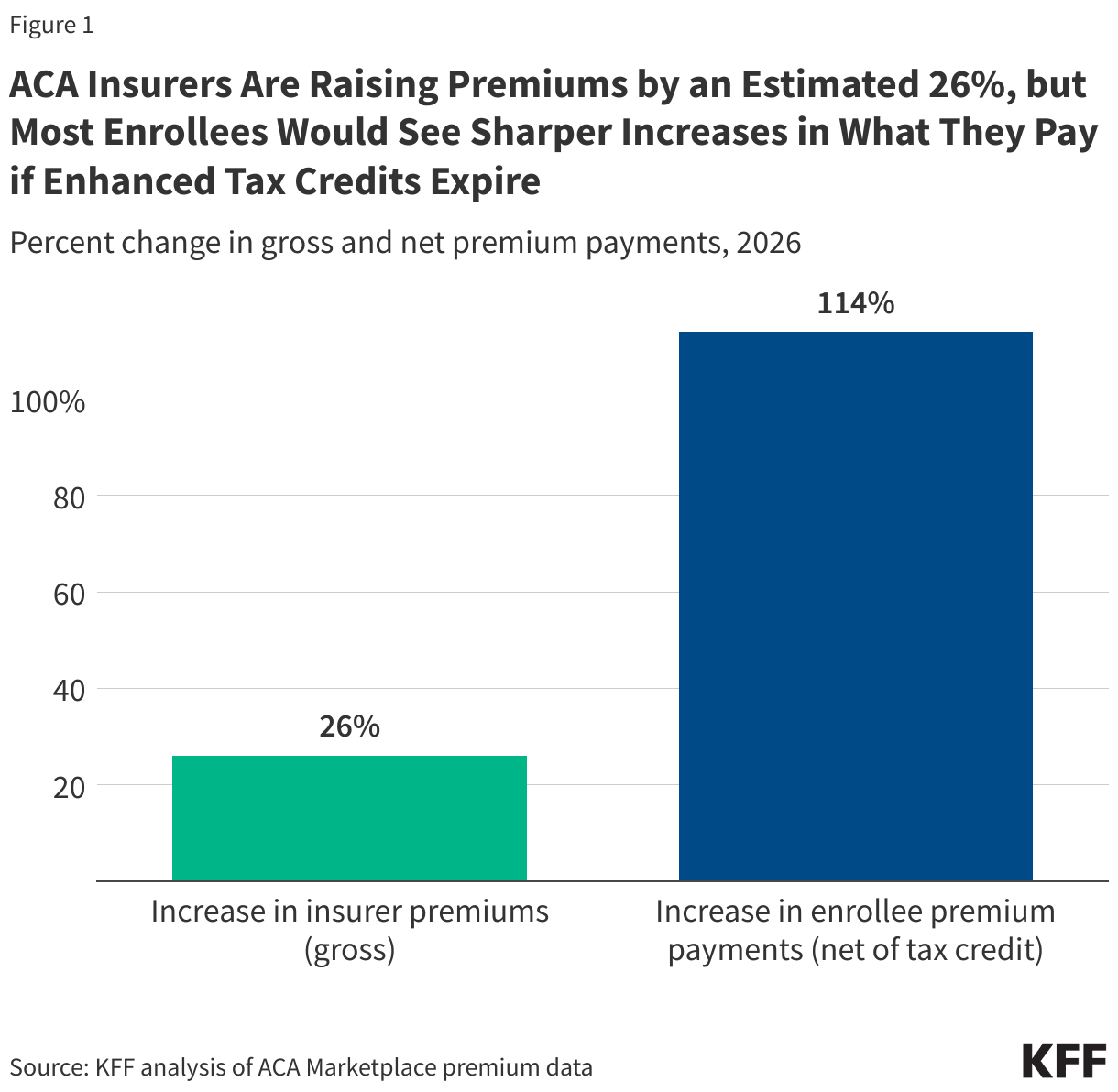
A new analysis of initial rate filings for Affordable Care Act (ACA) Marketplace plans submitted by 312 insurers in all 50 states and the District of Columbia finds the median proposed increase for 2026 is 18%, more than double last year’s 7% median proposed increase. The proposed rates are preliminary and could change before being finalized in late summer.

In addition to rising cost and utilization of services, insurers cited the expiration of enhanced premium tax credits as a significant factor in their rate hikes for next year. The analysis includes a data table showing proposed premium increases by state and by insurers.

The full analysis and other data on health costs are available on the Peterson-KFF Health System Tracker, an online information hub dedicated to monitoring and assessing the performance of the U.S. health system.


Source link

How Much and Why ACA Marketplace Premiums Are Going Up in 2026


rewrite this content and keep HTML tags

A new analysis of initial rate filings for Affordable Care Act (ACA) Marketplace plans submitted by 312 insurers in all 50 states and the District of Columbia finds the median proposed increase for 2026 is 18%, more than double last year’s 7% median proposed increase. The proposed rates are preliminary and could change before being finalized in late summer.

In addition to rising cost and utilization of services, insurers cited the expiration of enhanced premium tax credits as a significant factor in their rate hikes for next year. The analysis includes a data table showing proposed premium increases by state and by insurers.

The full analysis and other data on health costs are available on the Peterson-KFF Health System Tracker, an online information hub dedicated to monitoring and assessing the performance of the U.S. health system.


Source link

How Much is Health Spending Expected to Grow?


rewrite this content and keep HTML tags

This updated chart collection explores how health spending is expected to grow in coming years, based on National Health Expenditure (NHE) projections from federal actuaries.

Health spending is projected to reach $5.6 trillion in 2025, with hospitals making up the largest share of spending ($1.8 trillion). By 2033, health spending is expected to hit $8.6 trillion.

These projections do not account for recent regulatory changes under the Trump Administration, nor do they account for recent legislative changes in the tax and budget law (formerly “the One Big, Beautiful Bill Act”), which the Congressional Budget Office (CBO) expects to decrease spending on Medicaid and the Affordable Care Act (ACA) Marketplaces by over a trillion dollars through 2034.

The analysis can be found on the Peterson-KFF Health System Tracker, an information hub dedicated to monitoring and assessing the performance of the U.S. health system.


Source link

A Closer Look at the $50 Billion Rural Health Fund in the New Reconciliation Law


rewrite this content and keep HTML tags

Editorial Note: Originally published on July 16, this brief is being updated regularly as new information becomes available.

On July 4, 2025, President Trump signed a budget reconciliation bill into law that includes significant reductions in federal health care spending, large tax cuts, and other changes. The new law will reduce federal Medicaid spending alone by $911 billion over ten years and lead to 10 million more people becoming uninsured by 2034 based on Congressional Budget Office (CBO) estimates. While this legislation was being debated, Members of Congress from both parties raised concerns about the potential impact on rural hospitals, particularly given the ongoing trend of rural hospital closures. In response, and just prior to passage, the Senate added $50 billion in funding for a new “rural health transformation program,” referred to here as the “rural health fund.”

This brief describes the rural health fund, explains what the law says about the allocation of funds, and highlights outstanding questions about how the funds will be distributed across and within states to pay rural hospitals and for other purposes. Based on the statutory language, it is not yet clear what specific criteria the Centers for Medicare and Medicaid Services (CMS) will ultimately use to approve or deny state applications and distribute funds across states; what share of the $50 billion fund will go to rural areas; what share will go to the nearly 1,800 hospitals in rural areas or be used for other providers or purposes; whether funds will be targeted to certain types of rural hospitals, such as the 44% of rural hospitals with negative margins; and to what extent the CMS Administrator will be able to influence how states use their funds prior to approving an application. Further, the law does not require CMS to publish information about the distribution of funds so that the allocation decisions are transparent. Similar questions were raised during the COVID-19 pandemic about how well provider relief funds were targeted to hospitals with the greatest need.

The rural health fund includes $50 billion, which is a little over one third (37%) of the estimated loss of federal Medicaid funding in rural areas

The fund provides $50 billion for state grants (DC and the U.S. territories cannot apply). Half ($25 billion) will be distributed by CMS “equally among all states with an approved application,” which appears to suggest that each state with an approved application would receive the same amount from this pool regardless of the size of its rural population, the number of rural hospitals or other providers in the state, the financial standing of its rural hospitals, or other factors. For example, Connecticut (which has 3 rural hospitals based on one definition) could receive the same amount as Kansas (which has 90 rural hospitals) if both are approved for funding. CMS will have some discretion in determining how to allocate the remaining half ($25 billion) (see Figure 1 and more details below).

The Rural Health Fund Includes $50 Billion, With Half Distributed Equally Among States With Approved Applications and Half Distributed Based on an Approach Determined by CMS Within Broad Requirements

States can apply to use the funds in a variety of ways, such as for promoting care interventions, paying for health care services, expanding the rural health workforce, and providing technical assistance with system transformation.

The $50 billion in new funding could offset a little over a third (37%) of the estimated cuts to federal Medicaid spending in rural areas ($137 billion over ten years) based on KFF analysis of CBO’s estimates, or about 5% of the total estimated cuts to federal Medicaid spending ($911 billion over ten years). This does not account for other revenue losses related to the bill, including cuts to federal spending for the ACA Marketplaces, or the revenue losses stemming from the increased number of people who will be uninsured because of the expiration of the enhanced ACA premium tax credits and the implementation of final Marketplace integrity rules. The impact of these changes on rural areas, and the extent to which the rural health fund offsets losses, will vary across the country.

The rural health fund will be temporary, while many of the cuts in health spending are not time limited

While many of the major cuts related to Medicaid and the ACA Marketplaces under the law are not time limited, the rural health fund is temporary. The law provides $10 billion per year through the rural health fund for fiscal years 2026 through 2030, a five-year period. According to statements made by the CMS Administrator, CMS will distribute applications to states in early September 2025, states will submit applications to CMS in that month, and CMS will process their applications in November and send out the first batch of funds at the end of the year. States will be allowed to spend funds that they receive at a given point through the end of the following fiscal year, and CMS may be able to redistribute some unused funds over time, but all funds must be spent before October 1, 2032. New legislation would be required to provide additional support to rural areas after the funds dry up.

The distribution of dollars from the rural health fund will occur before many of the health care spending cuts under the law are fully realized. The rural health fund was put in place, and doubled in size, to address concerns of lawmakers from rural states, and front loading these dollars could allow systems to absorb forthcoming cuts. As described above, the law specifies that rural health fund dollars will first be available for fiscal year 2026, with $10 billion dollars available per year over five years through fiscal year 2030, and all funds must be spent before October 1, 2032. Yet most of the health care spending reductions are backloaded and occur after fiscal year 2030. For example, based on KFF’s analysis of CBO estimates, nearly two thirds (64%) of the ten-year reductions in federal Medicaid spending would occur after fiscal year 2030.

CMS will have broad leeway in how it distributes funds across states

The law grants CMS broad discretion over the distribution of funds and confirms that these decisions are not subject to administrative or judicial review. The law gives CMS authority to determine which state applications to approve or deny, without specifying the criteria CMS should use to make these decisions, though it does specify certain items that states must include in their applications.

As noted above, half of the funds ($25 billion) will be distributed equally among states with approved applications. For the second half of the funds ($25 billion), CMS has more flexibility. The law requires that CMS considers certain factors when distributing these funds (the share of the state population that lives in a rural part of a metropolitan area, the share of rural health facilities in the state as a share of all rural health facilities nationwide, and the situation of hospitals that serve a disproportionate number of low-income patients with special needs). It also allows the CMS Administrator to consider “any other factors that [it] determines appropriate.”  CMS could choose to restrict this $25 billion pool of funds to a subset of states, though the law specifies that it must distribute these funds to at least a quarter of states with approved applications.

States will have discretion in how they distribute funds among hospitals, and other providers, and may be able to steer some dollars to nonrural areas, subject to CMS approval

Just as the law grants CMS broad discretion over the distribution of funds across states, it also permits states to use the funds for a wide variety of purposes, subject to CMS approval. States must use the funds for at least three of the following purposes:

  • Promoting evidence-based, measurable interventions to improve prevention and chronic disease management.
  • Providing payments to health care providers for the provision of health care items or services, as specified by the CMS Administrator.
  • Promoting consumer-facing, technology-driven solutions for the prevention and management of chronic diseases.
  • Providing training and technical assistance for the development and adoption of technology-enabled solutions that improve care delivery in rural hospitals, including remote monitoring, robotics, artificial intelligence, and other advanced technologies.
  • Recruiting and retaining clinical workforce talent to rural areas, with commitments to serve rural communities for a minimum of 5 years.
  • Providing technical assistance, software, and hardware for significant information technology advances designed to improve efficiency, enhance cybersecurity capability development, and improve patient health outcomes.
  • Assisting rural communities to right size their health care delivery systems by identifying needed preventative, ambulatory, pre-hospital, emergency, acute inpatient care, outpatient care, and post-acute care service lines.
  • Supporting access to opioid use disorder treatment services, other substance use disorder treatment services, and mental health services.
  • Developing projects that support innovative models of care that include value-based care arrangements and  alternative payment models, as appropriate.
  • Additional uses designed to promote sustainable access to high quality rural health care services, as determined by the CMS Administrator.

Within the contours of this list, states could restrict the funds to rural hospitals or specific types of rural hospitals (such as those that are isolated and in financial distress) or they could use them for additional or different purposes, such as paying nursing facilities or recruiting clinical workers to rural areas.

While the fund is described as a “rural” program, the law appears to give states some ability to direct some of the dollars to urban and suburban areas, pending CMS approval. For example, most of the permitted uses in the list above do not specify that the funds would need to go to rural areas, such as the description of payments to hospitals and other providers and of support for opioid use treatment services, other substance use disorder treatment services, and mental health services. The current CMS Administrator indicated that nonrural areas could potentially receive money from the fund. The law also does not define “rural” when describing the scope of the program, meaning that states or the administration could do so broadly.

The law does not direct CMS or states to be transparent about the allocation and use of funds

CMS is not required to publish information about how the funds are distributed—such as by posting the amount sent to each state or why certain state applications were approved or denied—though it could choose to do so. States are required to submit annual reports to CMS on the use of the allotments. CMS could require states to disclose information about the amount they receive or the use of funds to the public.

This work was supported in part by Arnold Ventures. KFF maintains full editorial control over all of its policy analysis, polling, and journalism activities.


Source link

Implementation Dates for 2025 Budget Reconciliation Law


rewrite this content and keep HTML tags

On July 4, President Trump signed the budget reconciliation bill, previously known as “One Big Beautiful Bill Act,” into law. The bill includes significant health care policy changes. This timeline provides a brief overview of the specific provisions and their effective dates. You can view all health provisions in the order they are implemented or can filter them by the following categories: Medicaid, Medicare, Affordable Care Act and Health Savings Accounts. You can read a detailed summary of the health provisions of the law.

Implementation Dates for Health Provisions in the 2025 Republican Tax and Spending Cut Legislation


Source link

Health Provisions in the 2025 Federal Budget Reconciliation Law


rewrite this content and keep HTML tags

Eligibility and Cost Sharing Policies

Section 71119: Work Requirements

Background

Prior to passage of the federal budget reconciliation law, Medicaid eligibility could not be conditioned on meeting a work or reporting requirement without obtaining a Medicaid Section 1115 waiver. During the first Trump administration, 13 states received approval to implement work requirements through Section 1115 waivers. Work requirement waiver approvals were either rescinded by the Biden administration or withdrawn by states, and Georgia is the only state with a Medicaid work requirement waiver currently in place. Since the beginning of Trump’s second term, some states have shown renewed interest in pursuing work requirement policies through 1115 waivers.

Description

  • Requires states to condition Medicaid eligibility for individuals ages 19-64 applying for coverage or enrolled through the ACA expansion group (or a waiver) on working or participating in qualifying activities for at least 80 hours per month or attending school at least half-time.
  • Mandates that states exempt certain adults, including parents with children ages 13 and under, those who are medically frail, and those who are participating in a substance use disorder treatment program, from the requirements.
  • Requires states to verify that individuals applying for coverage meet the requirements for 1 and up to a maximum of 3 consecutive months preceding the month of application and that individuals who are enrolled meet the requirements for 1 or more months between the most recent eligibility redeterminations (at least twice per year).
  • Requires states to use data matching “where possible” to verify whether an individual meets the requirement or qualifies for an exemption.
  • Specifies that if a person is denied or disenrolled due to work requirements, they are also ineligible for subsidized Marketplace coverage.
  • Prohibits these provisions from being waived, including under Section 1115 authority.
  • Allows the Secretary to exempt states from compliance with the new requirements until no later than December 31, 2028, if the state is demonstrating a good faith effort to comply and submits progress in compliance or other barriers to compliance.
  • Provides $200 million in funding to states for systems development for FY 2026 and an additional $200 million to HHS to support implementation (for FY 2026).

Effective Date: Not later than December 31, 2026, or earlier at state option.

Budgetary Impact

CBO estimates this provision will reduce federal Medicaid spending by $326 billion over 10 years.

KFF Resources

Section 71107: More Frequent Eligibility Determinations

Background

Under the Affordable Care Act (ACA), states are required to renew eligibility every 12 months for Medicaid enrollees whose eligibility is based on modified adjusted gross income (MAGI), including children, pregnant individuals, parents, and expansion adults. For enrollees whose eligibility is based on age 65+ or disability, states must renew eligibility at least every 12 months . States are required to review eligibility within the 12-month period if they receive information about a change in a beneficiary’s circumstances that may affect eligibility.

Description

  • Requires states to conduct eligibility redeterminations every 6 months for Medicaid expansion adults.
  • Provides $75 million in implementation funding for FY 2026.

Effective Date: For renewals scheduled on or after December 31, 2026.

Budgetary Impact

CBO estimates this provision will reduce federal Medicaid spending by $63 billion over 10 years.

KFF Resources

Section 71103: Verifying Enrollee Address and Other Information

Background

The Eligibility and Enrollment final rule issued in April 2024 requires states to leverage reliable data sources to update enrollee address information, effective June 2025.

Description

  • Requires states to update enrollee address information using reliable data sources, including the National Change of Address Database and managed care entities.
  • Requires the Secretary to establish a system to share information with states for purposes of preventing individuals from being simultaneously enrolled in two states and requires states to submit monthly enrollee SSNs and other information to the system.

Effective Date: January 1, 2027 for states to obtain contact information; October 1, 2029 to establish system to prevent enrollment in two states simultaneously.

Budgetary Impact

CBO estimates this provision will reduce federal Medicaid spending by $17 billion over 10 years.

KFF Resources

Section 71104: Ensuring Deceased Individuals Do Not Remain Enrolled

Description

  • Requires states to review the Master Death File at least quarterly to determine if any enrolled individuals are deceased.

Effective Date: January 1, 2027.

Budgetary Impact

CBO estimates this provision will not affect federal Medicaid spending over 10 years.

KFF Resources

Section 71102: Eligibility and Enrollment Final Rule

Background

In April 2024, CMS issued a final rule to streamline application and enrollment processes in Medicaid, align renewal policies for all Medicaid enrollees, facilitate transitions between Medicaid, CHIP, and subsidized Marketplace coverage, and eliminate certain barriers in CHIP. Implementation deadlines for states vary across provisions, but many provisions in the rule are already in effect, and for others, states are already in compliance.

Description

  • Prohibits the Secretary from implementing, administering, or enforcing certain provisions that have not yet taken effect in an April 2024 CMS final rule until October 1, 2034.

Effective Date: Upon enactment.

Budgetary Impact

CBO estimates this provision will reduce federal Medicaid spending by $56 billion over 10 years.

KFF Resources

Section 71101: Medicare Savings Program Final Rule

Background

In September 2023, CMS issued a final rule to reduce barriers to enrollment in Medicare Savings Programs (MSPs), which provide Medicaid coverage of Medicare premiums and cost sharing for low-income Medicare beneficiaries. Implementation deadlines for states vary across provisions in the rule, but many provisions are already in effect, and for others, states are already in compliance.

Description

  • Prohibits the Secretary from implementing, administering, or enforcing certain provisions that have not yet taken effect in a September 2023 CMS final rule until October 1, 2034.

Effective Date: Upon enactment.

Budgetary Impact

CBO estimates this provision will reduce federal Medicaid spending by $66 billion over 10 years.

KFF Resources

Section 71109: Restricting Immigrant Eligibility for Medicaid and CHIP

Background

In addition to meeting other eligibility requirements, lawfully present immigrants must have a “qualified” immigration status to be eligible for Medicaid or CHIP. Qualified immigrants include: lawful permanent residents (LPRs); refugees; individuals granted parole for at least one year; individuals granted asylum or related relief; certain abused spouses and children; certain victims of trafficking; Cuban and Haitian entrants; and citizens of the Freely Associated States (COFA migrants) residing in states and territories. Many lawfully present immigrants must wait five years after obtaining qualified status before they may enroll in Medicaid; states may waive the five-year wait for children and pregnant individuals (referred to as the ICHIA option). Some states have state-only funded coverage programs for undocumented immigrants.

Description

  • Restricts the definition of qualified immigrants for purposes of Medicaid or CHIP eligibility to Lawful Permanent Residents (“green card” holders), certain Cuban and Haitian immigrants, citizens of the Freely Associated States (COFA migrants) lawfully residing in the US, and lawfully residing children and pregnant adults in states that cover them under the ICHIA option.
  • Provides $15 million in implementation funding for FY 2026.

Effective Date: October 1, 2026.

Budgetary Impact

CBO estimates this provision will reduce federal Medicaid spending by $6 billion over 10 years.

KFF Resources

Section 71112: Retroactive Coverage

Background

Under current law, states are required to provide Medicaid coverage for qualified medical expenses incurred up to 90 days prior to the date of application for coverage.

Description

  • Limits retroactive coverage to one month prior to application for coverage for individuals enrolled through the Medicaid expansion and two months prior to application for coverage for traditional enrollees.
  • Provides $15 million in implementation funding for FY 2026.

Effective Date: January 1, 2027.

Budgetary Impact

CBO estimates this provision will reduce federal Medicaid spending by $4 billion over 10 years.

Section 71120: New Cost Sharing Requirements for Certain Expansion Individuals

Background

States have the option to charge premiums and cost-sharing for Medicaid enrollees within limits, and certain populations and services (emergency, family planning, pregnancy and preventive) are exempt from cost-sharing. Cost-sharing is generally limited to nominal amounts but may be higher for those with income above 100% of the federal poverty level (FPL). Out-of-pocket costs cannot exceed 5% of family income. States may allow providers to deny services to enrollees for nonpayment of copayments.

Description

  • Requires states to impose cost sharing of up to $35 per service on expansion adults with incomes 100-138% FPL; maintains existing exemptions of certain services from cost sharing and exempts primary care, mental health, and substance use disorder services and services provided by federally qualified health centers, behavioral health clinics, and rural health clinics from cost sharing; limits cost sharing for prescription drugs to nominal amounts.
  • Maintains the 5% of family income cap on out-of-pocket costs.
  • Permits states to allow providers to deny services for failure to pay cost sharing but does not prevent providers from reducing or waiving cost sharing.
  • Eliminates enrollment fees or premiums for expansion adults.

Effective Date: October 1, 2028.

Budgetary Impact

CBO estimates this provision will reduce federal Medicaid spending by $7 billion over 10 years.

KFF Resources

Financing

Section 71115: Provider Taxes

Background

States are permitted to finance the non-federal share of Medicaid spending through multiple sources, including state general funds, health care related taxes (or “provider taxes”), and local government funds. Federal rules specify provider taxes must be broad-based and uniform (i.e., states can’t limit provider taxes to only Medicaid providers) and may not hold providers “harmless” (i.e., guarantee providers receive their money back). The hold harmless requirement does not apply when tax revenues comprise 6% or less of providers’ net patient revenues from treating patients (referred to as the “safe harbor” limit).

Description

  • Prohibits all states from establishing any new provider taxes or from increasing the rates of existing taxes.
  • Reduces the safe harbor limit for states that have adopted the ACA expansion by 0.5% annually starting in fiscal year 2028 until the safe harbor limit reaches 3.5% in FY 2032.
  • Applies the new safe harbor limit in expansion states to state and local government taxes on all providers except nursing facilities and intermediate care facilities.
  • Provides $20 million in implementation funding for FY 2026.

Effective Date: Upon enactment for prohibition of new or increased taxes; October 1, 2027 for reduction in safe harbor limit.

Budgetary Impact

CBO estimates this provision will reduce federal Medicaid spending by $191 billion over 10 years.

KFF Resources

Section 71117: Requirements for Provider Tax Uniformity Waivers

Background

States are permitted to finance the non-federal share of Medicaid spending through multiple sources, including state general funds, health care related taxes (or “provider taxes”), and local government funds. Federal rules specify provider taxes must be broad-based and uniform (i.e., states can’t limit provider taxes to only Medicaid providers) and may not hold providers “harmless” (i.e., guarantee providers receive their money back).

Description

  • Revises the conditions under which states may receive a waiver of the requirement that taxes be broad-based and uniform so that some currently permissible taxes, such as those on managed care plans, will no longer be permissible in future years.
  • Provision overlaps with a proposed rule released May 12, 2025.

Effective Date: Upon enactment; HHS Secretary may provide a transition period of up to three years.

Budgetary Impact

CBO estimates this provision will reduce federal Medicaid spending by $35 billion over 10 years.

KFF Resources

Section 71116: State Directed Payments

Background

States are generally not permitted to direct how managed care organizations (MCOs) pay their providers. However, subject to CMS approval, states may use “state directed payments” (SDPs) to require MCOs to pay providers certain rates, make uniform rate increases (that are like fee-for-service supplemental payments), or to use certain payment methods.

A 2024 rule on access to care in Medicaid managed care codified that the upper limit for SDPs is the average commercial rate for hospitals and nursing facilities, which is generally higher than the Medicare payment ceiling used for other Medicaid fee-for-service supplemental payments.

Description

  • Directs HHS to revise Medicaid regulations for state directed payment to cap the total payment rate for inpatient hospital and nursing facility services at 100% of the total published Medicare payment rate for expansion states and at 110% of the total published Medicare payment rate for non-expansion states.
  • Prevents payments approved after May 1, 2025 in excess of the new limits from taking effect unless they are for rural hospitals.
  • Reduces existing payments that are above the allowable Medicare-related payment limit by 10 percentage points each year until they reach the new lower limit.
  • Specifies that in the absence of published Medicare payment rates, the limit is set at the Medicaid fee-for-service payment rate.

Effective Date: Upon enactment for lower limit on new state directed payments; January 1, 2028 for reduction in existing state directed payments above new allowable Medicare-related limit.

Budgetary Impact

CBO estimates this provision will reduce federal Medicaid spending by $149 billion over 10 years.

KFF Resources

Section 71118: Section 1115 Demonstration Waiver Budget Neutrality

Background

Under long-standing policy and practice, Section 1115 demonstration waivers must be “budget neutral” to the federal government over the course of the waiver. Federal costs under an 1115 waiver may not exceed what they would have been for that state without the waiver. Typically, budget neutrality calculations are determined on a per enrollee basis—so, per enrollee spending over the course of the waiver (usually 5 years) cannot exceed the projected per enrollee spending calculated in the “without-waiver baseline.”

Budget neutrality calculations and the use of “savings” when expenditures decrease on account of the waiver are negotiated between states and CMS and the Office of Management and Budget.

Description

  • Specifies the Chief Actuary for CMS must certify 1115 waivers are not expected to result in an increase in federal expenditures compared to federal expenditures without the waiver.
  • Provides $5 million in implementation funding for each of FY 2026 and FY 2027.

Effective Date: January 1, 2027.

Budgetary Impact

CBO estimates this provision will reduce federal Medicaid spending by $3 billion over 10 years.

KFF Resources

Section 71106: Payment Reduction for Certain Erroneous Medicaid Payments

Background

Federal law directs CMS to recoup federal funds for erroneous payments made for ineligible individuals and overpayments for eligible individuals if the state’s eligibility “error rate” exceeds 3%. CMS may waive the recoupment if the Medicaid agency has taken steps to demonstrate a “good faith” effort to get below the 3% allowable threshold.

Description

  • Requires HHS to reduce federal financial participation to states for identified improper payment errors related to payments made for ineligible individuals and overpayments made for eligible individuals.
  • Expands the definition of improper payments to include payments where insufficient information is available to confirm eligibility.

Effective Date: October 1, 2029.

Budgetary Impact

CBO estimates this provision will reduce federal Medicaid spending by $8 billion over 10 years.

KFF Resources

Medicaid Expansion

Section 71114: Eliminating Temporary Financial Incentive for Medicaid Expansion

Background

The Affordable Care Act expands Medicaid eligibility to non-elderly adults with incomes up to 138% FPL based on modified adjusted gross income and provides 90% federal financing for the expansion population. The Supreme Court effectively made expansion an option for states. The American Rescue Plan Act (ARPA) added a temporary financial incentive for states that newly adopt expansion. Currently, 41 states, including DC, have implemented the Medicaid expansion.

Description

  • Eliminates the temporary incentive for states that newly adopt the Medicaid expansion.

Effective Date: January 1, 2026.

Budgetary Impact

CBO estimates this provision will reduce federal Medicaid spending by $14 billion over 10 years.

KFF Resources

Section 71110: Federal Medical Assistance Percentage (FMAP) for Emergency Medicaid

Background

Emergency Medicaid reimburses hospitals for the costs of emergency care provided to immigrants who would qualify for Medicaid except for their immigration status, which hospitals are required to provide under federal law. States receive federal matching payments based on the federal medical assistance percentage (FMAP), which is computed using a formula that takes into account states’ per capita income, for traditional populations; they receive a 90% federal match rate for individuals enrolled in the Medicaid expansion.

Description

  • Limits federal matching payments for Emergency Medicaid for individuals who would otherwise be eligible for expansion coverage except for their immigration status to the state’s regular FMAP.
  • Provides $1 million in implementation funding for FY 2026.

Effective Date: October 1, 2026.

Budgetary Impact

CBO estimates this provision will reduce federal Medicaid spending by $28 billion over 10 years.

KFF Resources

Long-term Care

Section 71111: Nursing Home Staffing Final Rule

Background

A 2024 Biden-administration final rule requires long-term care facilities (LTC) to meet minimum staffing levels (including a 24/7 RN on-site and a minimum of 3.48 total nurse staffing hours per resident day), requires state Medicaid agencies to report the share of Medicaid payments for institutional LTC that are spent on worker compensation, and provides funding for people to enter careers in nursing homes.

On April 7, 2025, the US District Court for Northern Texas ruled to overturn the minimum staffing requirements, and it is expected that the Administration will not appeal that decision.

Description

  • Prohibits the Secretary of Health and Human Services from implementing, administering, or enforcing the minimum staffing levels required by the final rule until October 1, 2034.

Effective Date: Upon enactment.

Budgetary Impact

CBO estimates this provision will reduce federal Medicaid spending by $23 billion over 10 years.

KFF Resources

Section 71108: Home Equity Limits

Background

Most Medicaid enrollees who qualify for Medicaid because they need long-term care (LTC) are subject to limits on their home equity. In 2025, federal rules specified that states’ limits on home equity must be between $730,000 and $1,097,000, and those amounts are updated each year for inflation.

Description

  • Reduces the maximum home equity limits to $1,000,000 regardless of inflation.
  • Allows states to apply different requirements for homes that are located on farms.

Effective Date: January 1, 2028.

Budgetary Impact

CBO estimates this provision will reduce federal Medicaid spending by $195 million over 10 years.

KFF Resources

Section 71121: New Home and Community Based Services (HCBS)

Background

States are required to cover nursing facility care under Medicaid, but nearly all home care (HCBS) is optional. Nearly all states provide home care through “1915(c) waivers,” which limit services to people who require an institutional level of care. Because those services are optional, states may limit the amount of care people receive and the number of people receiving services. Most states have waiting lists because the number of people seeking services exceeds the amount of care available.

Description

  • Allows states to establish 1915(c) HCBS waivers for people who do not need an institutional level of care.
  • Requires state waiver submissions to demonstrate that new waivers will not increase the average amount of time that people who need an institutional level of care will wait for services.
  • Includes $50 million in FY 2026 and $100 million in FY 2027 for implementation.

Effective Date: July 1, 2028 for new waiver approvals.

Budgetary Impact

CBO estimates this provision will increase federal Medicaid spending by $7 billion over 10 years.

KFF Resources

Access

Section 71401: Rural Health Transformation Program

Description

  • Establishes a rural health transformation program that will provide $50 billion in grants to states between fiscal years 2026 and 2030, to be used for payments to rural health care providers and for other purposes.
  • Distributes 50% of payments equally across states with approved applications; the remaining funds will be distributed by CMS based at least in part on states’ rural populations that live in metropolitan statistical areas, the percent of rural health facilities nationwide that are located in a state, and the situation of hospitals that serve a disproportionate number of low-income patients with special needs.
  • Uses of funds include promoting care interventions, paying for health care services, expanding the rural health workforce, and providing technical or operational assistance aimed at system transformation.
  • Provides CMS with $200 million in implementation funding for FY 2025.

Effective Date: Upon enactment but funding is first available in fiscal year 2026. CMS to determine state application deadline, which will be no later than December 31, 2025.

Budgetary Impact

CBO estimates this provision will increase federal spending by $47 billion over 10 years.

KFF Resources

Section 71113: Prohibiting Federal Medicaid Payments to Certain Providers

Background

States must generally allow beneficiaries to obtain Medicaid services from any provider that is qualified and willing to furnish services. Managed care organizations (MCOs) may restrict enrollees to providers in the MCO’s network, except that such plans cannot restrict free choice of family planning providers.

Description

  • Prohibits federal Medicaid funds to be paid to providers that meet the following criteria on October 1, 2025: are nonprofit organizations, essential community providers primarily engaged in family planning services or reproductive services, provide for abortions outside of the Hyde exceptions and received $800,000 or more in payments from Medicaid in 2023; this would affect Planned Parenthood and other Medicaid essential community providers.
  • Provides $1 million in implementation funding for FY 2026.

Effective Date: Upon enactment for 1 year; implementation is currently blocked for some providers due to ongoing litigation.

Budgetary Impact

CBO estimates this provision will increase federal spending by $53 million over 10 years.

KFF Resources

Section 71105: Medicaid Provider Screening Requirements

Background

Provider screening and enrollment is required for all providers in Medicaid fee-for-service or managed care networks. Additionally, the ACA requires states to terminate provider participation in Medicaid if the provider was terminated under Medicare or another state program. CMS has multiple tools to assist states with provider screening and enrollment compliance, including leveraging Medicare data.

Description

  • Requires states to conduct checks at provider enrollment or reenrollment and on a quarterly basis of the Social Security Administration’s Death Master File to determine whether providers enrolled in Medicaid are deceased.

Effective Date: January 1, 2028.

Budgetary Impact

CBO estimates this provision will not affect federal Medicaid spending over 10 years.

KFF Resources


Source link