Home Blog Page 17

Individual Market Insurers Requesting Largest Premium Increases in More Than 5 Years


rewrite this content and keep HTML tags

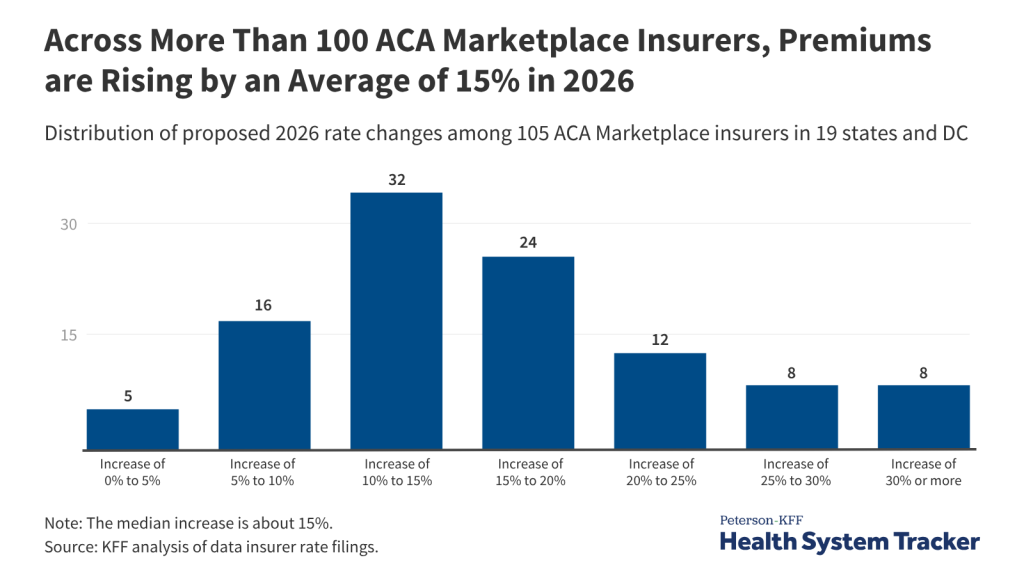
This analysis of preliminary rate filings submitted by 105 ACA Marketplace insurers in 19 states and DC finds that ACA Marketplace insurers are requesting a median premium increase of 15% for 2026, which would represent the largest hike in premiums since 2018, the last time policy uncertainty contributed to sharp premium growth.

In addition to the anticipated growth in the cost of health care services, insurers have cited several policy changes that they expect to drive up rates next year, including the expiration of the enhanced premium tax credits at the end of this year and the impact of tariffs on some drugs, medical equipment, and supplies.

The full analysis and other data on health costs are available on the Peterson-KFF Health System Tracker, an online information hub dedicated to monitoring and assessing the performance of the U.S. health system.


Source link

Health Care Access and Financial Barriers Among LGBT People Amidst Looming Health Care Cuts


rewrite this content and keep HTML tags

On July 4, 2025, President Trump signed the recent reconciliation bill into law which is expected to leave millions of low- and moderate-income people uninsured as they lose access to Medicaid. Additionally, questions remain about whether Congress will preserve enhanced Affordable Care Act (ACA) premium tax credits for those with marketplace coverage, without which millions more could find premiums unaffordable, disenroll, and become uninsured. Given LGBT adults have lower incomes and higher rates of Medicaid coverage than non-LGBT adults, these changes could disproportionately impact this community. Additionally, as LGBT people experience a wide range of health disparities, cost barriers may serve to exacerbate these differences.

This brief reviews new data from the May 2025 KFF Health Tracking Poll on LGBT adult’s experiences and concerns related to health care affordability. Overall, the survey findings show that LGBT adults face more widespread problems and concerns with health care affordability compared to non-LGBT adults. While this may reflect the lower average incomes of LGBT adults, many of these concerns cut across income, with similar shares of LGBT adults reporting concerns regardless of whether they have lower- or more moderate- income.

Findings

U.S. adults face challenges affording a range of common expenses, including those related to health care. Half (51%) of LGBT adults say that in the past year, they or a family member living with them has had problems paying for food, housing, transportation, or other necessities. This compares to three in ten non-LGBT adults. Over one-third (36%) of LGBT adults say they or a family member living with them has had problems paying for health care, compared to one in five (21%) non-LGBT adults. The differences between these groups may be due in part to LGBT adults generally being younger and having lower household incomes than non-LGBT adults. However, even when looking only at those under 35 years old, LGBT adults are still more likely than non-LGBT adults to say they or a household member had problems paying for necessities (62% vs. 38%) and health care (46% vs. 24%).

More than One-Third of LGBT People Say They or a Household Member Face Problems Paying for Health Care, More Than Half Face Challenges Paying for Other Necessities

LGBT adults with household incomes under $40,000 are more likely than LGBT adults with higher incomes to say they or a household member have experienced problems paying for food, housing and other basic necessities in the past year (63% vs. 36%). Issues with health care affordability cut across income levels among LGBT adults, as 40% of lower-income LGBT adults report problems paying for health care in the past 12 months, statistically similar to the share of higher-income LGBT adults who say the same (32%).

Similar Shares of LGBT Adults Across Income Groups Say They Face Problems Paying for Health Care

Paying for health care can be a burden for individuals and families, including for LGBT adults who tend to have lower incomes. About half (52%) of LGBT adults say it is difficult for them to afford their health care costs, including about one in five (18%) who say it is very difficult. This experience is more common among LGBT adults than non-LGBT adults and is driven by those finding affordability very difficult.

About Half of LGBT Adults Face Difficulties Affording Health Care, with About One in Five Saying it is Very Difficult

These challenges with affordability can have an impact on access to and willingness to seek care. Half (51%) of LGBT adults report that they have skipped or postponed getting the health care they needed in the past year because of the cost compared to one-third (34%) of non-LGBT adults. About half of LGBT adults with incomes under $40,000 (50%) and about half of those with incomes of $40,000 or more (53%) say they have skipped getting needed health care because of the cost. Additionally, one in four (25%) LGBT adults say their health got worse because they skipped or postponed care because of the cost, compared to 18% of non-LGBT adults who say the same.

Half of LGBT Adults Report Skipping or Postponing Care Due to Cost and One in Four Say Their Health Got Worse as a Result

Similarly, costs related to prescription drugs also lead some LGBT adults to take actions to reduce their expenses in this area. About one-third (32%) have taken an over-the-counter drug instead of getting a prescription filled, a quarter (26%) have not filled a prescription because of the cost, and almost as many (23%) have cut pills in half or skipped doses. More than four in ten LGBT adults (44%) report taking at least one of these actions, compared to about a third (32%) of non-LGBT adults. Notably, similar shares of LGBT adults with incomes under $40,000 and those with incomes of $40,000 or more report taking at least one of these cost saving actions with their prescription medications (43% and 46% respectively).

More than Four in Ten LGBT Adults Report Taking Cost-Saving Actions Related to Prescription Medication Cost, Including Not Filling it and Skipping Doses

Not surprisingly, these experiences translate to worry. Over half of LGBT adults express worry about being able to afford each of the following for themselves and their family: health costs, unexpected medical bills, rent/mortgage, food, gas/transportation, and utilities. Worry about affording health costs and unexpected medical bills are among the expenses of greatest concern to LGBT adults, with about two-thirds reporting they are worried about these expenses (68% and 66%, respectively). LGBT adults are more likely than non-LGBT adults to report affordability concerns related to rent/mortgage, food, and gas/transportation and similarly likely to report such concerns related to health care costs.

Worry About Affording Health Services Costs is Widespread Among LGBT People


Source link

Health Care Access and Financial Barriers Among LGBT People Amidst Looming Health Care Cuts


rewrite this content and keep HTML tags

On July 4, 2025, President Trump signed the recent reconciliation bill into law which is expected to leave millions of low- and moderate-income people uninsured as they lose access to Medicaid. Additionally, questions remain about whether Congress will preserve enhanced Affordable Care Act (ACA) premium tax credits for those with marketplace coverage, without which millions more could find premiums unaffordable, disenroll, and become uninsured. Given LGBT adults have lower incomes and higher rates of Medicaid coverage than non-LGBT adults, these changes could disproportionately impact this community. Additionally, as LGBT people experience a wide range of health disparities, cost barriers may serve to exacerbate these differences.

This brief reviews new data from the May 2025 KFF Health Tracking Poll on LGBT adult’s experiences and concerns related to health care affordability. Overall, the survey findings show that LGBT adults face more widespread problems and concerns with health care affordability compared to non-LGBT adults. While this may reflect the lower average incomes of LGBT adults, many of these concerns cut across income, with similar shares of LGBT adults reporting concerns regardless of whether they have lower- or more moderate- income.

Findings

U.S. adults face challenges affording a range of common expenses, including those related to health care. Half (51%) of LGBT adults say that in the past year, they or a family member living with them has had problems paying for food, housing, transportation, or other necessities. This compares to three in ten non-LGBT adults. Over one-third (36%) of LGBT adults say they or a family member living with them has had problems paying for health care, compared to one in five (21%) non-LGBT adults. The differences between these groups may be due in part to LGBT adults generally being younger and having lower household incomes than non-LGBT adults. However, even when looking only at those under 35 years old, LGBT adults are still more likely than non-LGBT adults to say they or a household member had problems paying for necessities (62% vs. 38%) and health care (46% vs. 24%).

LGBT adults with household incomes under $40,000 are more likely than LGBT adults with higher incomes to say they or a household member have experienced problems paying for food, housing and other basic necessities in the past year (63% vs. 36%). Issues with health care affordability cut across income levels among LGBT adults, as 40% of lower-income LGBT adults report problems paying for health care in the past 12 months, statistically similar to the share of higher-income LGBT adults who say the same (32%).

Paying for health care can be a burden for individuals and families, including for LGBT adults who tend to have lower incomes. About half (52%) of LGBT adults say it is difficult for them to afford their health care costs, including about one in five (18%) who say it is very difficult. This experience is more common among LGBT adults than non-LGBT adults and is driven by those finding affordability very difficult.

These challenges with affordability can have an impact on access to and willingness to seek care. Half (51%) of LGBT adults report that they have skipped or postponed getting the health care they needed in the past year because of the cost compared to one-third (34%) of non-LGBT adults. About half of LGBT adults with incomes under $40,000 (50%) and about half of those with incomes of $40,000 or more (53%) say they have skipped getting needed health care because of the cost. Additionally, one in four (25%) LGBT adults say their health got worse because they skipped or postponed care because of the cost, compared to 18% of non-LGBT adults who say the same.

Similarly, costs related to prescription drugs also lead some LGBT adults to take actions to reduce their expenses in this area. About one-third (32%) have taken an over-the-counter drug instead of getting a prescription filled, a quarter (26%) have not filled a prescription because of the cost, and almost as many (23%) have cut pills in half or skipped doses. More than four in ten LGBT adults (44%) report taking at least one of these actions, compared to about a third (32%) of non-LGBT adults. Notably, similar shares of LGBT adults with incomes under $40,000 and those with incomes of $40,000 or more report taking at least one of these cost saving actions with their prescription medications (43% and 46% respectively).

Not surprisingly, these experiences translate to worry. Over half of LGBT adults express worry about being able to afford each of the following for themselves and their family: health costs, unexpected medical bills, rent/mortgage, food, gas/transportation, and utilities. Worry about affording health costs and unexpected medical bills are among the expenses of greatest concern to LGBT adults, with about two-thirds reporting they are worried about these expenses (68% and 66%, respectively). LGBT adults are more likely than non-LGBT adults to report affordability concerns related to rent/mortgage, food, and gas/transportation and similarly likely to report such concerns related to health care costs.


Source link

Americans’ Challenges with Health Care Costs


rewrite this content and keep HTML tags

This brief was updated on July 11, 2025 to include the latest KFF polling data.

For many years, KFF polling has found that the high cost of health care is a burden on U.S. families, and that health care costs factor into decisions about insurance coverage and care seeking. These costs and the prospect of unexpected medical bills also rank as the top financial worries for adults and their families. This data note summarizes recent KFF polling on the public’s experiences with health care costs. Main takeaways include:

Just under half of U.S. adults say it is difficult to afford health care costs, and one in four say they or a family member in their household had problems paying for health care in the past 12 months. Black and Hispanic adults, those with lower incomes, and the uninsured are particularly likely to report problems affording health care in the past year.

The cost of health care can lead some to put off needed care. About one-third (36%) of adults say that in the past 12 months they have skipped or postponed getting health care they needed because of the cost. Notably three in four (75%) uninsured adults under age 65 say they went without needed care because of the cost.

The cost of prescription drugs prevents some people from filling prescriptions. About one in five adults (21%) say they have not filled a prescription because of the cost while a similar share (23%) say they have instead opted for over-the-counter alternatives. About one in seven adults say they have cut pills in half or skipped doses of medicine in the last year because of the cost. A third of all adults say they have taken at least one of these cost saving measures in the past year, including larger shares of women and those with lower incomes.

Health care debt is a burden for a large share of Americans. In 2022, about four in ten adults (41%) reported having debt due to medical or dental bills including debts owed to credit cards, collections agencies, family and friends, banks, and other lenders to pay for their health care costs, with disproportionate shares of Black and Hispanic adults, women, parents, those with low incomes, and uninsured adults saying they have health care debt.

Those who are covered by health insurance are not immune to the burden of health care costs. Almost four in ten insured adults under the age of 65 (38%) worry about affording their monthly health insurance premium and large shares of adults with employer-sponsored insurance (ESI) and those with Marketplace coverage rate their insurance as “fair” or “poor” when it comes to their monthly premium and to out-of-pocket costs to see a doctor.

Notable shares of adults say they are worried about affording medical costs such as the cost of health care services (including out-of-pocket costs not covered by insurance, such as co-pays and deductibles) or unexpected bills. About six in ten adults say they are either “very” or “somewhat worried” about being able to afford the cost of health care services (62%) or unexpected medical bills (61%) for themselves and their families.

Difficulty Affording Medical Costs

Many U.S. adults have trouble affording health care costs. While lower income and uninsured adults are the most likely to report this, those with health insurance and those with higher incomes are not immune to the high cost of medical care. Just under half of U.S. adults say that it is very or somewhat difficult for them to afford their health care costs (44%). Uninsured adults under age 65 are much more likely to say affording health care costs is difficult (82%) compared to those with health insurance coverage (42%). Additionally, a slight majority of Hispanic adults (55%) and half of Black adults (49%) report difficulty affording health care costs compared to about four in ten White adults (39%). Adults in households with annual incomes under $40,000 are more likely than adults in households with higher incomes to say it is difficult to afford their health care costs. (Source: KFF Health Tracking Poll: May 2025)

When asked specifically about problems paying for health care in the past year, about one in four (23%) adults say they or a family member in their household had problems paying for care, including three in ten Hispanic adults (33%) and Black adults (30%). Over half (55%) of uninsured adults under age 65 say they or a family member in their household had problems paying for health care, compared to just one in five (22%) insured adults. (Source: KFF Health Tracking Poll: May 2025)

The cost of care can also lead some adults to skip or delay seeking services, with one-third (36%) of adults saying that they have skipped or postponed getting needed health care in the past 12 months because of the cost. Women are more likely than men to say they have skipped or postponed getting health care they needed because of the cost (38% vs. 32%). Adults ages 65 and older, most of whom are eligible for health care coverage through Medicare, are much less likely than younger age groups to say they have not gotten health care they needed because of cost.

Three-quarters of uninsured adults say they have skipped or postponed getting the health care they needed due to cost. Having health insurance, however, does not offer ironclad protection as about four in ten adults with insurance (37%) still report not getting health care they needed due to cost. (Source: KFF Health Tracking Poll: May 2025)

Skipping care due to costs can have notable health impacts. Nearly two in ten adults (18%) report that their health got worse because they skipped or delayed getting care. Among adults under age 65, those who are uninsured are twice as likely as those with health coverage to say that their health worsened due to skipped or postponed care (42% vs. 20%). About four times as many adults under age 65 (23%) say their health got worse after skipping or postponing care as adults ages 65 and older (6%), most of whom have Medicare coverage. (Source: KFF Health Tracking Poll: May 2025)

A 2022 KFF report found that people who already have debt due to medical or dental care are disproportionately likely to put off or skip medical care. Half (51%) of adults currently experiencing debt due to medical or dental bills say in the past year, cost has been a probititor to getting the medical test or treatment that was recommended by a doctor. (Source: KFF Health Care Debt Survey: Feb.-Mar. 2022)

Prescription Drug Costs

The high cost of prescription drugs also leads some people to cut back on their medications in various ways. About one in four adults (23%) say in the past 12 months they have taken an over-the-counter drug instead of getting a prescription filled because of cost concerns and about one in five (21%) say they have not filled a prescription due to the cost. Additionally, about one in seven adults (15%) say that in the past 12 months they have cut pills in half or skipped doses of medicine due to cost.

One-third of the public (33%) say they have taken any of these cost saving measures in the past 12 months. Four in ten women (39%) say they have taken any of these prescription medication measures compared to one-quarter (26%) of men. Additionally, just under half of Hispanic adults (46%) say they’ve either taken an over-the-counter drug, skipped doses, or not filled prescriptions because of the cost, compared to three in ten (29%) White adults who say the same. Similarly, larger shares those with lower incomes report having taken a cost-saving measure in the last year compared to those with higher incomes (41% of those with a household income of less than $40,000 a year vs. 29% of those with an income of $40,000 or more). (Source: KFF Health Tracking Poll: May 2025)

Notably, adults with chronic conditions, who tend to have higher health care and medication needs, can often face challenges affording prescriptions. In KFF’s 2023 Survey of Consumer Experiences with Health Insurance, insured adult with a chronic condition were twice as likely as those without a chronic condition to say they had delayed or gone without prescription drugs due to the cost (18% vs. 9%).

Health Insurance Cost Ratings

Health insurance provides some financial protection, but premiums and out-of-pocket costs can still present a financial burden for many individuals. Overall, most insured adults rate their health insurance as “excellent” or “good” when it comes to the amount they have to pay out-of-pocket for their prescriptions (61%), the amount they have to pay out-of-pocket to see a doctor (53%), and the amount they pay monthly for insurance (54%). However, at least three in ten rate their insurance as “fair” or “poor” on each of these metrics, and affordability ratings vary depending on the type of coverage people have.

Adults who have private insurance through employer-sponsored insurance or Marketplace coverage are more likely than those with Medicare or Medicaid to rate their insurance negatively when it comes to their monthly premium, the amount they have to pay out of pocket to see a doctor, and their prescription co-pays. About one in four adults with Medicare give negative ratings to the amount they have to pay each month for insurance and to their out-of-pocket prescription costs, while about one in five give their insurance a negative rating when it comes to their out-of-pocket costs to see a doctor.

Medicaid enrollees are less likely than those with other coverage types to give their insurance negative ratings on these affordability measures (Medicaid does not charge monthly premiums in most states, and copays for covered services, where applied, are required to be nominal). (Source: KFF Survey of Consumer Experiences with Health Insurance)

Health Care Debt

In June 2022, KFF released an analysis of the KFF Health Care Debt Survey, a companion report to the investigative journalism project on health care debt conducted by KFF Health News and NPR, Diagnosis Debt. This project found that health care debt is a wide-reaching problem in the United States and that 41% of U.S. adults currently have some type of debt due to medical or dental bills from their own or someone else’s care, including about a quarter of adults (24%) who say they have medical or dental bills that are past due or that they are unable to pay, and one in five (21%) who have bills they are paying off over time directly to a provider. One in six (17%) report debt owed to a bank, collection agency, or other lender from loans taken out to pay for medical or dental bills, while similar shares say they have health care debt from bills they put on a credit card and are paying off over time (17%). One in ten report debt owed to a family member or friend from money they borrowed to pay off medical or dental bills.

While four in ten U.S. adults have some type of health care debt, disproportionate shares of lower income adults, the uninsured, Black and Hispanic adults, women, and parents report current debt due to medical or dental bills.

Vulnerabilities and Worries About Health Care and Long-Term Care Costs

KFF’s May 2025 Health Tracking Poll shows the cost of health care services and unexpected medical bills are at the top of the list of people’s financial worries, with about six in ten saying they are at least somewhat worried about affording the cost of health care services (62%) or unexpected medical bills (61%) for themselves and their families. These are larger than the shares who say they worry about affording housing costs (51%), transportation expenses (50%), utilities (49%), and food (48%) for their families.

Notably, eight in ten uninsured adults under age 65 say they are worried about affording the cost of health care services or unexpected medical bills (82% and 80%, respectively). About four in ten (38%) insured adults under the age of 65 say they are worried about affording their monthly health insurance premium. (Source: KFF Health Tracking Poll: May 2025)

Many U.S. adults may be one unexpected medical bill from falling into debt. About half of U.S. adults say they would not be able to pay an unexpected medical bill that came to $500 out of pocket. This includes one in five (19%) who would not be able to pay it at all, 5% who would borrow the money from a bank, payday lender, friends or family to cover the cost, and one in five (21%) who would incur credit card debt in order to pay the bill. Women, those with lower household incomes, Black and Hispanic adults are more likely than their counterparts to say they would be unable to afford this type of bill. (Source: KFF Health Care Debt Survey: Feb.-Mar. 2022)

Among older adults, the costs of long-term care and support services are also a concern. Almost six in ten (57%) adults 65 and older say they are at least “somewhat anxious” about affording the cost of a nursing home or assisted living facility if they needed it, and half say they feel anxious about being able to afford support services such as paid nurses or aides. These concerns also loom large among those between the ages of 50 and 64, with more than seven in ten saying they feel anxious about affording residential care (73%) and care from paid nurses or aides (72%) if they were to need these services. See The Affordability of Long-Term Care and Support Services: Findings from a KFF Survey for a deeper dive into concerns about the affordability of nursing homes and support services.


Source link

Americans’ Challenges with Health Care Costs


rewrite this content and keep HTML tags
This brief was updated on July 11, 2025 to include the latest KFF polling data.
For many years, KFF polling has found that the high cost of health care is a burden on U.S. families, and that health care costs factor into decisions about insurance coverage and care seeking. These costs and the prospect of unexpected medical bills also rank as the top financial worries for adults and their families. This data note summarizes recent KFF polling on the public’s experiences with health care costs. Main takeaways include:

Just under half of U.S. adults say it is difficult to afford health care costs, and one in four say they or a family member in their household had problems paying for health care in the past 12 months. Black and Hispanic adults, those with lower incomes, and the uninsured are particularly likely to report problems affording health care in the past year.
The cost of health care can lead some to put off needed care. About one-third (36%) of adults say that in the past 12 months they have skipped or postponed getting health care they needed because of the cost. Notably three in four (75%) uninsured adults under age 65 say they went without needed care because of the cost.
The cost of prescription drugs prevents some people from filling prescriptions. About one in five adults (21%) say they have not filled a prescription because of the cost while a similar share (23%) say they have instead opted for over-the-counter alternatives. About one in seven adults say they have cut pills in half or skipped doses of medicine in the last year because of the cost. A third of all adults say they have taken at least one of these cost saving measures in the past year, including larger shares of women and those with lower incomes.
Health care debt is a burden for a large share of Americans. In 2022, about four in ten adults (41%) reported having debt due to medical or dental bills including debts owed to credit cards, collections agencies, family and friends, banks, and other lenders to pay for their health care costs, with disproportionate shares of Black and Hispanic adults, women, parents, those with low incomes, and uninsured adults saying they have health care debt.
Those who are covered by health insurance are not immune to the burden of health care costs. Almost four in ten insured adults under the age of 65 (38%) worry about affording their monthly health insurance premium and large shares of adults with employer-sponsored insurance (ESI) and those with Marketplace coverage rate their insurance as “fair” or “poor” when it comes to their monthly premium and to out-of-pocket costs to see a doctor.
Notable shares of adults say they are worried about affording medical costs such as the cost of health care services (including out-of-pocket costs not covered by insurance, such as co-pays and deductibles) or unexpected bills. About six in ten adults say they are either “very” or “somewhat worried” about being able to afford the cost of health care services (62%) or unexpected medical bills (61%) for themselves and their families.

Difficulty Affording Medical Costs
Many U.S. adults have trouble affording health care costs. While lower income and uninsured adults are the most likely to report this, those with health insurance and those with higher incomes are not immune to the high cost of medical care. Just under half of U.S. adults say that it is very or somewhat difficult for them to afford their health care costs (44%). Uninsured adults under age 65 are much more likely to say affording health care costs is difficult (82%) compared to those with health insurance coverage (42%). Additionally, a slight majority of Hispanic adults (55%) and half of Black adults (49%) report difficulty affording health care costs compared to about four in ten White adults (39%). Adults in households with annual incomes under $40,000 are more likely than adults in households with higher incomes to say it is difficult to afford their health care costs. (Source: KFF Health Tracking Poll: May 2025)

When asked specifically about problems paying for health care in the past year, about one in four (23%) adults say they or a family member in their household had problems paying for care, including three in ten Hispanic adults (33%) and Black adults (30%). Over half (55%) of uninsured adults under age 65 say they or a family member in their household had problems paying for health care, compared to just one in five (22%) insured adults. (Source: KFF Health Tracking Poll: May 2025)

The cost of care can also lead some adults to skip or delay seeking services, with one-third (36%) of adults saying that they have skipped or postponed getting needed health care in the past 12 months because of the cost. Women are more likely than men to say they have skipped or postponed getting health care they needed because of the cost (38% vs. 32%). Adults ages 65 and older, most of whom are eligible for health care coverage through Medicare, are much less likely than younger age groups to say they have not gotten health care they needed because of cost.
Three-quarters of uninsured adults say they have skipped or postponed getting the health care they needed due to cost. Having health insurance, however, does not offer ironclad protection as about four in ten adults with insurance (37%) still report not getting health care they needed due to cost. (Source: KFF Health Tracking Poll: May 2025)

Skipping care due to costs can have notable health impacts. Nearly two in ten adults (18%) report that their health got worse because they skipped or delayed getting care. Among adults under age 65, those who are uninsured are twice as likely as those with health coverage to say that their health worsened due to skipped or postponed care (42% vs. 20%). About four times as many adults under age 65 (23%) say their health got worse after skipping or postponing care as adults ages 65 and older (6%), most of whom have Medicare coverage. (Source: KFF Health Tracking Poll: May 2025)

A 2022 KFF report found that people who already have debt due to medical or dental care are disproportionately likely to put off or skip medical care. Half (51%) of adults currently experiencing debt due to medical or dental bills say in the past year, cost has been a probititor to getting the medical test or treatment that was recommended by a doctor. (Source: KFF Health Care Debt Survey: Feb.-Mar. 2022)
Prescription Drug Costs
The high cost of prescription drugs also leads some people to cut back on their medications in various ways. About one in four adults (23%) say in the past 12 months they have taken an over-the-counter drug instead of getting a prescription filled because of cost concerns and about one in five (21%) say they have not filled a prescription due to the cost. Additionally, about one in seven adults (15%) say that in the past 12 months they have cut pills in half or skipped doses of medicine due to cost.
One-third of the public (33%) say they have taken any of these cost saving measures in the past 12 months. Four in ten women (39%) say they have taken any of these prescription medication measures compared to one-quarter (26%) of men. Additionally, just under half of Hispanic adults (46%) say they’ve either taken an over-the-counter drug, skipped doses, or not filled prescriptions because of the cost, compared to three in ten (29%) White adults who say the same. Similarly, larger shares those with lower incomes report having taken a cost-saving measure in the last year compared to those with higher incomes (41% of those with a household income of less than $40,000 a year vs. 29% of those with an income of $40,000 or more). (Source: KFF Health Tracking Poll: May 2025)
Notably, adults with chronic conditions, who tend to have higher health care and medication needs, can often face challenges affording prescriptions. In KFF’s 2023 Survey of Consumer Experiences with Health Insurance, insured adult with a chronic condition were twice as likely as those without a chronic condition to say they had delayed or gone without prescription drugs due to the cost (18% vs. 9%).

Health Insurance Cost Ratings
Health insurance provides some financial protection, but premiums and out-of-pocket costs can still present a financial burden for many individuals. Overall, most insured adults rate their health insurance as “excellent” or “good” when it comes to the amount they have to pay out-of-pocket for their prescriptions (61%), the amount they have to pay out-of-pocket to see a doctor (53%), and the amount they pay monthly for insurance (54%). However, at least three in ten rate their insurance as “fair” or “poor” on each of these metrics, and affordability ratings vary depending on the type of coverage people have.
Adults who have private insurance through employer-sponsored insurance or Marketplace coverage are more likely than those with Medicare or Medicaid to rate their insurance negatively when it comes to their monthly premium, the amount they have to pay out of pocket to see a doctor, and their prescription co-pays. About one in four adults with Medicare give negative ratings to the amount they have to pay each month for insurance and to their out-of-pocket prescription costs, while about one in five give their insurance a negative rating when it comes to their out-of-pocket costs to see a doctor.
Medicaid enrollees are less likely than those with other coverage types to give their insurance negative ratings on these affordability measures (Medicaid does not charge monthly premiums in most states, and copays for covered services, where applied, are required to be nominal). (Source: KFF Survey of Consumer Experiences with Health Insurance)

Health Care Debt
In June 2022, KFF released an analysis of the KFF Health Care Debt Survey, a companion report to the investigative journalism project on health care debt conducted by KFF Health News and NPR, Diagnosis Debt. This project found that health care debt is a wide-reaching problem in the United States and that 41% of U.S. adults currently have some type of debt due to medical or dental bills from their own or someone else’s care, including about a quarter of adults (24%) who say they have medical or dental bills that are past due or that they are unable to pay, and one in five (21%) who have bills they are paying off over time directly to a provider. One in six (17%) report debt owed to a bank, collection agency, or other lender from loans taken out to pay for medical or dental bills, while similar shares say they have health care debt from bills they put on a credit card and are paying off over time (17%). One in ten report debt owed to a family member or friend from money they borrowed to pay off medical or dental bills.
While four in ten U.S. adults have some type of health care debt, disproportionate shares of lower income adults, the uninsured, Black and Hispanic adults, women, and parents report current debt due to medical or dental bills.

Vulnerabilities and Worries About Health Care and Long-Term Care Costs
KFF’s May 2025 Health Tracking Poll shows the cost of health care services and unexpected medical bills are at the top of the list of people’s financial worries, with about six in ten saying they are at least somewhat worried about affording the cost of health care services (62%) or unexpected medical bills (61%) for themselves and their families. These are larger than the shares who say they worry about affording housing costs (51%), transportation expenses (50%), utilities (49%), and food (48%) for their families.
Notably, eight in ten uninsured adults under age 65 say they are worried about affording the cost of health care services or unexpected medical bills (82% and 80%, respectively). About four in ten (38%) insured adults under the age of 65 say they are worried about affording their monthly health insurance premium. (Source: KFF Health Tracking Poll: May 2025)

Many U.S. adults may be one unexpected medical bill from falling into debt. About half of U.S. adults say they would not be able to pay an unexpected medical bill that came to $500 out of pocket. This includes one in five (19%) who would not be able to pay it at all, 5% who would borrow the money from a bank, payday lender, friends or family to cover the cost, and one in five (21%) who would incur credit card debt in order to pay the bill. Women, those with lower household incomes, Black and Hispanic adults are more likely than their counterparts to say they would be unable to afford this type of bill. (Source: KFF Health Care Debt Survey: Feb.-Mar. 2022)

Among older adults, the costs of long-term care and support services are also a concern. Almost six in ten (57%) adults 65 and older say they are at least “somewhat anxious” about affording the cost of a nursing home or assisted living facility if they needed it, and half say they feel anxious about being able to afford support services such as paid nurses or aides. These concerns also loom large among those between the ages of 50 and 64, with more than seven in ten saying they feel anxious about affording residential care (73%) and care from paid nurses or aides (72%) if they were to need these services. See The Affordability of Long-Term Care and Support Services: Findings from a KFF Survey for a deeper dive into concerns about the affordability of nursing homes and support services.


Source link

New federal rule brings immediate changes to Marketplace enrollment


rewrite this content and keep HTML tags

A federal rule published in June 2025 will deliver significant changes to Affordable Care Act Marketplace enrollment, with some of the regulations becoming effective in August 2025. Here’s a look at the Marketplace Integrity and Affordability final rule’s changes and when they will take effect.

What is the federal rule and when does it take effect?

The Trump administration proposed the Marketplace Integrity and Affordability rule in early 2025, citing the need for new standards to ensure the integrity of the Marketplaces – including safeguards to protect consumers from improper enrollments. The proposed rule drew more than 26,000 public comments.

The final rule’s effective date is August 25, 2025, with some of the rule’s provisions taking effect immediately on that date. Other provisions are applicable for the 2026 plan year or the 2027 plan year.

And, although the proposed rule called for the changes to be permanent, several are only applicable through the end of 2026.

The first wave of changes – effective August 25, 2025

1. Pausing the special enrollment period for low-income individuals

Who’s affected: This will apply nationwide, meaning low-income people will no longer have year-round access to enroll in Marketplace plans.

Permanent? No. This is a pause rather than a termination. HHS has clarified that the low-income SEP will once again be available, at the option of each exchange, for plan year 2027.

Rationale for rule: HHS stated that the low-income SEP played a significant role in allowing fraudulent enrollments that made headlines in 2024, and is potentially resulting in adverse selection, with people waiting until they’re sick to enroll in coverage.

2. DACA recipients lose eligibility for coverage

Who’s affected: HHS estimates that 10,000 DACA recipients will lose Marketplace coverage as a result of this rule, and 1,000 people will lose Basic Health Program (BHP) coverage. DACA recipients became eligible for Marketplace coverage in November 2024, but access to enroll in Marketplace plans was soon revoked in 19 states that sued to prevent DACA recipients from enrolling. DACA recipients in the rest of the country have continued to be eligible, but that will end in August 2025.

What changes: Deferred Action for Childhood Arrivals (DACA) individuals who are currently enrolled in the Marketplace will be disenrolled as of August 25, 2025. Under the same rule DACA recipients will also become ineligible for BHP coverage because they will no longer be considered “lawfully present” for the purpose of accessing Marketplace or BHP coverage, although only Minnesota and Oregon operate BHPs.

3. Stricter income verification for Marketplace applications

Who’s affected: Applicants with income mismatches or missing IRS data.

What changes: Marketplace applicants will need to provide proof of household income if the applicant attests to an income that doesn’t match the information the exchange gets from its trusted data sources (such as the Internal Revenue Service).

This will include scenarios in which there are inconsistencies between what’s attested and what the Marketplace obtains from trusted data sources, such as the IRS, as well as scenarios in which the IRS doesn’t have tax return data on file for the applicant. It will also apply to situations in which the applicant attests to having a household income of at least 100% of the federal poverty level, but the exchange’s data sources indicate that’s not the case. In other words, the data sources show that the applicant is potentially in the coverage gap, but the applicant is attesting that they aren’t. The applicant will need to provide proof of their income to qualify for Marketplace financial assistance.

The final rule also permanently removes the current automatic 60-day extension to the regular 90-day window that applicants are given to provide requested income documentation.

Permanent change? This rule change is temporary – through the end of 2026.

4. Required payment of new coverage premiums if applicant has past-due premiums

Who’s affected: Enrollees who owe past-due premiums to an insurer and submit an application for a new policy with that insurer.

What changes: In this situation, the insurer will be allowed to add the past-due premium to the amount the applicant must pay to effectuate the new policy, as long as this is allowed under state law. If the applicant doesn’t pay the past-due premium, the insurer will be allowed to refuse to effectuate the new policy.

4 changes effective for enrollment in 2026 health plans

Open enrollment for 2026 coverage begins November 1, 2025. The following changes will apply to 2026 plans and/or the enrollment process that starts in November 2025:

1. Higher maximum out-of-pocket limits

Who’s affected: All Marketplace plan enrollees.

What changes: Starting in 2026, the new rule finalizes a methodology change for how maximum out-of-pocket limits are calculated. The result is that the highest allowable out-of-pocket limit for a single individual will be $10,600 in 2026.

Under the previous methodology, the Biden administration had finalized a 2026 maximum out-of-pocket limit of $10,150, but that has been replaced by the new limit in this final rule.

Impact: Higher out-of-pocket costs and less generous premium subsidies. Because the IRS uses the same premium indexing methodology to determine the percentage of income that Marketplace enrollees pay in after-subsidy premiums, the new methodology will also have the effect of reducing premium subsidies. This is because it will increase the percentage of income that people pay in after-subsidy premiums.

2. $5 minimum premium for auto-renewed $0 premium plans

Who’s affected: Auto-renewed enrollees in $0 premium plans on HealthCare.gov. Although auto-renewal is not a consumer’s best option (it’s better to actively compare plan choices each year), it’s widely used. During the open enrollment period for 2025 coverage, nearly 20.2 million people renewed their Marketplace coverage, and 10.8 million of those people used auto-renewal.

What changes: Under the new rules, if a person is enrolled in a $0 premium plan (meaning their premium subsidy covers the entire premium) and relies on auto-renewal for 2026, they will not have $0 premium coverage in 2026 until they reconfirm their eligibility information in their Marketplace account. Instead, they will have a minimum net premium of at least $5/month.

Duration: This rule change is temporary, just for the 2026 plan year and does not apply to state-run exchanges.

But H.R.1, the budget bill that was enacted on July 4, 2025 (known as the One Big Beautiful Bill Act), effectively calls for Marketplace auto-renewal to end altogether, starting with the 2028 plan year (the open enrollment period in the fall of 2027). From that point on, Marketplace enrollees will have to verify their ongoing eligibility for coverage and premium subsidies each year. Marketplaces will have the option to rely on automatic verification protocols for confirming enrollee information, in cases where it’s available via the Marketplace’s trusted data sources.

3. Bronze-to-Silver auto-renewal banned

Who’s affected: Marketplace enrollees with Bronze plans who are eligible for cost-sharing reductions (CSR) and let their coverage auto-renew.

What changes: The final rule permanently removes an auto-renewal protocol that HealthCare.gov adopted in 2024, allowing the Marketplace to switch a consumer from a Bronze plan to a Silver plan in some circumstances.

Impact: Enrollees may miss out on CSR unless they take action.

Details: Under the existing guidance, if an applicant is eligible for CSR, enrolled in a Bronze plan, and a Silver plan is available in the same product (HMO, PPO, etc.), with the same provider network, and with equal or lesser after-subsidy premiums, the exchange can auto-renew the enrollee into the Silver plan. This allows the enrollee to take advantage of their CSR benefits, which are only available on Silver plans.

The final rule prohibits this protocol, starting with the 2026 plan year. Instead, the auto-renewal will keep the enrollee in their existing plan if it continues to be available.

State-run exchanges “may retain their flexibility regarding their re-enrollment hierarchies at the discretion of the Secretary of Health and Human Services.” So a state-run exchange can seek HHS approval for a different approach to auto-renewal protocols.

4. Pre-enrollment SEP eligibility verification

Who’s affected: Special enrollment period applicants in states with exchanges that use HealthCare.gov for enrollment.

What changes: In recent years, HealthCare.gov applicants using a SEP have only been required to provide proof of their SEP eligibility if the qualifying life event was the loss of other qualifying coverage. The final rule removes that limitation, allowing pre-enrollment eligibility verification for any qualifying life event.

The exchange will be required to conduct pre-enrollment SEP eligibility verification for at least 75% of new SEP enrollments.

Permanent? No. This requirement will be in place only for the 2026 plan year.

All states? The proposed rule called for this to apply nationwide, but it was only finalized for states that use HealthCare.gov. State-run exchanges will continue to have the option to verify applicants’ SEP eligibility or not (some already do so, while others do not).

Changes effective for enrollment in 2027 health plans

Shorter open enrollment period

Who’s affected: Almost all Marketplace enrollees.

What changes: HHS had initially proposed a shorter open enrollment period starting in the fall of 2025, but the final rule pushes this out until the fall of 2026.

So, the open enrollment period for plan year 2026 begins on November 1, 2025 and will continue through January 15, 2026 in most states. State-run exchanges will have the option to extend it even later than that, which several have historically done.

But starting in the fall of 2026, and for future years, open enrollment will be shorter:

  • In states that use gov, it will run from November 1 to December 15.
  • States that run their own exchanges will have the option to extend open enrollment, but only within certain parameters:
    • It must begin no later than November 1
    • It can’t continue past December 31
    • It can’t last longer than nine weeks.

All policies selected during open enrollment will take effect January 1.

As is already the case, the open enrollment period will continue to apply both on-exchange and off-exchange.

Why are some of the rule’s changes temporary?

HHS notes that the decision to make some of the rules temporary is due largely to the fact that the current premium subsidy enhancements are scheduled to sunset at the end of 2025. This will result in smaller premium subsidies and fewer people eligible for $0 premium plans, which HHS believes will mitigate “improper and fraudulent enrollment concerns.”

But it’s also noteworthy that most of the provisions in the final rule were also incorporated (permanently) in the budget reconciliation bill passed by the U.S. House in May 2025, and some of them were in the Senate’s version that was ultimately enacted in July 2025

If the final rule made all of its provisions permanent, Congressional Republicans would not have been able to claim any tax savings from incorporating those changes into their budget bill, as the changes would already have been made via regulations.

But for rules that sunset at the end of 2026, lawmakers might be able to claim budgetary savings for 2027 and subsequent years, since the budget bill incorporated some of the same provisions but on a longer-term basis. The budget bill includes a combination of measures that would increase federal spending and others that will decrease federal spending; reductions in federal spending are counted as budgetary savings when determining the total economic impact of the bill.


Louise Norris is an individual health insurance broker who has been writing about health insurance and health reform since 2006. She has written hundreds of opinions and educational pieces about the Affordable Care Act for healthinsurance.org.


Source link

Media Availability: What the Budget Reconciliation Law Could Mean for Health Coverage, Affordability, and the States


rewrite this content and keep HTML tags

KFF hosted a virtual media availability for journalists to answer questions about health care provisions in the law and their implications for health coverage, affordability, and state budgets, as well as potential political considerations for future elections. KFF’s experts answered questions about the law’s provisions related to Medicaid, the Affordable Care Act, Medicare, and Health Savings Accounts, as well as public opinion and related issues.

Participants

Drew Altman President and CEO

Larry Levitt Executive Vice President for Health Policy

Cynthia Cox Vice President; Director, Program on the ACA; Director, Peterson-KFF Health System Tracker Project

Ashley Kirzinger Director of Survey Methodology and Associate Director for Public Opinion and Survey Research

Tricia Neuman Senior Vice President; Executive Director for Program on Medicare Policy; Senior Advisor to the President

Kaye Pestaina Vice President; Director, Program on Patient and Consumer Protection

Drishti Pillai Associate Director, Racial Equity and Health Policy Program; Director, Immigrant Health Policy

Robin Rudowitz Vice President, Director for Program on Medicaid and the Uninsured

Alina Salganicoff Senior Vice President; Director, Women’s Health Policy Program

Jennifer Tolbert Deputy Director, Program on Medicaid and the Uninsured


Source link

Tracking the Health Savings Accounts Provisions in the 2025 Budget Bill 


rewrite this content and keep HTML tags

Updated: July 8, 2025

Note: KFF now has a clean summary of the health care provisions in the 2025 federal budget reconciliation law as well as a separate implementation timeline highlighting key dates in the law.

This side-by-side comparison tool compares the health care provisions in the House-passed and Senate-passed 2025 budget reconciliation law to each other and prior law. The Senate-passed bill ultimately passed the House on July 3 and was signed into law by President Trump on July 4. The comparison is divided into four categories: Medicaid, the Affordable Care Act, Medicare and Health Savings Accounts (HSAs). It also compares the provisions to a earlier draft of the bill passed by the House on May 22.

Summary of HSA-Related Provisions in 2025 Reconciliation Bill


Source link

Actual Tobacco Settlement Payments Received by the States (in millions)


rewrite this content and keep HTML tags Actual Tobacco Settlement Payments Received by the States (in millions)


Source link

How Affordability of Employer Coverage Varies by Family Income


rewrite this content and keep HTML tags

People in lower-income families with employer coverage spend a greater share of their income on health costs than those with higher incomes, and the cost of employer sponsored health insurance—including premiums, deductibles, and other out-of-pocket costs—has risen steadily over time. Low-income workers offered health insurance through their employer are typically not eligible for subsidies on the Affordable Care Act (ACA) Marketplaces, even if they would face lower costs to buy coverage and with reduced cost sharing.

This analysis uses information from the 2024 Annual Social and Economic Supplement (ASEC) to the Current Population Survey to look at the share of family income people with employer-based coverage pay toward their premiums and out-of-pocket payments for medical care. It considers non-elderly people living with one or more family members who are full-time workers and have employer-based coverage.

The analysis is available through the Peterson-KFF Health System Tracker, an online information hub dedicated to monitoring and assessing the performance of the U.S. health system.


Source link