rewrite this content and keep HTML tags
Conventional wisdom has it that employer health costs are out of control. That builds on the general angst about health costs. Bad news also gets attention, and hyperbole justifies the efforts of large health benefits teams at companies. For some, painting the employer system as broken is a subliminal case for single payer. Employer health costs have certainly been out of control in the past when we saw double-digit annual increases in employer health premiums—one year way back in the 1980s they rose 18%—but what about lately?
What the data actually show is that employer health costs have been rising moderately in recent years. They are a problem, but not out of control. And the big story in 2026 was that employers chose to stick workers with a big increase in what they pay for premiums despite fairly moderate increases overall.
I have been studying this issue and writing about it since my days at MIT decades ago. Here are the key data from our annual benchmark employer survey and my assessment of what is going on.
On average, employer premiums rose 1% in 2022, 7% in 2023 and 2024, 6% in 2025, and 5% in 2026. These are substantial increases but far from the double-digit increases we saw back in the early 2000s, and short of the increases that benefits officers always tell consulting firms to expect. There is always a difference between the urgency that benefits officers and CEOs feel about health costs, and I doubt very many CEOs are having sleepless nights about a 5% premium increase given all the other problems they face.
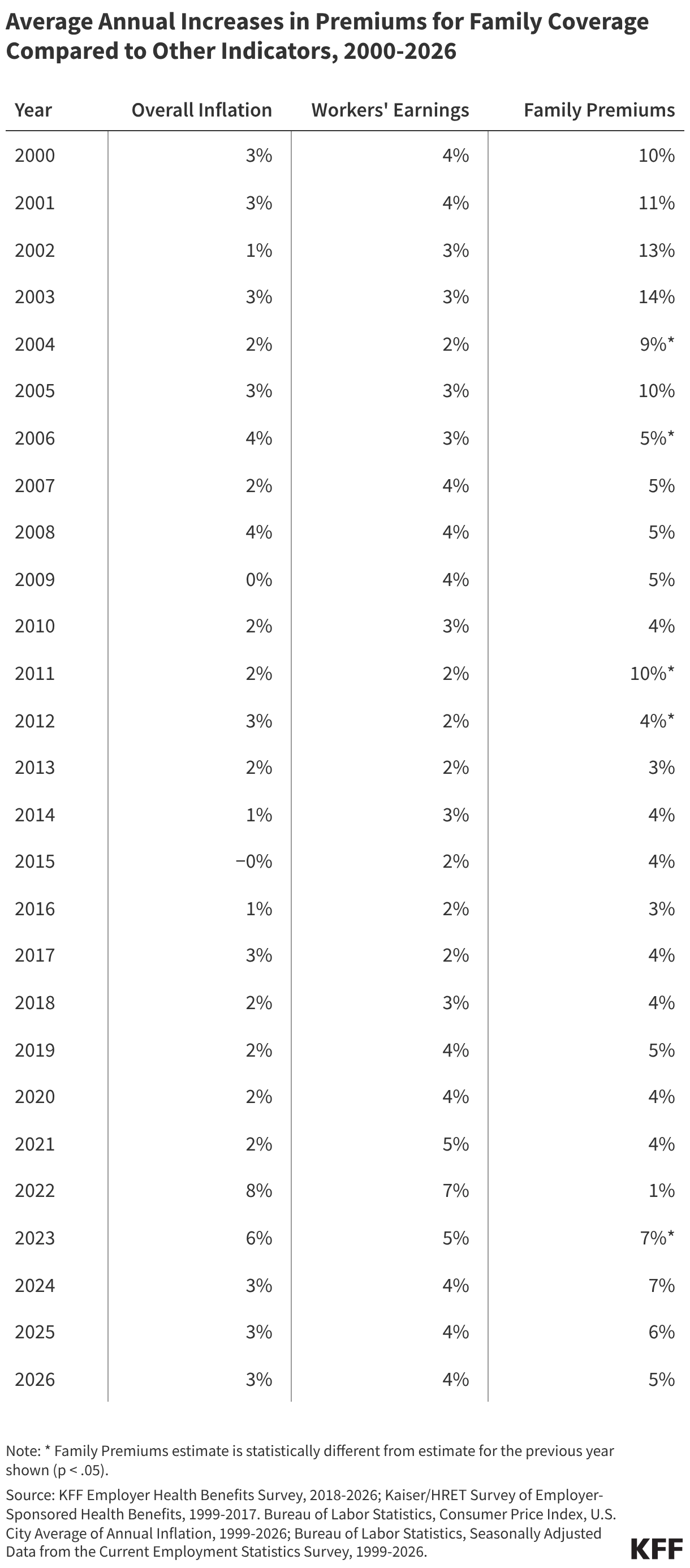
It’s possible that our reported 5% increase is low this year. It’s based on a survey, and sometimes surveys have statistical errors. Five percent “feels” low to me. However, it’s similar to recent increases, which also surprised me. That’s why we do the survey to get real numbers, but as rigorous and transparent as we can be in our methods, sometimes a survey is just off.
Still, modest increases add up, and with the cost of the average family policy passing $28,000 a year, providing coverage is a big lift for any employer.
With no silver bullet and limited market power, most employers typically do a little of everything to stem rising costs, stopping short of steps that would generate too much employee blowback. Smaller employers are basically helpless and take what they can get.
In a year with a moderate overall premium increase, it was surprising to see the worker share of premiums rise 9% this year, almost twice the rate of increase in employer premiums and three times the rate of inflation. (Employers still shoulder most of the overall bill, on average about 75% for family coverage and more for individual coverage.)
And, unlike increasing deductibles and other forms of cost sharing, which also adds to workers’ economic pain, increasing the share of premiums doesn’t impact underlying health costs by influencing health seeking behavior.
Time will tell, but this could signal that many employers feel the “fancier” cost strategies they have been using are played out. As a CEO, I know that nothing produces bottom-line savings faster for an employer than offloading premium costs, which we have resisted at KFF. Another step with immediate results looking forward: not covering expensive new drugs. Our survey shows that most employers are not covering GLP1s for weight loss.
One hundred and sixty million people are covered by employer-based insurance. Add the higher costs they are paying for premiums to the increased costs people are paying in the ACA Marketplace plus the new work requirements hitting in Medicaid and other Medicaid cuts and higher Medicare costs for many beneficiaries this year, and you begin to piece together why there is such a widespread sense of an affordability crisis in health care right now.
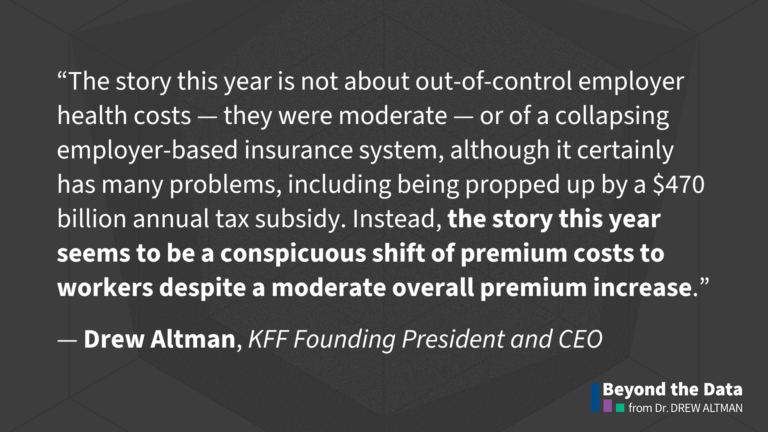
In any event, the story this year is not about out-of-control employer health costs—they were moderate—or of a collapsing employer-based insurance system, although it certainly has many problems, including being propped up by a $470 billion annual tax subsidy. Instead, the story this year seems to be a conspicuous shift of premium costs to workers despite a moderate overall premium increase.